Emergent Review: AI Platform for Building Full-Stack Web & Mobile Apps
Building a real product usually breaks at the same point: turning an idea into working software without burning months, money, or engineering goodwill. That gap is exactly where Emergent positions itself—by letting builders describe what they want and watching AI agents handle design, code, backend, and deployment in one flow.
Below is a deep, practical review of Emergent, written for founders, product teams, and operators deciding whether this tool deserves a spot in their stack.
Quick Summary
Emergent is an AI-powered app builder that turns natural language instructions into deployed, full-stack web and mobile applications.
Is it worth using? Yes, if speed matters more than manual control.
Who should use it? Non-technical founders, product managers, rapid prototypers, and small teams shipping MVPs.
Who should avoid it? Teams needing strict code governance, heavy customization, or low-cost long-running builds.
Verdict Summary
Best for
Shipping MVPs and internal tools fast
Builders without engineering teams
Product validation before investing in custom dev
Not for
Deeply regulated or security-sensitive systems
Teams that require full manual code ownership from day one
Long, compute-heavy builds on a tight budget
Rating
Public G2 / Capterra rating: Not yet widely listed
Editorial rating (based on features, pricing, user adoption): ⭐⭐⭐⭐☆ 4.6 / 5
What Is Emergent?
Emergent is an AI-driven development platform that builds production-ready software through conversation. Instead of assembling blocks or writing boilerplate, users describe the product they want. Emergent’s AI agents plan the architecture, generate frontend and backend code, connect databases, add authentication, integrate APIs, and deploy the app.
Unlike traditional no-code tools, Emergent does not stop at UI mockups. It produces working logic, real data models, and live URLs—making it closer to an autonomous dev team than a design tool.
How Emergent Works
Describe the product in plain language You explain what you want to build—features, user roles, workflows, and integrations—using a chat-style prompt.
AI agents plan the application Emergent’s agents break your request into architecture, frontend, backend, database, and deployment tasks.
Full-stack code is generated The platform creates UI components, backend logic, APIs, authentication, and data models in one flow.
Automatic testing and fixes If errors appear during the build, agents attempt fixes without manual intervention.
Instant deployment The app is deployed automatically with hosting, a live URL, and basic infrastructure handled for you.
Iterate through conversation You refine features, UI, or logic by chatting—no rebuilding from scratch.
Optional GitHub sync On paid plans, code can be pushed to GitHub for version control and external editing.
Key Features
Conversation-based app building
Full-stack web and mobile app generation
Built-in hosting and deployment
Database, auth, and API setup handled automatically
GitHub integration for version control
Credit-based usage across plans
Custom AI agents on higher tiers
Real-World Use Cases
Startup MVPs: Launch SaaS ideas without hiring engineers
Internal tools: Dashboards, CRMs, admin panels
Prototypes: Working demos for investors or clients
Automation tools: Data apps connected to third-party services
Solo projects: From landing pages to functional products
5. Can I use visual references like screenshots or Figma?
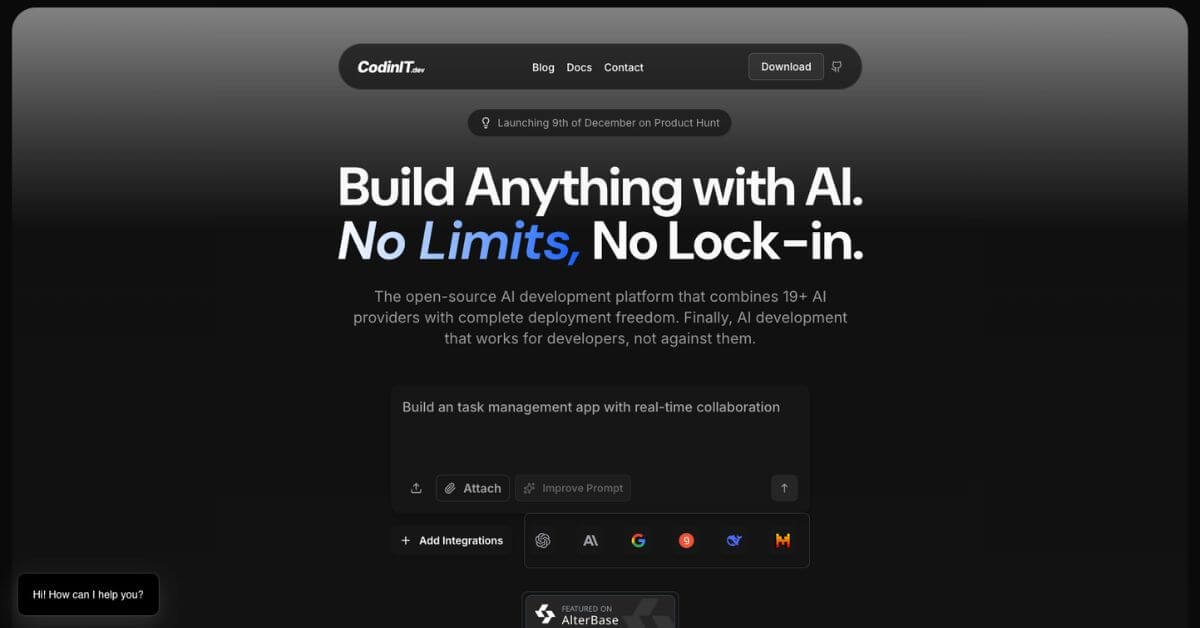
Yes. CodinIT.dev can interpret visual references to refine UI and layout.
6. Does it replace developers?
No. It speeds up repetitive and structural work. Developers still control logic and customization.
7. Can I integrate my own AI models or APIs?
Yes. Through the API Hub and model training.
8. How does it compare to Lovable.dev and Bolt.new?
CodinIT.dev focuses on open-source flexibility and multi-provider AI support—ideal for developers seeking control and deep customization.
Final Recommendation
Emergent is best viewed as a speed layer for product creation. If your goal is to validate, launch, or iterate fast—this tool delivers real leverage. For teams that value control over velocity, it works better as a starting point than a long-term replacement for custom engineering.