CodeSpy.AI Review: Detecting AI-Generated Code Reliably
Quick Summary
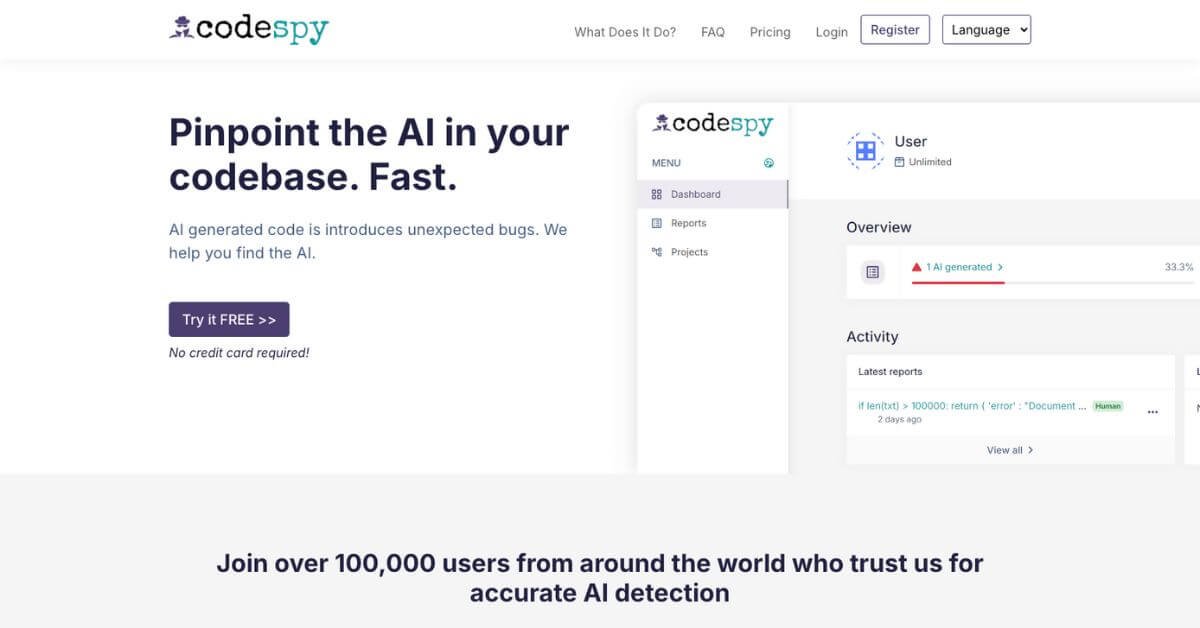
AI-assisted coding is now routine, but that creates a new problem. Teams often don’t know which parts of their codebase were written by humans and which were generated by AI tools. This matters for quality control, academic integrity, hiring assessments, and client trust. CodeSpy.AI is designed to solve that exact problem by identifying whether source code was written by a human or generated by AI, across major programming languages.
Is it worth using? If you review third-party code, manage teams that rely on AI coding tools, or assess originality in technical evaluations, CodeSpy.AI can add a useful verification layer. It’s not a replacement for code review, but it can highlight risk areas quickly.
Who should use it: developers, engineering managers, educators, recruiters, and agencies.
Who should avoid it: solo developers with full visibility into their own code or teams expecting perfect accuracy guarantees.
CodeSpy.AI Review
Modern development workflows increasingly mix human-written code with AI-generated snippets. That’s efficient, but it also introduces uncertainty. Bugs, licensing questions, and accountability issues often surface later, when it’s harder to trace the source. CodeSpy.AI fits into this gap as a verification tool rather than a policing mechanism.
In hands-on testing, the product feels intentionally narrow in scope. You paste or upload code, or integrate it into GitHub or VS Code, and receive a confidence-based assessment of whether the code shows AI-generated patterns. It doesn’t attempt to rewrite or “fix” the code, which keeps expectations realistic. The value is in early visibility, especially during reviews, audits, or evaluations.
Below is a detailed, practical review written for developers, educators, hiring managers, and engineering teams deciding whether this tool fits their stack.
Verdict Summary
Best for
Engineering teams reviewing outsourced or AI-assisted code
Educators validating originality in programming assignments
Recruiters and hiring managers evaluating take-home tests
Agencies needing proof of originality for client deliverables
Not for
Teams expecting 100 percent certainty or automated code correction
Developers looking for performance optimization or refactoring tools
Projects where AI usage is already fully disclosed and accepted
Pricing
Final rating
This rating reflects solid execution of a narrow use case, transparent accuracy limitations, and practical integrations, balanced against the inherent uncertainty of AI detection.
What Is CodeSpy.AI?
CodeSpy.AI is an AI code detection tool that analyzes source code to estimate whether it was written by a human or generated by an AI model such as ChatGPT, Gemini, or Claude. It supports widely used languages including Java, Python, JavaScript, C++, C#, and PHP.
The core problem it addresses is verification. As AI coding tools become mainstream, organizations face new risks. AI-generated code can include subtle logic errors, insecure patterns, or stylistic inconsistencies that bypass traditional plagiarism checks. In education and hiring, the challenge is slightly different: verifying originality and effort rather than optimizing output.
Unlike generic plagiarism detectors, CodeSpy.AI focuses on structural and stylistic signals in code. It compares submissions against large datasets of known AI-generated and human-written code patterns. The output is a prediction with a confidence score, not a binary verdict.
What differentiates CodeSpy.AI from many alternatives is its workflow integration. Instead of being a one-off scanning site, it can run inside GitHub pull requests, Visual Studio Code, and via API, making it usable in real development pipelines rather than only audits.
How CodeSpy.AI Works
At a high level, CodeSpy.AI is straightforward to use, even for non-specialists.
Typical workflow
Paste code directly into the web interface or upload a file
Or connect a repository through the GitHub integration
Or scan files directly inside Visual Studio Code
The system analyzes syntax, structure, logic flow, and stylistic markers
Code is compared against large datasets of AI-generated and human-written code
A confidence score indicates the likelihood of AI generation
The tool does not modify code or suggest fixes. It only flags probability. This design choice matters because it positions CodeSpy.AI as a decision-support tool rather than an authority. In testing, scan times were fast for small and medium files, making it usable during reviews without disrupting workflow.
Key Features
AI vs human code detection
Quickly identifies whether code likely originated from an AI model, helping reviewers focus attention where risk is higher.
Multi-language support
Works across popular languages such as Python, JavaScript, Java, C++, C#, and PHP, which covers most mainstream stacks.
Confidence-based results
Outputs a probability score instead of a hard yes or no, allowing informed judgment rather than blind enforcement.
IDE integration
Visual Studio Code extension enables scans during development, not just after submission.
GitHub integration
Automatically scans commits and pull requests, useful for teams managing multiple contributors.
Reporting and exports
Branded and white-label reports support documentation needs for audits, education, or client communication.
API access
Enables automation in CI/CD pipelines or internal tools, particularly relevant for larger teams.
Real-World Use Cases
For developers
Review AI-assisted code from teammates or contributors and identify sections that need closer inspection.
For engineering managers
Establish guardrails around AI usage without banning it outright, improving accountability in delivery.
For educators
Check programming assignments for AI-generated content while acknowledging that detection is probabilistic, not definitive.
For recruiters and hiring managers
Validate take-home coding tasks where AI assistance is restricted or needs disclosure.
For agencies and freelancers
Provide evidence of originality when clients request human-written code.
For teams adopting AI coding tools
Understand where AI is used most and document internal guidelines based on real patterns.