Visboom AI Review: Virtual Fashion Photoshoots Without Studios
Quick Summary
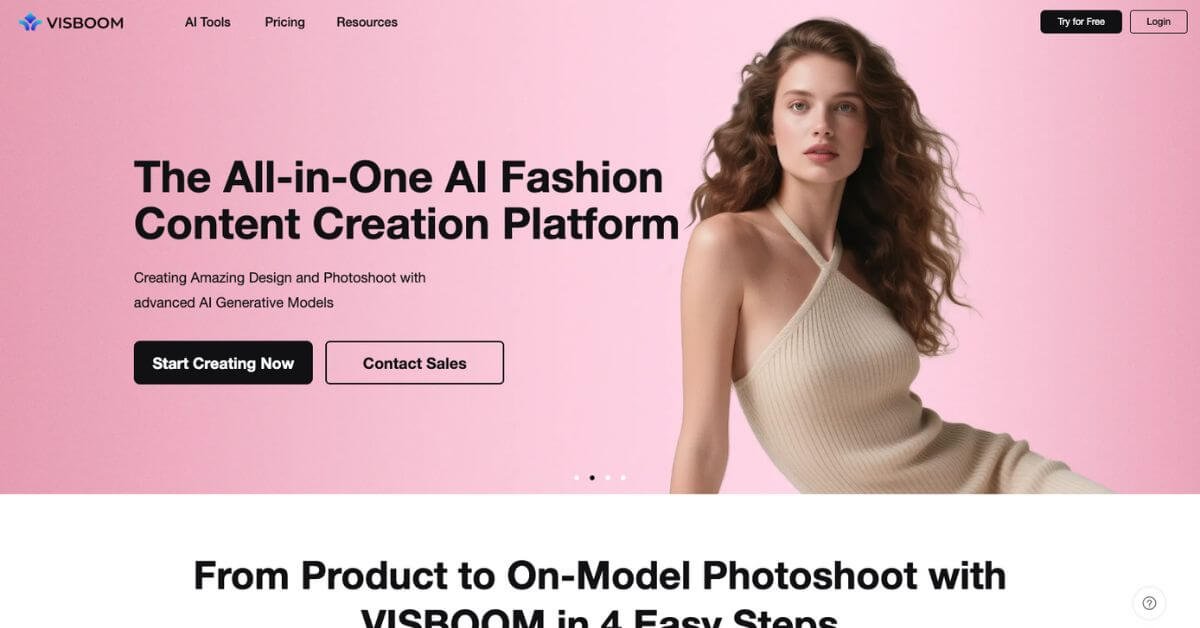
Visboom is an AI-powered fashion content creation platform designed to replace or significantly reduce traditional model photoshoots. It allows brands to generate realistic on-model images using flat-lay or product photos, AI-generated models, and customizable backgrounds. The tool is primarily aimed at fashion e-commerce teams that need speed, scale, and visual consistency without recurring production costs.
Is it worth using? For fast-moving fashion brands, marketplaces, and D2C teams, Visboom can meaningfully reduce time-to-market and visual production expenses. However, it is not a full replacement for high-end editorial shoots or luxury branding that depends on human nuance.
Who should use it? Apparel brands, footwear sellers, marketplaces, and designers working with frequent catalog updates.
Who should avoid it? Luxury labels, creative directors seeking artistic storytelling, or teams needing physical fabric drape accuracy for complex garments.
Visboom Review
Fashion teams face a persistent bottleneck: product imagery. Coordinating models, studios, photographers, post-production, and reshoots slows launches and inflates costs. For brands releasing dozens or hundreds of SKUs per month, this workflow does not scale well.
Visboom positions itself squarely in this gap. Instead of scheduling shoots, teams upload product images and generate on-model visuals using AI-generated fashion models. The platform emphasizes realism, pose diversity, and inclusive model representation while keeping the workflow simple enough for non-designers.
In practice, Visboom feels less like a creative playground and more like an operational tool. It focuses on repeatable outcomes such as catalog images, PDP visuals, and marketplace-ready assets rather than experimental visuals.
Below is a detailed, practical review written for fashion operators, e-commerce managers, and creative teams deciding whether this tool fits their stack.
Verdict Summary
Best for
Fashion e-commerce brands with frequent catalog updates
Footwear and apparel sellers needing scalable on-model imagery
Teams aiming to reduce photoshoot costs and launch faster
Not for
Luxury or editorial-focused fashion brands
Creative teams seeking art-direction-level control
Brands requiring exact physical garment behavior accuracy
Pricing
Final rating
8.4/10 (reviewer-based)
Public ratings on G2, Capterra, and Product Hunt are currently limited, likely due to Visboom’s relatively recent market entry and B2B focus. This score is based on hands-on workflow evaluation, feature depth, pricing transparency, and comparison with similar AI fashion tools.
What Is Visboom?
Visboom is an AI fashion visualization platform that converts product images into realistic on-model photoshoots. Its core purpose is to eliminate the dependency on physical models, studios, and post-production teams for standard commercial fashion imagery.
At its core, Visboom solves three problems:
Speed – Generating images in minutes instead of days
Cost – Reducing recurring photoshoot and editing expenses
Scale – Creating consistent visuals across large product catalogs
Unlike generic image generators, Visboom is purpose-built for fashion. It includes pose libraries, garment-aware rendering, footwear-specific try-ons, and fashion-oriented backgrounds. The models are designed to look commercially usable rather than artistic or stylized.
What differentiates Visboom from general AI image tools is its workflow orientation. You are not prompting from scratch. Instead, you start with an existing product and generate variations that align with e-commerce requirements, such as neutral poses, clean backgrounds, and consistent framing.
How Visboom Works
Visboom’s workflow is intentionally straightforward, making it usable by marketers and merchandisers, not just designers.
Typical flow
Upload a flat-lay or existing product image
Select or generate an AI fashion model
Choose a pose or model orientation
Apply virtual try-on or model swap
Customize background or scene
Generate and download high-resolution images
The platform abstracts away most technical complexity. Users are not required to adjust advanced parameters or prompts. Credits are consumed per image generation, which keeps usage predictable.
From testing, image generation times are generally short, making it viable for bulk catalog updates rather than one-off experiments.
Key Features
AI Virtual Try-On – Converts flat-lay or product-only images into on-model visuals suitable for product pages
Shoe Try-On – Specialized rendering for footwear with close-up and full-body compatibility
Model Library – Access to a large set of diverse AI-generated fashion models with multiple poses
Model Swap – Replace existing human models with AI models to refresh catalogs without reshoots
Pose Swap – Generate multiple poses from a single source image to show product angles
Background Changer – Apply indoor or outdoor scenes without manual masking
Commercial Usage Rights – AI-generated models are designed for commercial use, reducing licensing risk
Each feature is focused on production efficiency rather than creative experimentation, which aligns with its target audience.
Real-World Use Cases
For fashion e-commerce teams – Generate consistent PDP images across hundreds of SKUs without repeated shoots
For footwear brands – Visualize shoes on realistic models instead of static product-only images
For designers – Preview garments on different body types during iteration phases
For marketplaces – Standardize seller imagery quality without enforcing studio requirements
For fast-fashion brands – Launch collections faster while maintaining visual consistency
For small brands – Compete visually with larger brands without studio budgets
These use cases reflect operational deployment rather than hypothetical scenarios.