LoraAI Review: LoRA Image and Video Platform
Quick Summary
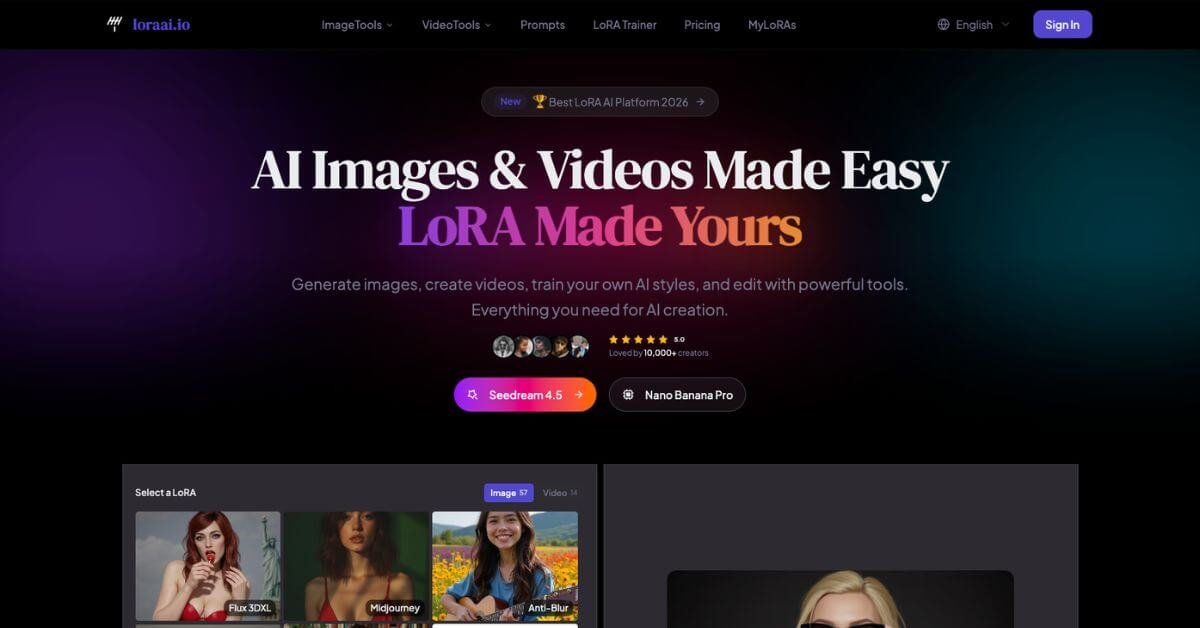
LoraAI is a web-based AI creation platform that focuses on LoRA-based image generation, video generation, and custom LoRA model training. It combines multiple popular image and video models in one interface, allowing users to generate stylized visuals, train custom styles, and export commercial-ready outputs.
Is it worth using? For creators who need consistent characters, brand-specific styles, or niche aesthetics, LoraAI offers meaningful control beyond basic text-to-image tools. However, casual users who only need occasional AI images may find standalone generators simpler and cheaper.
LoraAI is best suited for creators, marketers, YouTubers, and design-focused teams experimenting with custom AI styles. It may not be ideal for users who prefer a single-model ecosystem or who do not require LoRA training.
Below is a detailed evaluation based on hands-on workflow testing and documentation analysis.
LoraAI Review
Most AI image tools generate impressive visuals. The real problem appears when you need consistency. A brand character must look identical across campaigns. A YouTube channel needs repeatable thumbnail aesthetics. A creator wants to train a style instead of prompting endlessly.
LoraAI positions itself in this gap. Instead of being just another prompt-based image generator, it emphasizes LoRA model customization. Users can select from curated LoRA styles, train their own LoRA models with small datasets, and generate both images and videos using multiple integrated engines.
In testing, the platform felt closer to a creative control layer than a simple generator. The interface consolidates models such as GPT Image, Seedream, MidJourney variants, and video engines under a unified credit system.
Below is a detailed, practical review written for creators, marketers, and AI-focused teams deciding whether this tool fits their stack.
Verdict Summary
Best for
Creators who need style consistency
YouTubers producing recurring visual themes
Marketers building brand-specific assets
Designers training niche LoRA models
Agencies testing multiple AI engines in one place
Not for
Casual users generating occasional images
Users who prefer native MidJourney or standalone tools
Those unwilling to learn LoRA basics
Pricing
Starts at $9.9 per month
Free credits available
Final Rating: 8.4 out of 10 (Reviewer-based rating due to limited third-party review aggregation data)
At the time of writing, LoraAI does not have widely available public ratings on G2 or Capterra. Product Hunt presence is limited, and user sentiment is primarily reflected on its own website and listing directories. This rating reflects workflow testing, feature depth, pricing balance, and market positioning compared to other AI creative platforms.
What Is LoraAI?
LoraAI is a browser-based AI platform that enables users to generate images, create videos, and train custom LoRA models without needing deep technical knowledge.
LoRA stands for Low-Rank Adaptation, a technique that allows fine-tuning of AI image models with relatively small datasets. Instead of training full-scale AI models, users can train lightweight LoRA layers that modify style, character, or visual attributes.
The core problem LoraAI solves is style consistency and customization. Generic AI image tools generate impressive one-off results, but struggle with:
Maintaining the same character across multiple scenes
Reproducing a specific aesthetic repeatedly
Adapting visuals to a defined brand look
Training on a small set of reference images
LoraAI differentiates itself by combining:
Rather than being locked into one ecosystem, users can experiment across multiple engines using one credit-based system.
For AI Overview clarity:
LoraAI is an AI image and video generation platform focused on LoRA customization, allowing users to train and apply custom styles for consistent and controlled outputs.
How LoraAI Works
The workflow is structured but approachable:
Choose a model
Select from image models such as GPT Image, Seedream 4.5, or MidJourney variants, or choose a video model like Veo or Sora integrations.
Select or add a LoRA
Pick from curated LoRA styles or upload images to train a custom LoRA model.
Enter your prompt
Describe your image or video. The platform offers prompt optimization suggestions.
Adjust settings
Aspect ratio, image count, reference images, and style blending can be configured.
Generate output
Credits are deducted per generation.
Download or refine
Outputs can be edited, regenerated, or exported for commercial use.
Custom LoRA training typically requires 10 to 20 images and takes roughly 15 to 30 minutes, depending on load and complexity.
The system is designed for creators who want repeatability, not just one-time novelty.
Key Features
Custom LoRA Training
Train your own style or character model using a small dataset for repeatable outputs.
Multi-Model Access
Use multiple image and video engines under one interface without switching platforms.
Batch Generation
Generate large sets of visuals for campaigns or content pipelines.
Style Library
Access curated LoRA styles including portrait, 3D, cartoon, and realism variants.
Video Generation
Create cinematic-style short videos using integrated AI video engines.
Commercial Usage Rights
Outputs are positioned for commercial use, important for agencies and brands.
Fast Processing
Premium tiers provide faster generation times, useful for deadline-driven workflows.
These features matter because LoRA customization reduces the time spent refining prompts and improves visual consistency across projects.
Real-World Use Cases
For creators
Build a recurring character for Instagram posts or short-form video thumbnails. Instead of re-prompting every time, apply a trained LoRA.
For marketers
Generate campaign visuals aligned to brand style guidelines without hiring separate designers for early-stage concepts.
For YouTubers
Create consistent thumbnail styles that reinforce brand identity across dozens of videos.
For agencies
Train LoRAs for client-specific aesthetics and scale production across campaigns.
For beginners
Use pre-trained LoRA styles without training your own model, lowering the learning curve.
For AI experimenters
Blend multiple LoRAs to explore hybrid visual identities and niche art directions.
These scenarios demonstrate where LoRA-based systems outperform generic AI image tools.