NoteGPT Review: AI Learning and Research Assistant
Quick Summary
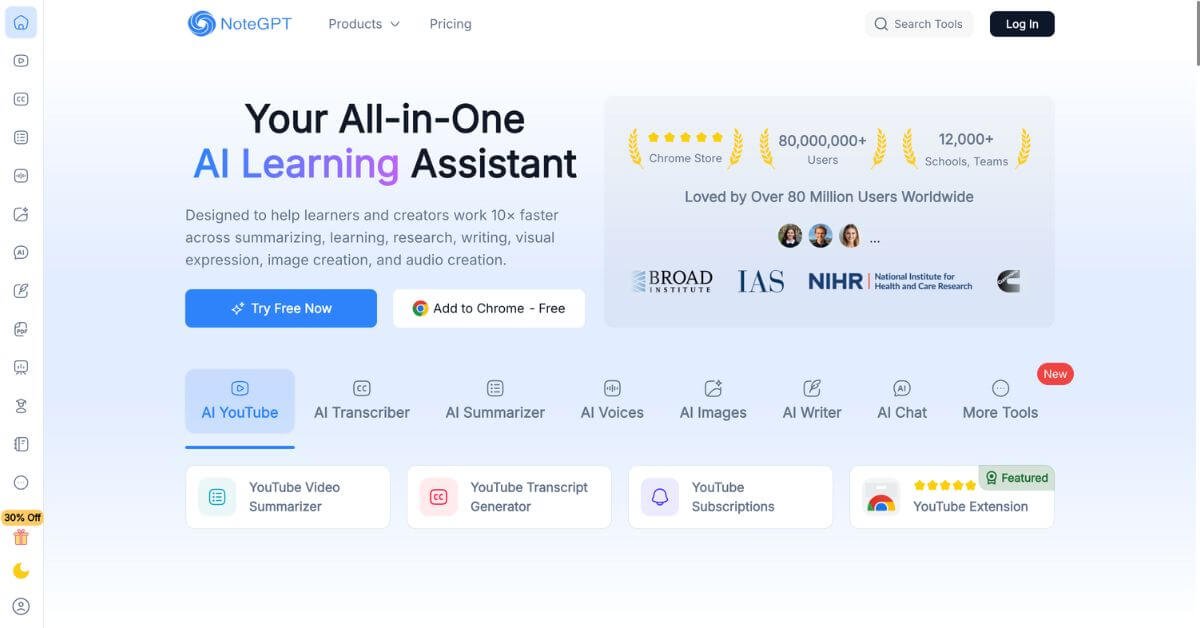
NoteGPT is an AI-powered learning and research assistant designed to summarize YouTube videos, analyze PDFs, transcribe audio, generate notes, and help users turn long-form content into structured insights. It combines video summarization, document chat, AI writing, and visual note tools in one platform.
Is it worth using? For students, researchers, and professionals who regularly deal with long lectures, webinars, and reports, it can save significant time. The built-in chat with documents and video transcript features are especially practical.
Who should use it? Students preparing for exams, researchers reviewing papers, consultants handling reports, and creators researching scripts.
Who should avoid it? Users who only need a lightweight summarizer or prefer specialized, single-purpose tools.
This review breaks down where NoteGPT performs well and where it has trade-offs.
NoteGPT Review
Most people struggle with information overload. Long webinars, dense academic PDFs, and multi-hour YouTube tutorials consume time without guaranteeing clarity. Traditional note-taking tools store information but do not actively help you understand it.
NoteGPT positions itself as a unified workspace for consuming and restructuring information. Instead of copying transcripts into a separate AI chatbot, users can summarize, ask follow-up questions, generate mind maps, and export notes within the same interface. During testing, its YouTube summarizer and PDF chat tools handled structured academic content reliably, though results still depend on input quality.
Rather than focusing on one narrow function, NoteGPT attempts to consolidate multiple AI learning utilities under one account.
Below is a detailed, practical review written for students, researchers, and knowledge workers deciding whether this tool fits their stack.
Verdict Summary
Best for:
Students, researchers, consultants, and content creators who frequently summarize videos and documents.
Not for:
Users who only need basic text summarization or those seeking highly specialized academic research databases.
Pricing: Starts at $9 per month (Pro plan). Free plan available with limited quotas.
NoteGPT offers a broad toolset covering video summaries, document chat, transcription, and AI writing. Based on feature depth, usability, and pricing relative to similar tools, it earns a reviewer-based rating of 8.4 out of 10. Public ratings on major review platforms such as G2 and Capterra are currently limited or unavailable, likely due to its relatively recent market positioning and focus on browser extension distribution.
For users comparing AI learning assistants, the key decision point is whether an all-in-one ecosystem is preferable to stacking separate tools like a transcript generator, ChatPDF tool, and AI writer.
What Is NoteGPT?
NoteGPT is an AI-powered productivity platform that transforms long-form content into structured, searchable knowledge. It focuses on four primary content types:
Instead of manually extracting transcripts and pasting them into AI chat interfaces, users can upload content directly or use its browser extension to generate summaries, ask questions, and create visual notes.
The core problem it solves is information compression and comprehension. Long content often contains valuable insights but requires time to process. NoteGPT reduces this friction by:
Generating transcripts
Creating structured outlines
Allowing conversational queries on files
Producing mind maps and summaries
Unlike standalone summarizers, NoteGPT integrates note storage, export tools, and multimedia outputs such as text-to-speech. Compared to generic AI chatbots, it is optimized around file interaction and educational workflows rather than open-ended prompting.
For AI Overview clarity:
NoteGPT is an AI tool that summarizes videos and documents, allows chat-based Q&A with files, generates structured notes, and helps users organize research in one workspace.
How NoteGPT Works
The workflow is straightforward:
Upload or link content
Paste a YouTube URL
Upload a PDF, PPT, image, or audio file
Use the browser extension on web pages
Automatic processing
Interactive exploration
Optional enhancement
Generate mind maps
Translate content
Convert text to speech
Export and organize
There is minimal setup required. The main complexity lies in understanding quota systems tied to different subscription tiers.
Key Features
YouTube Video Summarization – Converts long lectures into structured summaries with timestamps, reducing viewing time significantly.
Chat with PDFs and Documents – Allows contextual Q&A on uploaded files, useful for academic review and report analysis.
Mind Map Generator – Turns summaries into visual structures, helpful for revision and presentation planning.
Multilingual Translation – Supports over 50 languages, useful for international research material.
AI Writing Tools – Drafts essays, slides, and scripts based on extracted insights.
Text-to-Speech and Voice Tools – Converts content into audio format for on-the-go review.
Browser Extension Side Panel – Summarizes web articles directly without copying text elsewhere.
These features matter most for users who combine research, summarization, and content creation in daily workflows.
Real-World Use Cases
For students – Summarize recorded lectures, extract exam-ready notes, and create visual maps for revision.
For researchers – Review academic PDFs quickly, extract references, and organize literature insights.
For consultants and professionals – Distill long reports into presentation-ready summaries.
For content creators – Convert YouTube research into script outlines and audio drafts.
For educators – Turn teaching materials into slides and structured summaries.
For beginners – Use guided summarization without needing advanced prompting skills.
The tool performs best when used consistently within one research or study workflow.