Together AI Review: Open Source AI Inference Platform for Developers and Enterprises
The open-source AI model ecosystem has exploded. Llama, Mistral, Falcon, Qwen, and dozens of other models are available to anyone, but running them at production scale requires infrastructure that most teams cannot build themselves. Together AI provides that infrastructure: a cloud platform where developers and enterprises access, fine-tune, and deploy open-source models through a simple API without managing any underlying hardware or configuration.
Quick Summary
Together AI is a cloud inference platform for open-source AI models, providing API access to over 100 models including the Llama family, Mixtral, and Stable Diffusion variants, with fine-tuning and dedicated deployment options.
Is it worth using? Yes for development teams needing affordable access to a broad range of open-source models with fine-tuning capability. Who should use it? Developers, AI researchers, and enterprise teams building applications on open-source foundation models who need reliable cloud inference without self-managing infrastructure. Who should avoid it? Teams whose requirements are met by a single proprietary model like GPT-4o with no need for open-source flexibility.
Verdict Summary
Best for
Development teams needing API access to a broad catalogue of open-source models
Teams requiring fine-tuning capability on base open-source models for domain adaptation
Enterprises needing dedicated model deployment with predictable performance
Not for
Users who need proprietary models from OpenAI or Anthropic
Individuals without development skills looking for a consumer AI product
Teams whose use case is served by a single model without needing variety
Rating ⭐⭐⭐⭐ 4.4 / 5
What Is Together AI?
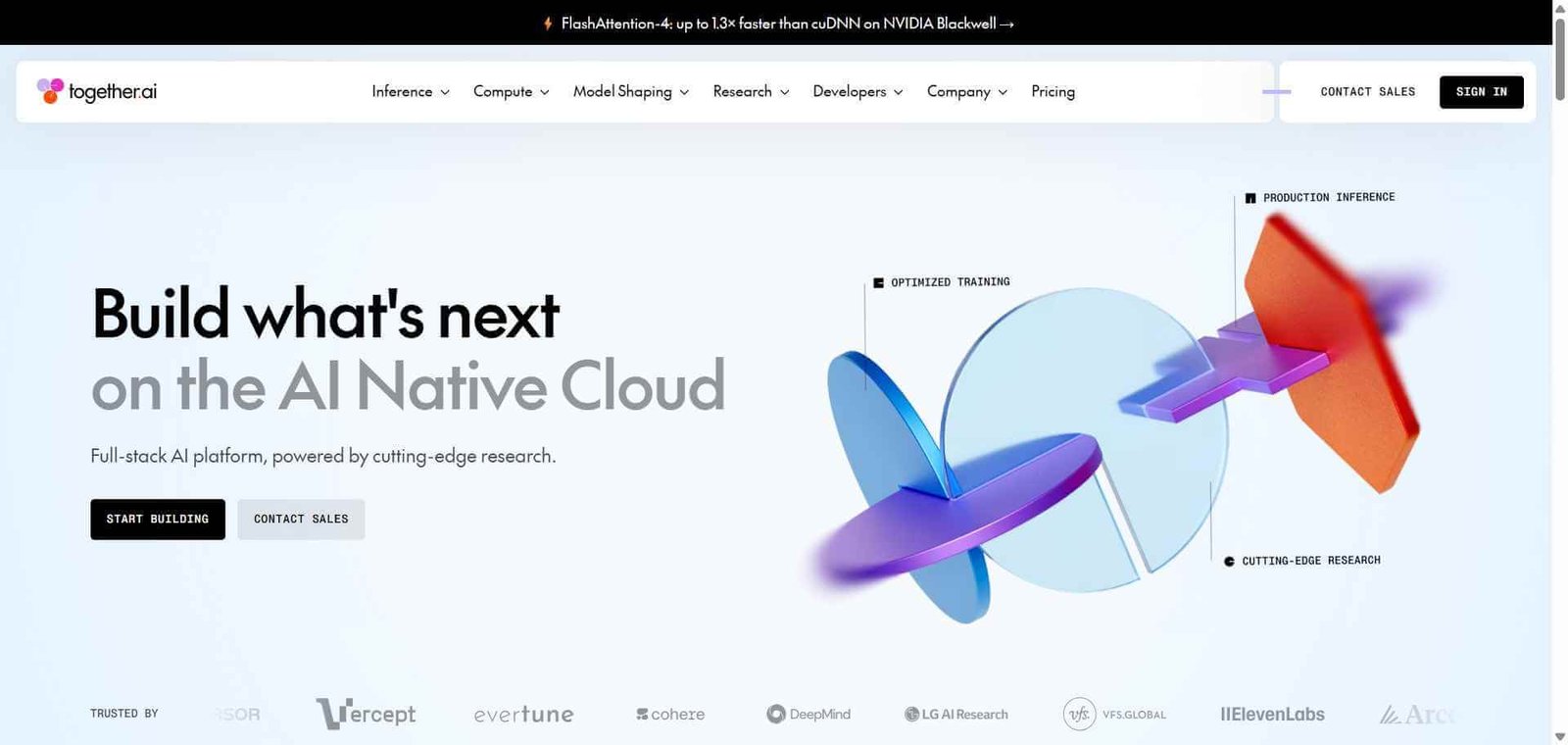
Together AI is an AI infrastructure company founded in 2022 and backed by prominent investors including Andreessen Horowitz and Nvidia. It was built to solve the infrastructure problem for open-source AI adoption: great models exist but running them at production scale requires significant engineering investment that most teams cannot justify. Together AI provides a managed cloud platform where this infrastructure is handled, allowing teams to focus on building products rather than managing clusters.
The platform hosts over 100 open-source language, code, image, and embedding models and provides a unified API that is compatible with the OpenAI SDK format. This compatibility dramatically reduces the engineering effort required to switch between models or migrate from OpenAI to open-source alternatives.
How Together AI Works
Create a free account at together.ai and generate an API key from the dashboard.
Browse the model catalogue. Explore over 100 available models organised by category including chat, code, image, and embedding.
Make API calls. Use the REST API or OpenAI-compatible SDK to send inference requests. Existing OpenAI integrations can often be redirected to Together AI with minimal code changes.
Fine-tune a model. Upload training data in the supported format and launch a fine-tuning job on any compatible base model to create a domain-adapted version.
Deploy a dedicated endpoint. For production applications requiring consistent low latency, deploy a dedicated instance of your chosen model on reserved hardware.
Monitor and manage. Track usage, costs, and model performance from the Together AI dashboard.
Key Features
Over 100 open-source models including Llama 3.1, Mixtral, Qwen, and Stable Diffusion variants
OpenAI-compatible API for easy migration and integration
Fine-tuning on base models with custom training data
Dedicated endpoint deployment for production applications
Serverless inference for cost-efficient development and testing
Image generation models alongside language models on the same platform
Embedding models for RAG and semantic search applications
Enterprise security and compliance features
Real-World Use Cases
Multi-model evaluation: Test the same prompt across 10 different open-source models simultaneously to identify the best fit for a specific task before committing to a deployment choice.
Domain fine-tuning: Fine-tune Llama 3.1 on your proprietary dataset to create a specialised model that outperforms general models on your specific use case.
Cost optimisation: Replace expensive proprietary model API calls with open-source alternatives on Together AI at a fraction of the cost for tasks where the quality difference is negligible.
Image generation pipeline: Access Stable Diffusion and Flux models through the same API as language models, simplifying infrastructure for multi-modal applications.
Fine-tuning requires ML knowledge and clean training data
Fine-tuning capability for domain adaptation
Dedicated endpoints add cost versus serverless
Covers language, code, image, and embedding models
Customer support less mature than established cloud providers
Competitive pricing versus self-managed infrastructure
Fewer enterprise features than AWS or Azure AI
Pricing & Plans
Free — $0 credit on signup
Shared inference access
Access to the full model catalogue
Standard rate limits
Pay as you go — Production pricing
Llama 3.1 8B from $0.10 per million tokens
Llama 3.1 70B from $0.54 per million tokens
Mixtral 8x7B from $0.54 per million tokens
Fine-tuning from $0.30 per million tokens
Enterprise — Custom pricing
Dedicated endpoints with reserved capacity
SLA guarantees
Priority support
Custom security and compliance
Best Alternatives & Comparisons
Groq — Faster inference on a smaller model selection using custom LPU hardware
Cohere — Enterprise focus with private deployment, specialised in retrieval and embedding tasks
Hugging Face — Broader open-source ecosystem with more community tooling, less managed infrastructure
OpenAI — More capable proprietary models, no open-source flexibility or fine-tuning on base models
Frequently Asked Questions (FAQ)
What is Together AI?
Together AI is a cloud platform for running, fine-tuning, and deploying open-source AI models through a unified API, covering language, code, image, and embedding model categories.
Is Together AI free?
Together AI provides a free credit on signup for exploration. Production usage is pay-per-token with no monthly minimum required.
How many models does Together AI support?
Together AI hosts over 100 open-source models across language, code, image, and embedding categories, including the full Llama 3.1 family, Mixtral, Qwen, and various Stable Diffusion variants.
Can Together AI fine-tune models?
Yes, Together AI supports fine-tuning on compatible base models using custom training data, allowing teams to create domain-adapted model versions without managing training infrastructure themselves.
Is Together AI compatible with the OpenAI API?
Yes, Together AI uses an OpenAI-compatible API format, meaning existing applications built on the OpenAI SDK can often switch to Together AI by changing the base URL and API key.
How does Together AI compare to Groq?
Together AI prioritises model variety and fine-tuning capability across over 100 models. Groq prioritises raw inference speed on a smaller selection of models using custom hardware. Both are strong infrastructure choices for different priorities.
Final Recommendation
Together AI is the most practical solution for development teams that need flexibility across the open-source model ecosystem without the overhead of building and managing their own inference infrastructure. The combination of broad model access, fine-tuning capability, and OpenAI-compatible API makes it an effective foundation for AI applications where cost, flexibility, and model choice matter as much as raw capability.