
Peec AI
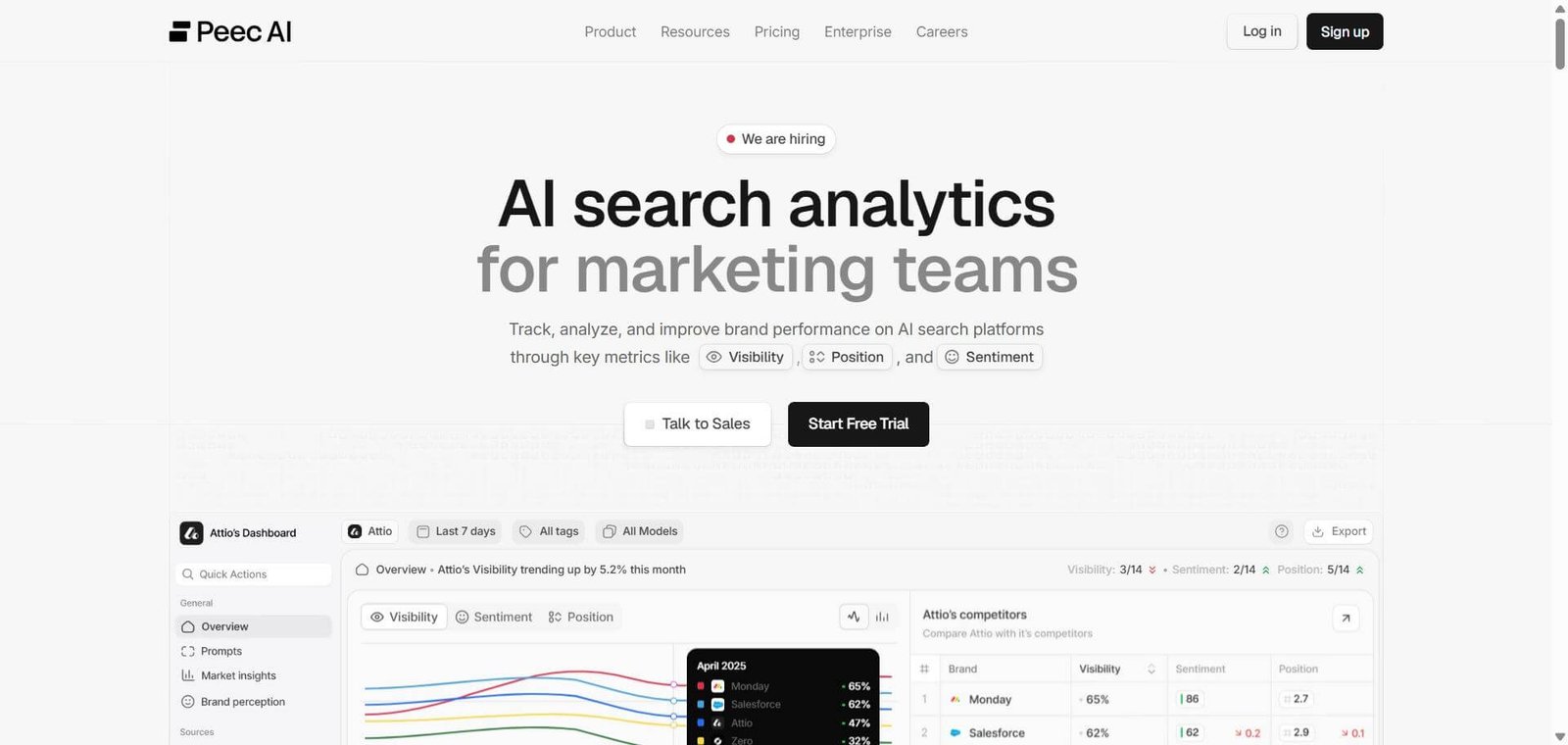
Peec AI monitors brand visibility, competitor mentions, citations and product recommendations across AI search platforms.
Peec AI Review: AI Search Visibility, GEO Analytics and Brand Tracking
Businesses can rank well on Google and still struggle to appear when potential customers ask ChatGPT, Gemini or Perplexity for product recommendations. Traditional SEO tools do not always explain why certain brands appear in AI-generated answers while others remain absent.
Peec AI helps marketing teams measure this gap. It is an AI search analytics platform that tracks brand visibility, mentions, position, sentiment, competitors and cited sources across supported AI platforms.
It is particularly useful for SEO agencies, content strategists, SaaS companies and e-commerce brands developing a Generative Engine Optimization (GEO) strategy. Its source analytics and competitor tracking help teams investigate where AI-generated recommendations come from and identify opportunities to improve their brand presence.
However, Peec AI is not an automatic optimization solution. Its Starter plan costs $95 per month, and businesses must still turn its findings into content, SEO and digital PR activities. It is worth considering if AI search monitoring is an ongoing marketing requirement, but smaller websites may find the subscription difficult to justify.
Quick Verdict
| Attribute | Details |
|---|---|
| Product | Peec AI |
| Category | AI search analytics and GEO |
| Primary purpose | AI brand visibility tracking |
| Target users | SEO agencies, marketing teams and businesses |
| Starting price | $95/month |
| Tracking frequency | Daily |
| Starter prompt limit | 50 |
| Main capabilities | Visibility, prompts, sources, competitors and shopping analytics |
Best for: SEO agencies, SaaS businesses, e-commerce brands and marketing teams that regularly monitor how their brands appear in AI-generated answers.
Not for: Individual bloggers, hobby websites and businesses that only need occasional AI visibility checks.
Pricing: Starts at $95/month. No permanent free plan is listed in the supplied pricing structure, although a free trial is advertised.
User rating: 4.7/5 on G2 from 21 reviews.
Peec AI stands out because it combines prompt-based monitoring with competitor benchmarking, source analytics and product visibility tracking. These capabilities help marketers investigate not just whether their brand appears in AI answers, but also which competitors and external sources influence those answers.
The main limitation is that data collection and analysis do not automatically improve brand visibility. Teams still need to investigate the findings and implement changes themselves.
What Is Peec AI?
Peec AI is a GEO analytics platform that helps businesses understand how their brands appear in AI-powered search experiences.
Traditional SEO platforms measure keyword rankings, backlinks, organic traffic and search visibility. AI search introduces another measurement challenge. When someone asks ChatGPT for the best project management software or Perplexity for recommendations on marketing platforms, the resulting answer may mention several brands without requiring the user to visit a conventional search results page.
A business might rank well on Google but rarely appear in these recommendations. Another competitor might receive frequent mentions because AI platforms retrieve information from comparison articles, industry publications, product documentation and other sources.
Peec AI helps investigate these differences through several connected capabilities:
AI visibility tracking: Measures how frequently a brand appears in responses to selected prompts.
Brand position: Shows where a brand appears within tracked AI answers.
Share of Voice: Measures the brand’s share of total tracked brand mentions relative to competitors.
Sentiment analysis: Examines how AI platforms describe a brand.
Source analytics: Identifies domains and URLs cited in AI-generated answers.
Competitor benchmarking: Compares brand performance across selected prompts and AI models.
AI Shopping Analytics: Tracks product-level visibility and recommendations.
Agent Analytics: Provides information about AI crawler activity and website access.
One distinction worth understanding is the difference between Visibility and Share of Voice.
Visibility measures the proportion of tracked AI answers that mention your brand. Share of Voice measures your proportion of brand mentions among all tracked brand mentions, including competitors.
For example, suppose a company tracks 100 AI answers and its brand appears in 30 of them. Its visibility is 30%. If the tracked answers contain 100 total brand mentions and the company accounts for 40, its Share of Voice is 40%.
These metrics answer different questions. Visibility tells marketers how frequently they appear, while Share of Voice shows how their brand presence compares with competing businesses.
Peec AI is therefore a measurement and research platform rather than a traditional SEO tool or an automated content optimization system.
How Does Peec AI Work?
Peec AI uses selected prompts to monitor how brands appear across supported AI platforms. The process starts with identifying relevant customer questions and ends with analysing brand mentions, competitor presence and cited sources.
Consider a company selling project management software. Instead of tracking only generic keywords, its marketing team could monitor questions such as:
Best project management software for remote teams.
Asana alternatives for small businesses.
Project management tools for marketing agencies.
Affordable project management platforms for startups.
The platform runs the selected prompts against supported AI models and collects the resulting answers for analysis.
A typical workflow looks like this:
Create a project: Add your brand information and website to establish the business context.
Select prompts: Add customer questions relevant to your products, services and industry. Use suggested prompts to identify additional topics.
Choose AI models: Select the supported platforms you want to monitor. Standard brand subscriptions allow three selected models.
Add competitors: Include competing brands to understand how they appear in the same conversations.
Monitor responses: Review brand mentions, position, visibility, sentiment and source information.
Investigate gaps: Find prompts where competitors appear but your brand does not.
Plan improvements: Use the findings to identify content gaps, product information issues and potential digital PR opportunities.
Measure changes: Monitor subsequent tracking periods to understand whether brand visibility changes.
Peec AI documents daily prompt tracking, with initial insights generally becoming available within 24 hours of adding prompts.
The quality of the analysis depends heavily on prompt selection. A business tracking relevant customer questions is more likely to obtain useful insights than one monitoring hundreds of unrelated prompts.
Its prompt-volume indicator also deserves clarification. The platform provides a relative demand score from 1 to 5. This helps prioritise topics, but it should not be interpreted as verified monthly Google search volume.
Key Features
Peec AI offers several capabilities, but some are more valuable to marketing teams than others. The following features deserve particular attention.
1. AI Search Visibility and Share of Voice
The visibility dashboard helps marketers understand how frequently their brands appear in tracked AI-generated answers.
Rather than manually asking the same questions across multiple AI platforms, teams can monitor a defined set of prompts and compare changes over time.
Share of Voice adds a competitive perspective by showing how much of the total tracked brand-mention share belongs to each competitor.
Why it matters: A company may discover that competitors consistently appear in product comparisons while its own brand receives fewer mentions. This provides a starting point for investigating content coverage, brand information and external references.
Limitation: These measurements apply to the prompts and platforms being tracked. They should not be interpreted as a complete representation of every AI search interaction.
2. Prompt Discovery and Management
Prompt discovery helps businesses identify questions worth monitoring based on their brand context, topics and potential demand.
Teams can organise prompts by categories, personas, regions, languages and search intent. Bulk imports and keyword-based prompt suggestions also help manage larger tracking projects.
Why it matters: Marketing teams can move beyond generic questions and focus on the queries that reflect actual customer research and purchasing decisions.
Limitation: Suggested prompts still require human review. A high relative prompt-volume score does not guarantee commercial value or actual customer demand.
3. Source and Citation Analytics
One of the more useful capabilities is the ability to investigate the domains and URLs cited in AI-generated answers.
This gives content strategists and digital PR teams a clearer picture of which publications, review websites, comparison pages and other sources influence AI recommendations.
For example, a SaaS company might discover that several AI platforms frequently cite independent software comparison websites when answering questions about its product category.
The marketing team can investigate those pages, understand why competitors are included and identify relevant opportunities for product information, editorial coverage or comparison content.
Why it matters: It connects AI visibility research with practical content and digital PR decisions.
Limitation: Identifying a frequently cited website does not guarantee that securing a mention or backlink will result in better AI visibility.
4. Competitor Benchmarking
Peec AI allows businesses to track competing brands across selected prompts, topics and AI models.
This can reveal where competitors receive more mentions, which products are recommended and which topics generate stronger visibility.
For example, a marketing automation company could compare its brand against HubSpot, Brevo and ActiveCampaign across prompts related to email marketing, automation and CRM software.
Why it matters: Competitor analysis helps teams identify missed opportunities and understand how AI platforms position different products.
Limitation: Competitor visibility should be evaluated alongside product relevance and customer intent. Being mentioned more frequently does not automatically mean a competitor is winning more customers.
5. AI Shopping and Product Visibility
AI Shopping Analytics extends Peec AI beyond brand-level monitoring.
Businesses can upload product catalogues through CSV files or connect supported Shopify data sources. The platform provides product-level insights, including visibility, recommendation position, win rate, merchant appearances and shopping-related source information.
Teams can also investigate product attributes used in AI comparisons, competing products and prices displayed in recommendations.
Why it matters: E-commerce businesses can investigate whether their individual products appear when customers ask AI platforms for recommendations.
For example, an electronics retailer could monitor questions about wireless headphones, compare which brands and models appear in recommendations and investigate the product information influencing those answers.
Limitation: Product visibility depends on the supported shopping experiences and tracked queries. It should not be treated as a substitute for sales analytics, inventory management or conversion tracking.
6. Brand Perception and Sentiment
Peec AI analyses how AI platforms describe a business and the attributes associated with its brand.
Its brand perception capabilities help identify recurring positive descriptions, negative associations and objections appearing in AI-generated answers.
Higher-tier plans also include custom brand attributes and more extensive objection monitoring.
Why it matters: This can help businesses discover whether AI systems repeatedly associate their products with outdated information, missing features or negative comparisons.
Limitation: Sentiment analysis is an interpretation of generated responses, not a direct measurement of customer satisfaction or actual brand reputation.
7. AI Agent and Crawler Analytics
Agent Analytics provides insight into how AI crawlers access a website.
Peec AI uses server-log data to examine crawler visits, pages accessed and HTTP response codes. Its crawlability audit also checks robots.txt permissions across supported AI bots.
Why it matters: Technical SEO teams can investigate whether AI crawlers are accessing important pages, encountering errors or being restricted by website crawling rules.
For websites with large product catalogues or documentation libraries, this information can help identify accessibility problems that deserve further investigation.
Limitation: Allowing an AI crawler to access a website does not guarantee that its content will appear in AI-generated answers.
8. Reporting, API and MCP Integrations
Peec AI supports CSV exports, shareable dashboards and integrations designed for marketing reporting.
It also offers an MCP connection that allows compatible AI assistants and tools to access Peec AI data. API access is available through Enterprise in the supplied pricing structure.
Looker Studio integration is included in the Advanced plan.
Why it matters: Agencies and in-house marketing teams can connect AI visibility information with their reporting workflows rather than manually collecting data for every client update.
Limitation: Integration availability depends on the subscription. Businesses should check the relevant plan before building reporting or automation processes around a particular connection.
Who Should Use Peec AI?
Peec AI is most useful when a business has a defined GEO strategy and needs regular insight into its AI search performance.
SEO agencies: Monitor client visibility, compare competitors and investigate frequently cited sources when preparing GEO reports.
SaaS companies: Understand whether AI assistants recommend their products for software comparisons, alternatives and industry-specific questions.
E-commerce businesses: Examine product-level visibility and competing recommendations across supported AI shopping experiences.
Content strategists: Identify publications, comparison articles and other sources influencing AI answers, then use the findings to plan content and digital PR.
Marketing managers: Monitor brand mentions, sentiment and changes in how AI platforms describe their products.
International businesses: Compare brand visibility across markets, languages and competitors.
Technical SEO teams: Investigate AI crawler visits, website response codes and robots.txt permissions.
Peec AI is less suitable for individual bloggers and small website owners who only want to check whether ChatGPT mentions their website occasionally. In those situations, a dedicated subscription may not provide enough additional value to justify its cost.
Pros and Cons
Peec AI combines AI search visibility tracking, competitor analysis and citation insights in one platform. However, its prompt limits, subscription cost and reliance on manual optimization may not suit every business.
| Pros | Cons |
|---|---|
| Tracks brand visibility, position, sentiment and Share of Voice across supported AI platforms. | Starter plan is limited to 50 prompts, which may be insufficient for larger monitoring requirements. |
| Identifies cited domains and URLs, helping teams investigate sources influencing AI-generated answers. | Standard subscriptions allow only three selected AI models. |
| Provides competitor benchmarking to identify prompts where competing brands receive more visibility. | Visibility measurements depend on the selected prompts, markets and supported platforms. |
| Includes AI Shopping Analytics for monitoring product visibility, recommendations and competing products. | Tracking AI visibility does not automatically improve brand mentions, citations or Google rankings. |
| Agent Analytics provides insights into AI crawler visits, accessed pages and website response codes. | Teams must interpret the findings and implement content, SEO and digital PR improvements themselves. |
| Supports CSV exports, shareable dashboards and integrations for marketing reporting. | The $95/month starting price may be difficult to justify for individual creators and smaller websites. |
Pricing & Plans
Peec AI offers four main subscription tiers for businesses with different monitoring and reporting requirements.
The following are the monthly brand-plan prices in the supplied official pricing information.
| Plan | Monthly price | Prompts | Projects |
|---|---|---|---|
| Starter | $95 | 50 | 1 |
| Pro | $245 | 150 | 2 |
| Advanced | $495 | 350 | 5 |
| Enterprise | Custom | Unlimited | Unlimited |
The three standard plans allow users to select three AI models and include daily tracking. All plans include unlimited users.
Starter ($95/month)
Designed for SEO and content managers starting with AI search visibility monitoring. It includes 50 prompts, three selected models, one project and daily tracking.
Pro ($245/month)
Designed for SEO teams that need broader prompt coverage and multiple projects. It includes 150 prompts and two projects, along with chat and email support.
Advanced ($495/month)
Designed for marketing teams managing several projects. It includes 350 prompts, five projects, multi-country tracking and Looker Studio integration.
Enterprise (Custom pricing)
Designed for global businesses requiring custom tracking, broader model coverage, unlimited projects, API access, SSO and dedicated support.
Does Peec AI offer a free plan?
The supplied pricing structure does not list a permanent free plan. Peec AI advertises a free trial, but users should check the current signup conditions for trial duration and eligibility.
Which plan should you choose?
Starter is a reasonable starting point for a single brand with a focused monitoring strategy. Pro makes more sense when tracking multiple product categories or managing two projects.
Advanced is more appropriate for teams that require international tracking and Looker Studio reporting. Enterprise is intended for organisations with more extensive integration and reporting requirements.
For smaller publishers and individual creators, the Starter subscription may be difficult to justify unless AI search visibility is already an important business metric.
Best Alternatives & Comparisons
Peec AI operates in a growing category of AI search visibility platforms. Some alternatives focus on affordable monitoring, while others combine AI visibility with broader SEO research or enterprise marketing capabilities.
The following comparison focuses on positioning and use cases rather than treating different subscription prices as directly equivalent.
| Platform | Best suited for | Main distinction |
|---|---|---|
| Peec AI | GEO analytics and brand monitoring | Prompt, citation, shopping and crawler analytics |
| Otterly.AI | Affordable AI search monitoring | Accessible entry point for smaller monitoring requirements |
| Profound | Enterprise AI search intelligence | Broader enterprise-oriented AI visibility workflows |
| Semrush | Traditional SEO and AI visibility | AI visibility alongside a wider SEO toolkit |
| Ahrefs Brand Radar | Brand and prompt research | AI brand visibility research within the Ahrefs ecosystem |
| SE Visible | AI visibility and SEO workflows | AI monitoring within the SE Ranking ecosystem |
Peec AI vs Otterly.AI
Otterly.AI is worth considering if affordability and straightforward AI search monitoring are the main priorities.
Peec AI is a stronger consideration for teams that need a broader analytical workflow involving brand perception, citation analysis, product visibility and crawler monitoring.
Choose Otterly.AI for simpler monitoring requirements. Consider Peec AI when source-level analysis and wider brand intelligence matter more.
Peec AI vs Profound
Profound is an alternative for organisations looking for enterprise-oriented AI search intelligence and broader marketing workflows.
Peec AI is worth considering for teams that prefer a focused interface combining prompt tracking, source analysis and brand monitoring.
The choice depends on the scale of the organisation, reporting requirements and the depth of AI search analysis needed. Compare current feature availability and pricing directly before choosing.
Peec AI vs Semrush
Semrush is a better fit for businesses that already depend on traditional SEO research and want AI visibility analysis within a wider marketing toolkit.
Peec AI is more specialised in GEO analytics, particularly when teams want to monitor prompts, investigate cited sources and understand AI brand perception.
If keyword research, backlinks, site audits and organic search reporting remain equally important, Semrush deserves consideration. If AI search visibility is the primary requirement, Peec AI offers a more focused approach.
Peec AI vs Ahrefs Brand Radar
Ahrefs Brand Radar is useful for researching brand visibility across AI search experiences and exploring prompt-related opportunities.
Peec AI is worth considering when ongoing prompt monitoring, brand analytics and source-level investigation are central to the workflow.
Businesses already using Ahrefs may prefer keeping their research within the same ecosystem. Teams looking for a specialist GEO analytics platform should compare the available tracking and reporting capabilities.
Peec AI vs SE Visible
SE Visible is worth considering for businesses already working with the SE Ranking ecosystem.
Peec AI provides a different combination of brand perception, AI shopping analytics, source tracking and crawler insights.
The better choice depends on whether the team prioritises integration with an existing SEO platform or more specialised AI search analytics.
Comparison note: Competitor products have different prompt limits, model coverage, billing periods and feature bundles. Their starting prices should not be treated as equivalent measures of value. Check each vendor’s current official pricing before making a decision.
Is Peec AI Worth It?
Peec AI is worth considering if your business regularly needs to measure brand visibility across AI search platforms and use that information to guide marketing decisions.
Its strongest value comes from connecting several types of analysis: how frequently your brand appears, which competitors are mentioned, which sources are cited and how AI platforms describe your products.
For agencies, this can support recurring GEO reporting and client research. For SaaS companies, it can help identify gaps in software comparisons and product recommendations. For e-commerce businesses, AI Shopping Analytics provides another way to investigate how individual products appear in AI-generated recommendations.
However, there are important limitations.
Peec AI does not guarantee that your brand will appear in AI answers, secure citations or improve Google rankings. Its visibility measurements depend on selected prompts and supported platforms. It also does not replace the work required to improve product information, publish useful content or build relevant external coverage.
The lack of automated recommendations is another consideration. Teams still need to investigate the findings and decide which changes are worth implementing.
Frequently Asked Questions (FAQ)
Peec AI helps businesses monitor how their brands appear in AI-generated search results. It tracks mentions, visibility, position, sentiment, competitors and cited sources across supported AI platforms.
The supplied pricing structure does not include a permanent free plan. Peec AI advertises a free trial, but users should verify the current signup terms before registering.
The standard pricing information lists ChatGPT, Perplexity, Google AI Overviews, Google AI Mode, Gemini, Naver AI Briefing, ERNIE and Bing AI Mode. The available models depend on the subscription, with broader model access available through Enterprise.
Peec AI provides visibility data, competitor comparisons and source insights that help identify opportunities. However, teams still need to interpret the findings and implement content, SEO or digital PR improvements themselves.
Yes. Peec AI identifies domains and URLs used as sources in supported AI-generated answers. This helps businesses investigate which external websites and pages influence their brand visibility.
No. Peec AI focuses on AI search visibility and GEO analytics. Businesses still need traditional SEO tools for keyword research, backlink analysis, technical audits, organic rankings and website traffic analysis.
Peec AI is not a traditional Google ranking optimization tool. Its insights can inform content and digital PR decisions, but they do not guarantee improvements in organic rankings or AI-generated recommendations.
Final Recommendation
Peec AI is best suited to SEO agencies, established marketing teams, SaaS companies and e-commerce businesses that want to understand how their brands appear across AI-powered search platforms.
Its strongest capabilities are prompt tracking, competitor benchmarking, source analytics and brand perception monitoring. AI Shopping Analytics and Agent Analytics also give it a wider scope than tools focused only on brand mentions.
The main drawbacks are its $95/month entry price, limited prompt capacity on the Starter plan and the need for teams to turn analytical findings into actual improvements. It is not a replacement for traditional SEO software, and tracking AI visibility should not be confused with improving it automatically.
If you need a dedicated GEO analytics platform, Peec AI deserves consideration. If affordability is the priority, compare it with Otterly.AI. If traditional SEO research is equally important, look at Semrush or Ahrefs.
Before subscribing, test a representative set of customer questions, examine competitor mentions and check whether the source data leads to practical marketing decisions.
Explore Peec AI: Visit the official website to review the latest plans and features, or compare it with other AI search visibility tools on itirupati.com.