GPTZero
GPTZero detects potentially AI-generated writing and offers sentence-level analysis, plagiarism checking, and authorship review tools.
GPTZero Review: How Accurate Is Its AI Detector?
A polished article can come from a professional writer, ChatGPT, Claude, or a combination of all three. That makes AI detection increasingly difficult, particularly for educators and publishers reviewing work they did not create themselves. GPTZero attempts to identify these patterns, but how much confidence should you place in its results?
GPTZero is an AI content detection platform that analyzes writing, highlights potentially AI-generated sentences, and offers additional tools for plagiarism checking, writing feedback, and document authorship analysis. Its free plan makes it accessible for occasional checks, while paid subscriptions add features for professional and institutional workflows.
The platform is worth evaluating if you regularly review written submissions. However, its detection scores are not definitive proof of AI authorship. Independent research has also identified limitations in detecting certain types of AI-generated and mixed writing. GPTZero is best treated as an initial screening tool, not a replacement for human editorial judgment.
Quick Verdict
GPTZero is a useful AI writing detection platform, but its results require human interpretation. Its combination of document-level classification, sentence highlighting, Writing Replay, and plagiarism checking makes it relevant to educators, publishers, and content review teams.
| Category | Assessment |
|---|---|
| Product | GPTZero |
| Category | AI content detection |
| Free plan | Yes |
| AI detection | Yes |
| Sentence-level analysis | Yes, Advanced Scan |
| Plagiarism checker | Available on Premium and Professional |
| Writing analysis | Yes |
| Browser extension | Yes |
| API | Yes |
| Best for | Educators, editors, publishers and content reviewers |
Best for: Teachers reviewing student assignments, publishers screening submissions, content agencies evaluating freelance work, and businesses monitoring written content.
Not for: Users who need conclusive proof of authorship, guaranteed detection accuracy, or an automated way to penalize someone for using AI.
Pricing: Free plan available. Paid subscriptions include Essential, Premium, and Professional. Current prices vary by billing period and should be checked on the official pricing page.
Editorial rating: 7.5/10
What Is GPTZero?
GPTZero is an AI detection platform that estimates whether submitted writing was generated by artificial intelligence, written by a human, or contains a combination of both.
Launched in 2023, it initially gained attention among teachers and academic institutions concerned about students submitting AI-generated assignments. Its product offering has since expanded to cover publishing, recruitment, content moderation, and professional writing workflows.
The platform analyzes submitted text and provides an overall classification. Its Advanced Scan can also highlight individual sentences that contribute to an AI detection result.
Unlike a simple AI checker, GPTZero combines detection with several supporting tools:
AI detection: Estimates whether submitted content resembles AI-generated writing.
Advanced Scan: Provides more detailed sentence-level analysis.
Writing Replay: Helps examine how a document was created and edited.
Plagiarism Checker: Checks for similarities with existing sources.
Writing Feedback: Provides suggestions for improving written content.
Grammar Checker: Identifies grammar and spelling issues.
API and integrations: Allow organizations to incorporate detection into existing workflows.
One important distinction is that GPTZero does not establish who wrote a document. It evaluates writing patterns and produces a classification with a confidence level.
For example, a document classified as AI-generated does not establish that ChatGPT was used by a particular student or employee. Similarly, a human classification does not guarantee that AI was never involved.
This makes GPTZero more appropriate for preliminary content screening than for making disciplinary or employment decisions.
How Does GPTZero Work?
GPTZero analyzes text using a machine-learning-based classification system trained on human-written and AI-generated writing samples.
The company describes its detector as examining patterns across submitted documents. Its current approach is based on a deep-learning architecture rather than relying on the older perplexity and burstiness method commonly associated with early AI detectors.
The process generally works as follows:
Submit a document: Paste text into the detector or upload a supported file. Google Drive uploads are also available.
Run Basic AI Scan: GPTZero evaluates the submitted material and returns an overall classification.
Review the result: The document may be classified as Human, AI, or Mixed, with an associated confidence level.
Run Advanced Scan: Available on paid plans, this provides more detailed analysis and highlights individual sentences.
Investigate the writing: Use Writing Replay and other authorship tools when additional document history is available.
Review the evidence: Consider the detection result alongside drafts, citations, writing samples, and other relevant information.
GPTZero’s classification percentage needs careful interpretation.
A result showing 80% AI does not mean that 80% of the document was written by artificial intelligence. It represents the detector’s confidence in its classification of the document.
This distinction is particularly important for editors and educators who might otherwise misunderstand the result.
Key Features
GPTZero has expanded beyond basic AI detection. These are its main features and where they provide practical value.
1. AI Content Detector
The primary feature estimates whether submitted writing was generated by AI. It supports detection across major language model families, including ChatGPT, Claude, and Gemini.
For publishers and educators, this provides a starting point for reviewing suspicious submissions.
2. Advanced AI Scan
Advanced Scan provides sentence-level highlighting to show which sections contribute to the overall classification.
This is useful when an editor needs to investigate a particular section rather than reviewing an entire article based on one score.
However, GPTZero’s own documentation states that document-level classification is more accurate than paragraph-level classification, which in turn is more accurate than sentence-level classification.
3. Writing Replay and Authorship Analysis
Writing Replay helps users examine document development and writing activity.
This is particularly relevant to educational institutions that need additional context about how an assignment was prepared.
Its value depends on the availability of document history and supported integrations. A replay should not automatically be treated as proof of independent authorship.
4. Plagiarism Checker
GPTZero also offers plagiarism checking to identify similarities between submitted writing and existing material.
This is useful for publishers and academic reviewers who need to investigate originality alongside possible AI involvement.
AI detection and plagiarism checking address different problems. Original AI-generated text may not match an existing source, while human-written text can still contain unattributed copied material.
5. Writing Feedback
Writing Feedback provides suggestions to help improve the clarity and quality of written content.
This can be useful for students and writers who want to review their work rather than simply check an AI score.
6. Chrome Extension
The browser extension brings GPTZero’s writing-related capabilities into supported online environments, including Google Docs and other browsing workflows.
It can reduce the need to repeatedly copy and paste content into a separate detection website.
7. LMS Integrations and API
GPTZero supports educational integrations such as Google Classroom and Canvas, alongside API access for developers.
The API can return detection probabilities for documents, paragraphs, and sentences. It also supports file-based scanning, making it relevant to organizations that process larger volumes of written content.
How Accurate Is GPTZero? What Independent Research Shows
GPTZero can identify some AI-generated writing, but its performance is not consistent across every writing type and detection scenario. Its own documentation acknowledges false positives and false negatives.
This is the most important consideration when deciding whether to use GPTZero.
A detector can incorrectly classify human-written material as AI-generated. It can also miss AI-generated passages, particularly when content has been edited, combined with human writing, or produced using newer language models.
What GPTZero says about its own accuracy
GPTZero acknowledges several limitations in its official documentation:
Longer documents generally produce more reliable document-level classifications.
Sentence-level detection is less reliable than document-level detection.
Its training dataset primarily consists of English prose written by adults.
Heavily edited AI-generated writing can be more difficult to classify.
Procedural or machine-generated writing can sometimes receive an AI classification.
These limitations matter because technical writing, structured reports, academic material, and short passages can have writing patterns that differ from ordinary prose.
Official documentation: https://support.gptzero.me/articles/1787085022-what-are-the-limitations-of-gptzeros-ai-classifier
What does the 2026 independent research say?
A particularly relevant study was published in the International Journal for Educational Integrity on June 29, 2026.
The paper, titled “Who wrote this? Evaluating the reliability of AI detection tools in higher education”, was written by Marijke Van Vlasselaer, Filip Van Droogenbroeck, and Bram Spruyt.
The researchers compared four AI detection platforms:
GPTZero
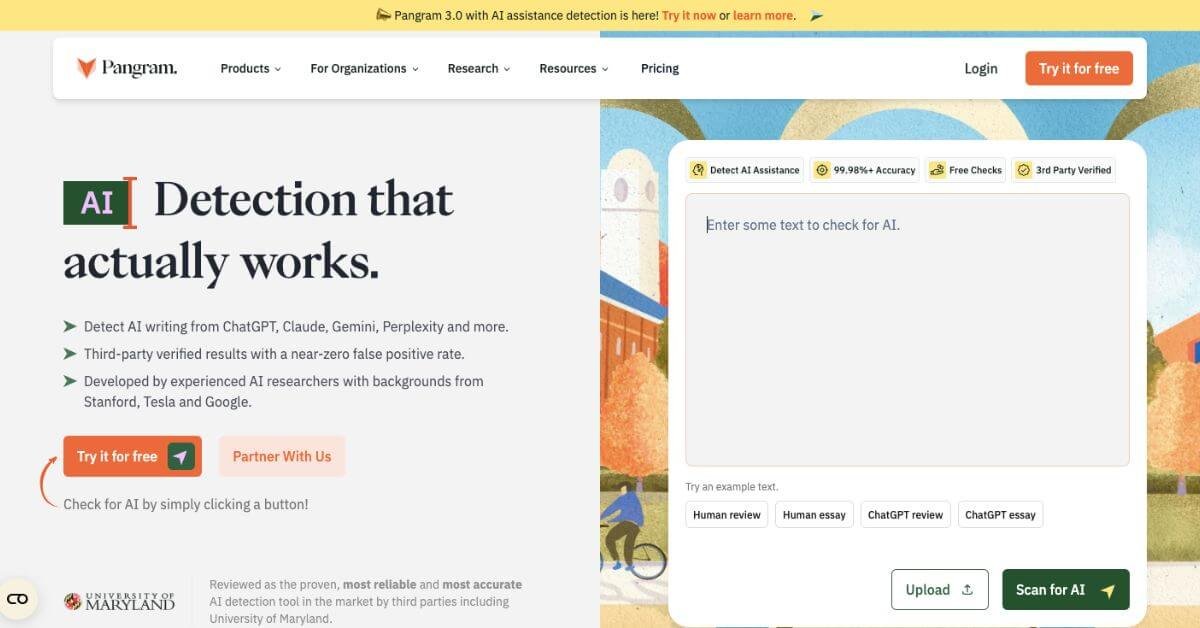
Pangram
Copyleaks
Turnitin
They evaluated 160 academic documents across four categories:
Fully human-written documents.
Fully AI-generated documents.
Hybrid documents containing human writing and AI-generated passages.
Humanised AI documents, where AI-generated passages had been rewritten to resemble student writing.
What did the study find?
Pangram consistently performed better than the other tested detectors when identifying fully AI-generated, hybrid, and humanised writing.
GPTZero, Copyleaks, and Turnitin underestimated AI involvement in several of the tested scenarios, particularly with content generated using the more advanced model involved in the experiment.
All four tools correctly classified the fully human-written documents in this particular dataset.
The researchers also applied Pangram to 1,163 master’s theses from the 2024-2025 academic year. However, these documents did not have known authorship ground truth, so those results cannot establish the actual accuracy of the detector in that group.
The study was subsequently corrected on October 6, 2026, to clarify that the fully AI-generated documents used ChatGPT Deep Research mode, which was powered by an o3-based model. The correction did not change the study’s results or conclusions.
What does this mean for GPTZero users?
The research raises a concern for anyone relying on GPTZero to identify AI-assisted academic writing. In particular, a detector may not identify every AI-generated passage in a mixed document.
However, this study should not be interpreted as a universal ranking of AI detectors.
It used a controlled dataset of 160 academic documents. Its findings do not automatically apply to every language, content genre, model version, or real-world publishing environment.
The study also demonstrates why AI detection results need to be interpreted alongside other evidence rather than used as a standalone judgment.
Research source: https://link.springer.com/article/10.1007/s40979-026-00226-w
What about GPTZero false positives and false negatives?
A false positive occurs when human-written content is incorrectly classified as AI-generated.
A false negative occurs when AI-generated content is classified as human-written.
Both errors matter:
A false positive can unfairly damage a student’s academic standing or a writer’s professional reputation.
A false negative can allow AI-generated content to pass through an editorial review undetected.
For this reason, GPTZero results should trigger further investigation rather than an automatic rejection.
Real-World Use Cases
GPTZero is most useful when detection is part of a wider review process.
For educators: Screen student assignments and use writing history or oral assessment to investigate potential AI involvement.
For publishers: Review freelance articles and identify passages that may require additional editorial checks.
For content agencies: Add an initial screening stage when reviewing large numbers of outsourced articles.
For recruitment teams: Examine written assessments when the authenticity of submitted work matters.
For researchers: Investigate writing samples while considering the limitations of automated detection.
For students: Check their own work and understand why certain passages may receive an AI classification.
For developers: Integrate document detection into internal content review applications using the API.
For example, a publishing agency receiving 30 freelance articles could use GPTZero to screen submissions before assigning them to editors. Any unusual results could then be reviewed alongside source material, drafts, and the writer’s explanation.
This is a more defensible workflow than rejecting articles automatically because of an AI score.
GPTZero Limitations: What You Should Know Before Using It
GPTZero has several limitations that prospective users should understand.
False positives: Human-written material can receive an AI classification. This is particularly concerning when detection results influence academic or professional decisions.
False negatives: Some AI-generated passages may go undetected, especially in hybrid or heavily edited documents.
Short-text limitations: Short passages provide less information for document-level analysis. GPTZero itself recommends caution with smaller samples.
Mixed human-AI writing: A document containing original writing and AI-generated passages can be more difficult to classify consistently.
Sentence-level uncertainty: Highlighted sentences are useful for investigation but should not be treated as independent proof of AI authorship.
Language and genre differences: The detector’s documentation identifies English adult prose as the majority of its training material. Performance should not be assumed to transfer equally across every language or writing style.
Authorship verification: A detection score cannot establish who created a document or whether AI use violated a particular institution’s policy.
For organizations using AI detection in high-stakes decisions, these limitations should be reflected in their internal policies.
Pros and Cons
| Pros | Cons |
|---|---|
| Free plan available for initial testing. | Detection results can be incorrect. |
| Supports major AI writing model families. | AI detection is not definitive proof of authorship. |
| Advanced Scan provides sentence-level highlighting. | Sentence-level classifications are less reliable. |
| Writing Replay provides additional document context. | Writing history is not always available or conclusive. |
| Includes plagiarism and writing feedback tools. | Some useful features require paid subscriptions. |
| API and educational integrations support larger workflows. | Independent research raises concerns about missed AI-generated content. |
GPTZero’s strongest advantage is its broader writing review ecosystem. Its biggest weakness is the uncertainty that remains around AI detection itself.
Pricing and Plans
GPTZero offers four subscription tiers: Free, Essential, Premium, and Professional.
The following comparison reflects the features and usage allowances described in GPTZero’s official support documentation. Exact subscription prices should be checked on its live pricing page because billing currency, annual discounts, and plan availability can change.
| Plan | Main features | Best suited for |
|---|---|---|
| Free | Basic AI Scan, one Advanced Scan, 10,000 words/month | Occasional users |
| Essential | Grammar Check, AI Vocabulary Check, browser extension | Individual writers |
| Premium | Advanced Scan, Writing Feedback, Plagiarism Check, source and citation generation | Regular content reviewers |
| Professional | Page-by-page scanning, enterprise security, LMS integration, higher file and usage allowances | Institutions and larger teams |
Is GPTZero Free Enough?
For occasional users, the free plan is a reasonable starting point.
It includes 10,000 words per month, Basic AI Scan, and one free Advanced Scan. Individual scans are limited to 10,000 characters, and batch uploads are limited to three files.
The free plan is sufficient for understanding the interface and checking a small number of documents.
Which Paid Plan Should You Choose?
Essential: Consider this if you primarily need grammar checking, vocabulary assistance, and the browser extension.
Premium: More appropriate for editors, marketers, and writers who need Advanced Scan, writing feedback, and plagiarism checking.
Professional: Designed for institutions and organizations requiring page-by-page analysis, larger batch uploads, enterprise security, and LMS integration.
My recommendation is to avoid upgrading simply for a higher word allowance. First establish how frequently you use the detector and whether the additional features solve a real problem in your workflow.
Best Alternatives and Comparisons
GPTZero competes with several AI detection products. The best choice depends on whether you prioritize academic workflows, publishing, plagiarism checking, or alternative detection approaches.
| Tool | Better suited for | Main consideration |
|---|---|---|
| GPTZero | Educators and general content reviewers | Writing Replay and integrated writing analysis |
| Originality.ai | SEO publishers and content agencies | AI detection combined with plagiarism and publishing-related tools |
| Copyleaks | Organizations with multilingual detection needs | AI detection, plagiarism checking, and institutional integrations |
| Turnitin | Universities and educational institutions | Academic integrity workflows and existing institutional adoption |
| Winston AI | Writers and organizations wanting text and image detection | Additional detection capabilities beyond text |
| Pangram | Users evaluating alternative AI detection approaches | Strong results in the cited 2026 academic comparison |
GPTZero vs Originality.ai
Originality.ai is worth evaluating for publishers and SEO agencies that need AI detection and plagiarism checking as part of their content quality process.
GPTZero offers a different emphasis through its Writing Replay and educational workflow features.
For a website owner, the choice should depend on whether content publishing and originality checks or document authorship analysis are more important.
GPTZero vs Copyleaks
Copyleaks is relevant for organizations that need multilingual AI detection and plagiarism checking in one platform.
Its support for educational and enterprise workflows makes it worth comparing with GPTZero Professional.
GPTZero vs Turnitin
Turnitin is primarily an academic integrity platform used by educational institutions. It is not simply a consumer AI detector that individuals can purchase and use independently.
Universities already using Turnitin should evaluate its institutional capabilities before adding another detection platform.
GPTZero vs Winston AI
Winston AI offers AI text detection and additional capabilities, including image detection and document scanning.
It is worth comparing if your review process extends beyond written text.
GPTZero vs Pangram
Pangram deserves particular attention because of its performance in the 2026 academic comparison discussed earlier.
However, one study is not enough to establish that it will outperform GPTZero across every real-world content category. Test both tools using representative samples from your own workflow.
Who Should Use GPTZero?
GPTZero is a reasonable option for people who regularly review written content and need more than a basic AI probability score.
Choose GPTZero if:
You review student assignments or academic submissions.
You manage freelance writers and editorial teams.
You need sentence-level analysis.
You want writing history and authorship-related tools.
You need integrations or an API for an existing workflow.
Consider alternatives if:
Your main priority is a different detection methodology.
You need a specialist plagiarism checking workflow.
You want to compare detection performance using independent research.
Your institution requires a particular academic integrity platform.
Avoid relying on any AI detector as the sole evidence of misconduct.
Frequently Asked Questions (FAQ)
GPTZero can identify some AI-generated writing, but its reliability varies by document length, language, writing style, and editing. Its own documentation acknowledges false positives and false negatives, so it should be used as a screening tool rather than definitive proof.
Yes. GPTZero supports detection across major AI writing model families, including ChatGPT, Claude, and Gemini. However, support for a model family does not guarantee that every generated or edited passage will be identified.
GPTZero has an AI Paraphrased classification designed to identify some AI-generated writing that has been rewritten by a person or another tool. Its documentation describes this capability, but detection is not guaranteed.
Yes. Human-written text can sometimes be classified as AI-generated, particularly when its writing patterns resemble material in the detector’s training data. This is why an AI score should not be used as the sole basis for academic or professional consequences.
Neither tool can be declared universally better without testing both on the same writing samples. GPTZero offers Writing Replay and educational features, while Originality.ai is worth evaluating for SEO publishing and content originality workflows.
Yes. Its free plan includes 10,000 words per month, Basic AI Scan, one free Advanced Scan, and limited batch uploads. Paid plans provide additional writing tools, higher usage allowances, and institutional features.
No. GPTZero advises educators not to use its results as the sole basis for punishing students. Teachers should consider writing drafts, previous work, classroom assessments, and direct discussions before reaching conclusions.
Final Recommendation
GPTZero is best suited for educators, publishers, and content review teams who want to screen writing for potential AI involvement and investigate suspicious passages through additional analysis.
Its combination of AI detection, Advanced Scan, Writing Replay, plagiarism checking, and integrations gives it a broader purpose than a basic AI checker.
However, the independent academic research discussed in this review raises legitimate questions about its ability to identify AI-generated passages in hybrid and humanised documents. Its own documentation also acknowledges classification errors.
For individual users, the free plan is a sensible place to start. For professional teams, Premium and Professional are worth evaluating when their additional features fit an established review process.
If your primary concern is detection performance, compare GPTZero with Pangram, Originality.ai, and Copyleaks before committing to a subscription.
Visit the official GPTZero website, compare its features with alternatives, and decide whether its additional writing analysis justifies a subscription.
You can also explore other AI detection products in the itirupati.com AI Tools Directory or submit your own AI product for consideration.