
Ambience Healthcare
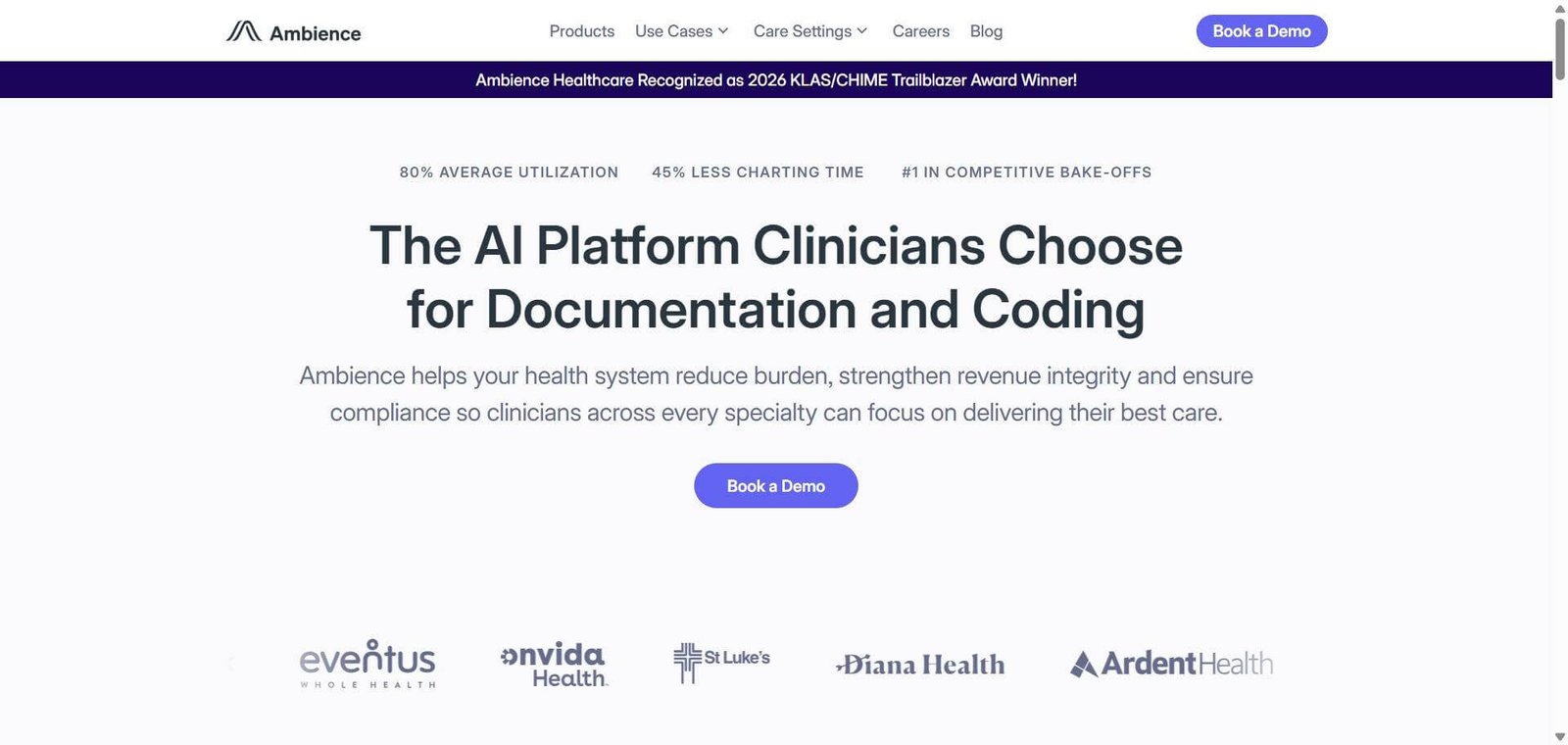
Enterprise AI scribing and coding for health systems — AutoScribe listens, documents, and codes across 200 plus specialties inside Epic.
Ambience Healthcare Review: The Enterprise AI Clinical Documentation Platform That Combines Scribing and Revenue Cycle in One System
Most ambient AI medical scribes solve one problem — documentation. They listen to the clinical encounter, generate a note, and leave the revenue cycle workflow to separate systems. Ambience Healthcare solves both simultaneously. AutoScribe generates the structured clinical note from the ambient conversation. AutoCDI checks that note against coding requirements — identifying documentation gaps that would reduce reimbursement before the note reaches the chart and the claim is submitted. The combined workflow is why health systems like Cleveland Clinic, UCSF Health, and Houston Methodist chose Ambience for enterprise deployment rather than simpler ambient scribes — the documentation and revenue cycle protection work together inside Epic without requiring a separate coding review step.
Quick Summary
Ambience Healthcare is an enterprise AI clinical documentation platform combining AutoScribe ambient scribing, AutoCDI automated coding and documentation improvement, AutoAVS after-visit summaries, AutoRefer referral letter drafting, and AutoPrep pre-visit chart review — deployed at major health systems including Cleveland Clinic, UCSF Health, and Houston Methodist across 200 plus specialties, with native Epic, Oracle Cerner, and athenahealth integration, backed by $370 million in funding at a $1.25 billion valuation.
Is it worth using? Yes for large health systems on Epic, Oracle Cerner, or athenahealth that want the enterprise-grade combination of ambient documentation and automated coding intelligence in one platform with native EHR integration — the deepest enterprise offering in the ambient scribing category.
Who should use it? CMOs, CISO-level health system leaders, clinical informatics teams, and medical directors at large health systems deploying ambient AI documentation across multiple specialties and departments.
Who should avoid it? Individual clinicians and small to mid-size practices where Freed AI ($39 to $119/month with self-serve setup) or Nabla provide accessible ambient scribing at a fraction of the cost without enterprise implementation requirements.
Verdict: Detailed Summary
Best for
- Large health systems on Epic who want the deepest possible native integration — Ambience runs inside Epic Hyperdrive and Haiku through Epic’s Ambient Module and native FHIR APIs, not a browser extension or copy-paste workflow
- Health systems whose clinical documentation improvement and revenue cycle protection are a priority alongside physician documentation burden reduction — AutoCDI addresses both simultaneously rather than requiring separate CDI review
- Multi-specialty health system deployments requiring broad coverage — Ambience’s 200 plus specialty support enables enterprise rollout across departments without specialty-specific exceptions
Not for
- Individual clinicians and small practices where enterprise pricing at approximately $233 to $500 plus per provider per month is disproportionate — Freed AI at $39/month or Nabla at $119/month are accessible alternatives
- Organisations not on Epic, Oracle Cerner, or athenahealth where Ambience’s integration depth does not apply
- Health systems that need rapid self-serve deployment — Ambience’s enterprise sales cycle and implementation timeline require months, not days
Rating
⭐⭐⭐⭐½ 4.5 / 5
What Is Ambience Healthcare?
Ambience Healthcare was founded in 2020 by Mike Ng and Nikhil Buduma — a Stanford-educated team that built the platform specifically for enterprise health system deployment rather than the individual clinician market. The company has raised more than $370 million in funding, including a $70 million raise led by OpenAI and Kleiner Perkins, reaching a $1.25 billion valuation. Cleveland Clinic’s decision to deploy Ambience across more than 80 specialties in a pilot that tested broad specialty coverage was a significant enterprise validation for the platform.
Ambience describes itself as an AI operating system for clinical documentation — not a single ambient scribe but a suite of AI products that cover the full clinical documentation and coding lifecycle, all integrated natively into the EHR workflows clinicians already use.
How Ambience Healthcare Works
- Open Ambience before the encounter. Clinicians launch Ambience through their Epic interface — on a workstation, tablet, or phone — before the patient visit begins. No separate app installation or hardware required beyond the existing clinical devices.
- AutoScribe listens and documents in real time. During the clinical encounter, AutoScribe listens to the physician-patient conversation — separating medically relevant content from small talk, handling multiple speakers, and drafting a structured problem-organised note in the clinician’s own style before the visit ends.
- AutoCDI checks the note against coding requirements. Simultaneously, AutoCDI analyses the documented note for coding completeness — identifying documentation gaps that would reduce reimbursement or fail CDI review, and prompting the clinician to address them before signing.
- Clinician reviews and signs inside Epic. The complete note — with AutoCDI coding recommendations — appears inside the Epic chart for review. Clinicians edit, approve, and sign without leaving their EHR workflow.
- Supporting modules complete the documentation cycle. AutoAVS generates patient-friendly after-visit summaries. AutoRefer drafts referral letters. AutoPrep generates pre-visit chart reviews for scheduled patients — completing the documentation workflow beyond the clinical note itself.
Key Features
- AutoScribe real-time ambient clinical documentation across 200 plus medical specialties
- AutoCDI automated coding and clinical documentation improvement — simultaneous with note generation
- AutoAVS after-visit summary generation for patients
- AutoRefer referral letter drafting from encounter documentation
- AutoPrep pre-visit chart review and preparation
- Native Epic integration through Epic Toolbox — works inside Hyperdrive and Haiku via Epic Ambient Module and FHIR APIs
- Oracle Cerner and athenahealth integration through native APIs
- Multi-language support for diverse patient populations
- HIPAA compliant with BAA provided — Trust Center at trust.ambiencehealthcare.com
- Deployed at Cleveland Clinic, UCSF Health, Houston Methodist, and other major health systems
- $370 million raised from OpenAI, Kleiner Perkins, and others at $1.25 billion valuation
- Competes head-to-head with Abridge and Microsoft Dragon Copilot for enterprise health system deployments
Real-World Use Cases
- Enterprise health system rollout: Cleveland Clinic pilots Ambience across more than 80 specialties before signing an enterprise agreement — the breadth test validates that the platform’s specialty coverage is sufficient for health system-wide deployment rather than requiring specialty-specific tools for different departments.
- Documentation and revenue cycle combined: A health system deploys Ambience for documentation burden reduction — within the first quarter, the CDI team reports that AutoCDI is surfacing coding documentation gaps during the encounter rather than through post-discharge CDI queries, improving first-pass claim accuracy and reducing CDI team workload simultaneously.
- Multi-language clinic: A community health system with patient populations speaking multiple languages deploys Ambience — the platform handles encounters in multiple languages, generating English-language notes regardless of the encounter language, without requiring language-specific documentation tools.
- Physician satisfaction: A hospital system tracks physician satisfaction metrics before and after Ambience deployment across the internal medicine department — post-deployment surveys show documentation time reduced by more than an hour per day and after-hours charting eliminated for the majority of participating physicians.
Pros and Cons
| Pros | Cons |
|---|---|
| AutoScribe and AutoCDI work simultaneously — documentation and revenue cycle protection in one workflow rather than sequential processes | Enterprise-only — no self-serve access, no public pricing, multi-month sales and implementation cycle |
| Native Epic integration through Epic Toolbox is the deepest available — works inside Hyperdrive and Haiku without browser extension or copy-paste | Pricing approximately $233 to $500 plus per provider per month — accessible only to health systems with enterprise procurement capacity |
| 200 plus specialty support enables health system-wide deployment without specialty-specific exceptions | Competes directly with Abridge (Best in KLAS 2025 and 2026) — health systems should evaluate both before committing |
| Deployed at Cleveland Clinic, UCSF Health, and Houston Methodist — enterprise validation at major academic and community health systems | Individual clinicians and small practices have no practical path to Ambience — Freed AI or Nabla are the appropriate alternatives |
| $370 million raised from OpenAI, Kleiner Perkins, and others — financial stability for enterprise healthcare commitments | Implementation complexity requires dedicated clinical informatics and IT resources alongside vendor engagement |
Pricing & Plans
Ambience Healthcare does not publish pricing. All contracts are custom-negotiated through an enterprise sales process. Based on third-party industry estimates:
- Core AutoScribe module: approximately $233 to $267 per provider per month ($2,800 to $3,200/year)
- Full platform with AutoCDI and additional modules: approximately $300 to $500 plus per provider per month
- One-time implementation fee for EHR integration and specialty template tuning
- Annual contracts with custom volume pricing for health system-wide deployments
Contact Ambience Healthcare at ambiencehealthcare.com to book a demo and begin the enterprise evaluation process.
Best Alternatives & Comparisons
- Abridge — Direct enterprise competitor — Best in KLAS for Ambient AI in 2025 and 2026, deepest Epic integration with Linked Evidence auditable AI — evaluate alongside Ambience for any health system decision
- Freed AI — Better for individual clinicians and small practices at $39 to $119/month with self-serve setup and a 7-day free trial
- Nabla — Better for mid-size clinics and practices at approximately $119/month with Epic and Cerner integration
- Nuance DAX Copilot — Microsoft-backed enterprise ambient scribe with deep Microsoft and Epic integration — the third enterprise competitor alongside Ambience and Abridge
Frequently Asked Questions (FAQ)
Ambience Healthcare is an enterprise AI clinical documentation platform combining AutoScribe ambient scribing, AutoCDI automated coding, and suite of additional modules — deployed at Cleveland Clinic, UCSF Health, and Houston Methodist across 200 plus specialties with native Epic, Oracle Cerner, and athenahealth integration.
Ambience does not publish pricing. Industry estimates place the core AutoScribe module at approximately $233 to $267 per provider per month, with full platform including AutoCDI at $300 to $500 plus per provider per month. All contracts are custom-negotiated through the enterprise sales process.
AutoCDI is Ambience’s automated clinical documentation improvement and coding intelligence module — checking the generated clinical note against coding requirements simultaneously with documentation, identifying gaps that would reduce reimbursement before the note is signed rather than through post-discharge CDI queries.
Ambience runs inside the Epic Toolbox, working within Epic Hyperdrive and Haiku through the Epic Ambient Module and native FHIR APIs — reading and writing into the Epic chart without copy-paste or a separate browser extension.
No — Ambience is an enterprise platform sold exclusively through health system procurement. Individual clinicians and small practices should evaluate Freed AI ($39 to $119/month, self-serve setup) or Nabla ($119/month) as accessible alternatives with similar ambient scribing capability.
Both are enterprise ambient scribing platforms competing for the same large health system deployments. Abridge holds Best in KLAS for Ambient AI in both 2025 and 2026 with the Linked Evidence auditable AI differentiator. Ambience combines documentation with AutoCDI revenue cycle protection in one workflow — a differentiator for health systems prioritising both physician burden and CDI simultaneously. Health systems should evaluate both platforms through parallel pilots before committing.
Final Recommendation
Ambience Healthcare is one of the two enterprise-leading AI clinical documentation platforms for large health systems — competing head-to-head with Abridge for the same deployments at Cleveland Clinic, UCSF Health, and Houston Methodist scale. The combination of AutoScribe ambient documentation and AutoCDI revenue cycle protection in one native Epic workflow is the most distinctive aspect of the Ambience proposition — addressing both the physician burnout problem and the CDI efficiency problem simultaneously rather than treating them as separate initiatives. For any health system evaluating enterprise ambient AI documentation, Ambience deserves a parallel evaluation alongside Abridge before either platform is selected.
Next steps