itirupati.com AI Tools

Photomath

Point your camera at any math problem and get the full step-by-step solution — 100 million plus students already have.

Photomath Review: The Camera Math Solver That Taught a Generation of Students to Understand Their Homework

Photomath did not just solve math problems — it changed how students interact with math homework by making the step-by-step solution available at any moment, for any problem, without requiring a tutor or a textbook worked example. Founded in 2014 by Damir Sabol and acquired by Google in 2023, the app now has more than 100 million downloads and solves approximately 1.2 billion math problems per month. What made it distinctive from the beginning — and what has kept it the category leader after a decade — is the quality of its step-by-step explanations. Photomath does not just return an answer; it shows every step, explains the reasoning, and offers multiple solution methods for the same problem so students who think differently can find the approach that makes sense to them.

Quick Summary

Photomath is a Google-owned AI math solver mobile app with 100 million plus downloads — using camera OCR to scan printed or handwritten math problems and deliver instant step-by-step solutions across arithmetic, algebra, geometry, trigonometry, pre-calculus, statistics, and basic calculus for K-12 and introductory college mathematics, with unlimited free basic solutions and Photomath Plus at $9.99/month or $69.99/year adding animated tutorials and textbook-specific solutions.

Is it worth using? Yes for K-12 students and introductory college math learners who want to understand how math problems are solved step-by-step rather than just getting the final answer — the free tier alone delivers genuine value that makes it the most accessible math learning tool available.
Who should use it? Middle school, high school, and introductory college students studying arithmetic through calculus who want instant step-by-step explanations to understand their homework and check their work.
Who should avoid it? Advanced university students in pure mathematics, engineering mathematics beyond introductory calculus, or physics whose problem types exceed Photomath’s K-12 and introductory college coverage ceiling.

Verdict: Detailed Summary

Best for

  • Students who are visual learners and get lost in textbook explanations — Photomath’s step-by-step visual layout and multiple solution methods make the process of solving problems transparent rather than opaque
  • Parents who want to help their children with math homework but are not confident in the specific topics being studied — Photomath’s instant step-by-step explanations allow parents to understand and guide homework alongside their child
  • Students who want to check their own work and understand where they went wrong rather than simply receiving the right answer — the step-by-step explanation of a correctly solved problem is a teaching tool, not just an answer checker

Not for

  • Advanced mathematics students — Photomath covers K-12 through introductory college calculus and statistics, but complex multi-step engineering mathematics and upper-division university topics exceed its reliable coverage ceiling
  • Students who want to build daily math practice habits — Photomath solves problems on demand but does not include structured curriculum, spaced repetition, or habit-forming daily challenges
  • Users whose handwriting is messy or unconventional — the OCR scanner can struggle with non-standard notation, fractions, and exponents written in unusual ways

Rating
⭐⭐⭐⭐ 4.3 / 5

What Is Photomath?

Photomath was created in 2014 by Damir Sabol — launched initially as a camera-based math scanner that could read a problem from a photo and solve it. The core innovation was the OCR-to-solution workflow: take a photo of a math problem, the app reads it, solves it, and shows every step. What distinguished Photomath from a calculator was not just the camera input but the explanation layer — the decision to show not just the answer but the complete logical sequence of steps, with reasoning at each stage.

Google acquired Photomath in 2023 as a complement to its educational AI initiatives. The app is now available in dozens of languages, covers the full K-12 curriculum from arithmetic through introductory calculus and statistics, and handles both printed textbook problems and handwritten homework. The free tier provides unlimited basic step-by-step solutions with no account required — no ads, no usage limits on core functionality.

How Photomath Works

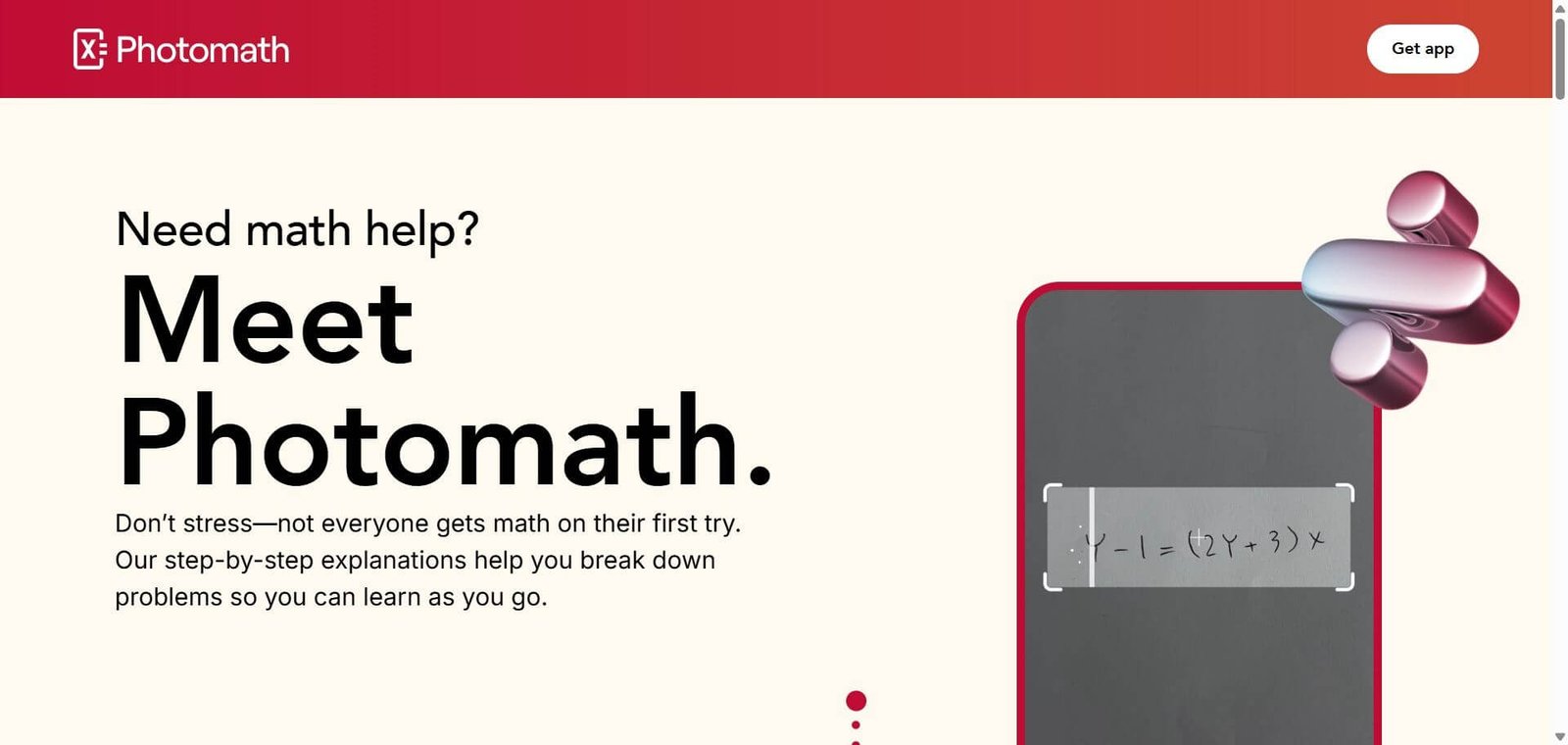
  • Open the app and point the camera. Open Photomath on iOS or Android and point the camera at the math problem — printed in a textbook, on a worksheet, or handwritten in a notebook. The app reads the problem using OCR technology in real time.
  • Problem recognised instantly. The problem appears in the preview window as the app reads it — including fractions, exponents, radicals, and other mathematical notation. Tap the shutter button to confirm and solve.
  • Step-by-step solution appears. Photomath breaks the solution into individual steps — each step showing what mathematical operation was applied and why, following the logical sequence from the initial problem to the final answer.
  • Multiple solution methods available. For most problems, Photomath offers two or more solution methods — solving by substitution and elimination for a system of equations, or by factoring and the quadratic formula for a quadratic. Students choose the method that matches how they think or how their teacher expects them to solve it.
  • Animated tutorials on Plus. Photomath Plus subscribers access animated step-by-step tutorials — animated walkthroughs that show each step being applied visually, adding a motion-based explanation layer for students who learn better from dynamic visual content.
  • Type problems manually. For problems that are difficult to photograph — complex expressions with unclear handwriting, or problems typed on a screen — Photomath’s math keyboard allows manual entry with all necessary mathematical symbols.

Key Features

  • Camera OCR scanning of printed and handwritten math problems with real-time recognition
  • Step-by-step solutions covering arithmetic, pre-algebra, algebra, geometry, trigonometry, pre-calculus, statistics, and basic calculus
  • Multiple solution methods showing different valid approaches to the same problem
  • Animated tutorial walkthroughs for visual learners on Photomath Plus
  • Textbook-specific deep-dive solutions for popular textbooks on Photomath Plus
  • Math keyboard for typed problem entry alongside camera scanning
  • Free tier with unlimited basic step-by-step solutions — no account required, no ads, no usage limits
  • Multi-language support covering dozens of languages for international student access
  • iOS and Android apps with offline capability for scanning and basic solutions
  • Google ownership bringing AI research investment into ongoing model improvement
  • 100 million plus downloads, solving approximately 1.2 billion math problems per month

Real-World Use Cases

  • Algebra homework help: A Year 10 student photographs their algebra homework — a system of two equations requiring solution by substitution. Photomath recognises the equations, solves by substitution step-by-step with each arithmetic operation shown, and offers the alternative elimination method so the student can see both approaches their teacher has covered.
  • Calculus understanding: A first-year university student struggles with their calculus problem set — not just getting wrong answers but not understanding where the process breaks down. Using Photomath, they photograph each problem and follow the step-by-step solution to identify specifically which step they are missing in their own work.
  • Parent homework support: A parent helping their child with geometry homework encounters a topic they have not studied since high school. Photomath provides the step-by-step solution immediately — the parent understands the process and can guide their child through it rather than saying they cannot help.
  • International student access: A student in India uses Photomath in their native language to access math explanations that a textbook written in English does not make accessible — the multilingual support makes the step-by-step logic available regardless of language.

Pros and Cons

ProsCons
Unlimited free step-by-step solutions with no account required — the most accessible math help tool available at any priceCoverage limited to K-12 and introductory college — complex engineering and advanced university mathematics exceed the reliable ceiling
Multiple solution methods for most problems — teaches that math is not one rigid path, reinforcing flexible thinkingHandwriting recognition can struggle with messy notation, non-standard fraction writing, and complex exponents
Google ownership brings ongoing AI research investment into accuracy and coverage improvementsDoes not build daily math practice habits — solving problems on demand does not develop the retention that structured practice produces
100 million plus downloads and 1.2 billion monthly solves validate that the core experience genuinely worksPhotomath Plus at $69.99/year adds meaningful features but the free tier is sufficient for most K-12 homework needs
Animated tutorials on Plus provide a visual learning layer beyond static step-by-step text explanationsNo conversational AI tutor — Photomath explains solutions but does not ask guiding questions or engage the student interactively

Pricing & Plans

Free — $0
  • Unlimited camera scanning and step-by-step solutions
  • Core subjects across arithmetic through introductory calculus
  • Multiple solution methods
  • No account required
  • No ads or usage limits
Photomath Plus — $9.99/month or $69.99/year ($5.83/month)
  • All Free features
  • Animated step-by-step tutorial walkthroughs
  • Textbook-specific deep-dive solutions for hundreds of popular textbooks
  • Custom visual aids and enhanced explanations
  • Annual billing saves approximately 40% versus monthly

Best Alternatives & Comparisons

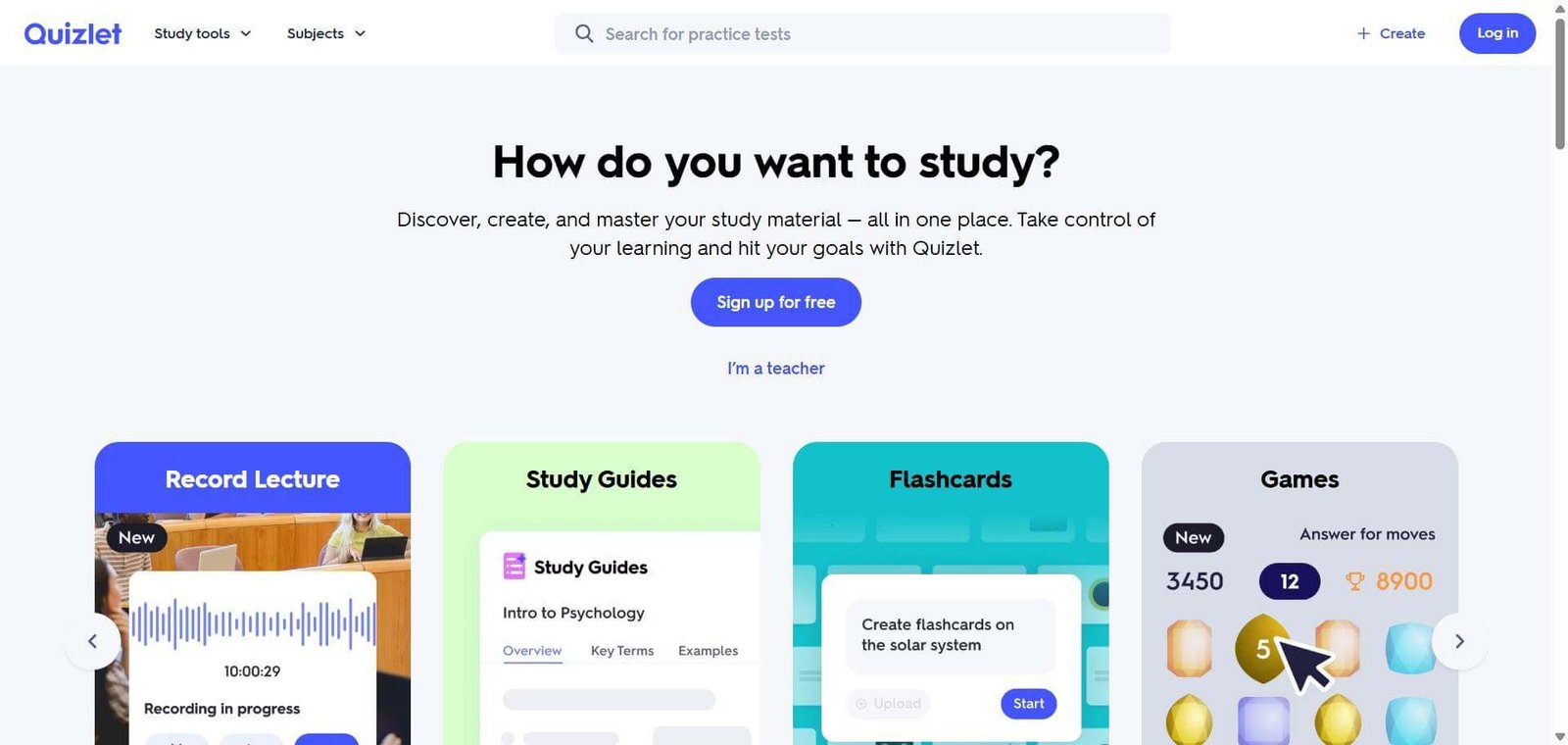
  • Quizlet AI — Better for flashcard-based study and AI tutor interaction across all subjects, less camera-based math solving depth
  • Wolfram Alpha — Better for advanced university and engineering mathematics with computation depth beyond Photomath’s K-12 ceiling
  • Microsoft Math Solver — Better for completely free math solving including graphing calculator without any paid tier
  • Symbolab — Better for step-by-step algebra and calculus with a web interface alongside mobile app access

Frequently Asked Questions (FAQ)

What is Photomath?

Photomath is a Google-owned AI math solver app with 100 million plus downloads — scanning printed or handwritten math problems with a phone camera and delivering instant step-by-step solutions across arithmetic through introductory calculus and statistics for K-12 and college students.

Is Photomath free?

Yes — the core Photomath app is free with unlimited step-by-step solutions, no account required, no ads, and no usage limits. Photomath Plus at $9.99/month or $69.99/year adds animated tutorials and textbook-specific solutions.

Does Photomath work on handwritten problems?

Yes — Photomath’s OCR technology reads both printed and handwritten math problems. Handwriting recognition works well for clear notation but can struggle with very messy writing, non-standard fraction formatting, and unconventional exponent placement.

What subjects does Photomath cover?

Photomath covers arithmetic, pre-algebra, algebra, geometry, trigonometry, pre-calculus, statistics, and basic calculus — the full K-12 curriculum and introductory college mathematics. Advanced university mathematics beyond introductory calculus exceeds the reliable coverage ceiling.

Does Google own Photomath?

Yes — Google acquired Photomath in 2023. The acquisition connects Photomath’s camera-based math solving with Google’s broader AI and education initiatives.

How does Photomath compare to Wolfram Alpha?

Photomath is optimised for K-12 and introductory college students — camera scanning, step-by-step explanations in accessible language, and multiple solution methods. Wolfram Alpha covers advanced university and engineering mathematics with computational depth that Photomath does not reach. Photomath for K-12 and introductory college homework. Wolfram Alpha for advanced university and technical mathematics.

Final Recommendation

Photomath is the most accessible and widely proven AI math learning tool available — and the free tier alone, with unlimited step-by-step solutions and no account required, makes it the default recommendation for any K-12 or introductory college student who wants to understand how math problems are solved rather than just what the answers are. The multiple solution methods, Google’s ongoing AI investment, and 1.2 billion monthly solves validate that the core experience works at a scale no competitor approaches. For any student who has stared at a math problem not knowing where to start, Photomath turns that moment of frustration into a learning opportunity in seconds.

Next steps

Feature your app on AI tools for free

Subscribe to our Newsletter

Stay up-to-date with the latest AI Apps and cutting-edge AI news.

Trending Categories