AI that listens to patient consultations and writes the clinical notes — so physicians can focus on care.
Clinical documentation is one of the leading causes of physician burnout — doctors spend an average of two hours on documentation for every hour of direct patient care. Nabla addresses this with an AI that listens to patient consultations, understands the medical content, and automatically generates accurate clinical notes in the physician’s preferred format — SOAP notes, consultation summaries, referral letters, and others — ready for review and sign-off rather than creation from scratch. The result is documentation time reduced by up to 70 percent with physicians consistently reporting that the quality of the AI-generated notes matches or exceeds what they would write manually.
Nabla is an AI medical scribe that automatically generates clinical notes from patient-physician conversations — producing SOAP notes, consultation summaries, and other documentation formats for review and sign-off, reducing physician documentation time significantly.
Is it worth using? Yes for physicians, clinics, and healthcare organisations who want to reduce the documentation burden that contributes to physician burnout without compromising clinical note quality or accuracy.
Who should use it? Primary care physicians, specialists, and healthcare clinics who conduct patient consultations and spend significant time on post-consultation documentation that AI can generate more efficiently.
Who should avoid it? Healthcare settings with strict on-premise data requirements that preclude cloud AI processing of patient conversations, or highly specialised fields where AI note accuracy requires extensive validation.
Best for
Not for
Rating
⭐⭐⭐⭐ 4.4 / 5
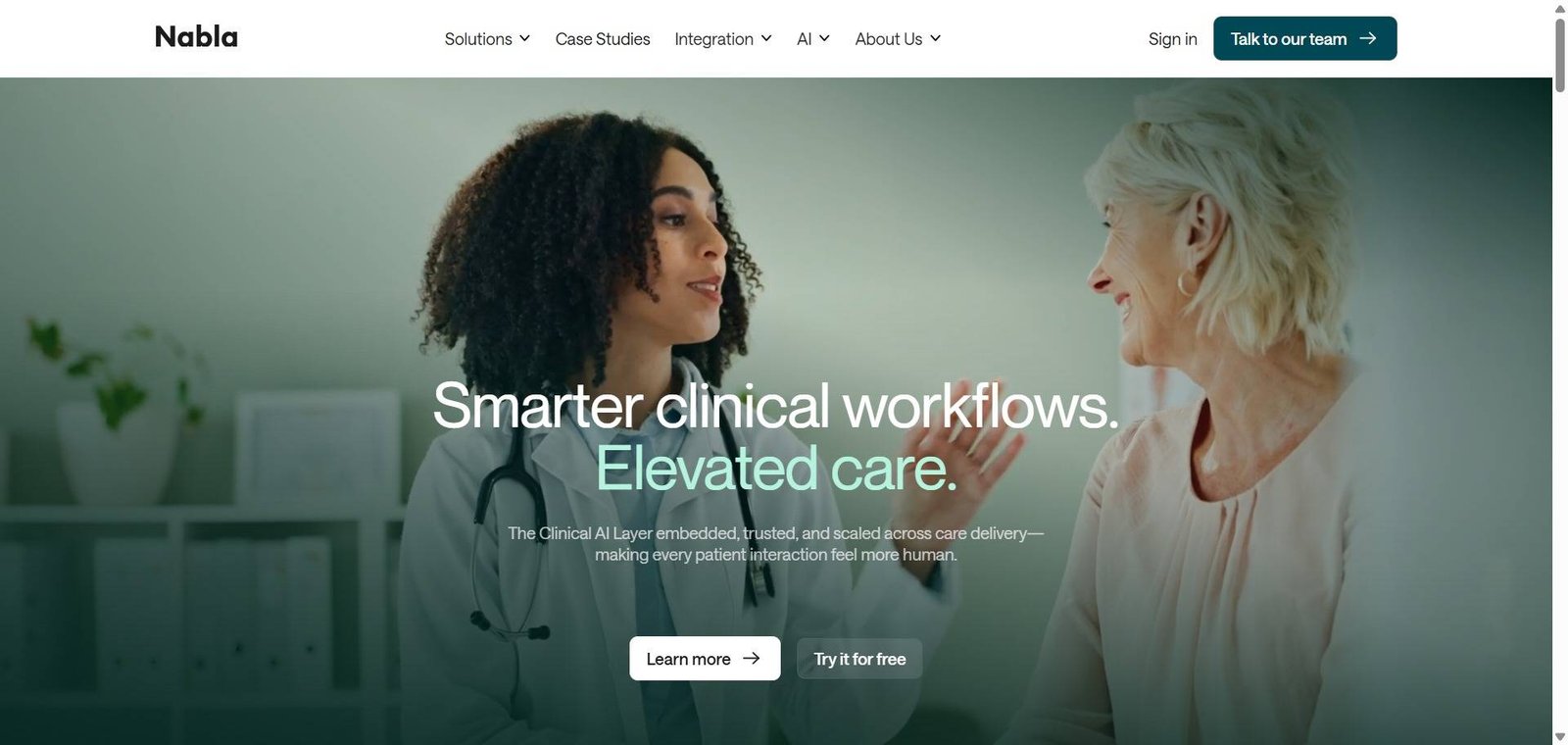
Nabla is an AI healthcare company specialising in ambient clinical intelligence — AI that passively listens to patient-physician interactions and converts them into structured clinical documentation without requiring the physician to dictate, type, or click during the consultation. Its AI understands medical terminology, clinical reasoning patterns, and documentation standards to generate notes that reflect the clinical content of the consultation accurately.
The platform integrates with major Electronic Health Record (EHR) systems — including Epic, Cerner, and others — allowing generated notes to be reviewed and signed off directly in the physician’s existing workflow rather than requiring separate documentation in a new tool.
| Pros | Cons |
|---|---|
| Dramatic reduction in documentation time addresses the leading cause of physician burnout | Requires cloud processing of patient audio — not suitable for all data sovereignty requirements |
| Ambient listening requires no physician interaction during consultation | AI accuracy requires physician review before sign-off for every note |
| EHR integration fits existing clinical workflows without tool switching | Specialty-specific accuracy may require template customisation for niche specialties |
| HIPAA-compliant data handling meets healthcare security requirements | Implementation requires IT and compliance approval in larger healthcare organisations |
| Multilingual support covers diverse patient populations | Monthly cost per provider adds up across large clinical teams |
Nabla pricing is structured per provider per month with custom enterprise pricing for health systems. Individual physician plans and clinic plans are available — contact Nabla at nabla.com for current pricing based on provider count and EHR integration requirements.
Nabla is an AI medical scribe that automatically generates clinical notes from patient-physician consultations — producing SOAP notes, consultation summaries, and other documentation for physician review and sign-off, integrated with major EHR systems.
Yes, Nabla is designed to meet HIPAA compliance requirements for healthcare data privacy and security — with data handling practices appropriate for processing patient-physician conversations in clinical settings.
Nabla integrates with Epic, Cerner, and other major EHR systems — allowing generated notes to be pushed directly to the patient record in the physician’s existing clinical workflow.
Physicians using Nabla typically report reducing documentation time by 50 to 70 percent — converting a 10 to 15-minute post-consultation documentation task into a 1 to 2-minute review and sign-off process.
Nabla processes audio from patient consultations to generate clinical notes. Patient consent and notification practices should follow applicable healthcare regulations and institutional policies. Nabla provides guidance on consent workflows for different clinical settings.
Both are ambient AI medical scribe solutions. Nuance DAX is the most established enterprise solution with deep Microsoft and Epic integration for large health systems. Nabla is more accessible for individual physicians and smaller clinics with a smoother onboarding process and more flexible deployment. Nabla for individual and clinic-level adoption; Nuance DAX for enterprise health system deployment.
Nabla is the most accessible AI medical scribe for physicians and clinics who want to address documentation burden without a lengthy enterprise implementation process. The ambient listening approach requires no behaviour change during consultations, the EHR integration fits existing workflows, and the documentation time savings are immediate and measurable. For any physician spending more than an hour daily on clinical notes, Nabla delivers a quality-of-working-life improvement that justifies its cost from the first week of use.
Next steps