AI that listens to your patient conversations and writes clinical notes in real time — inside Epic.
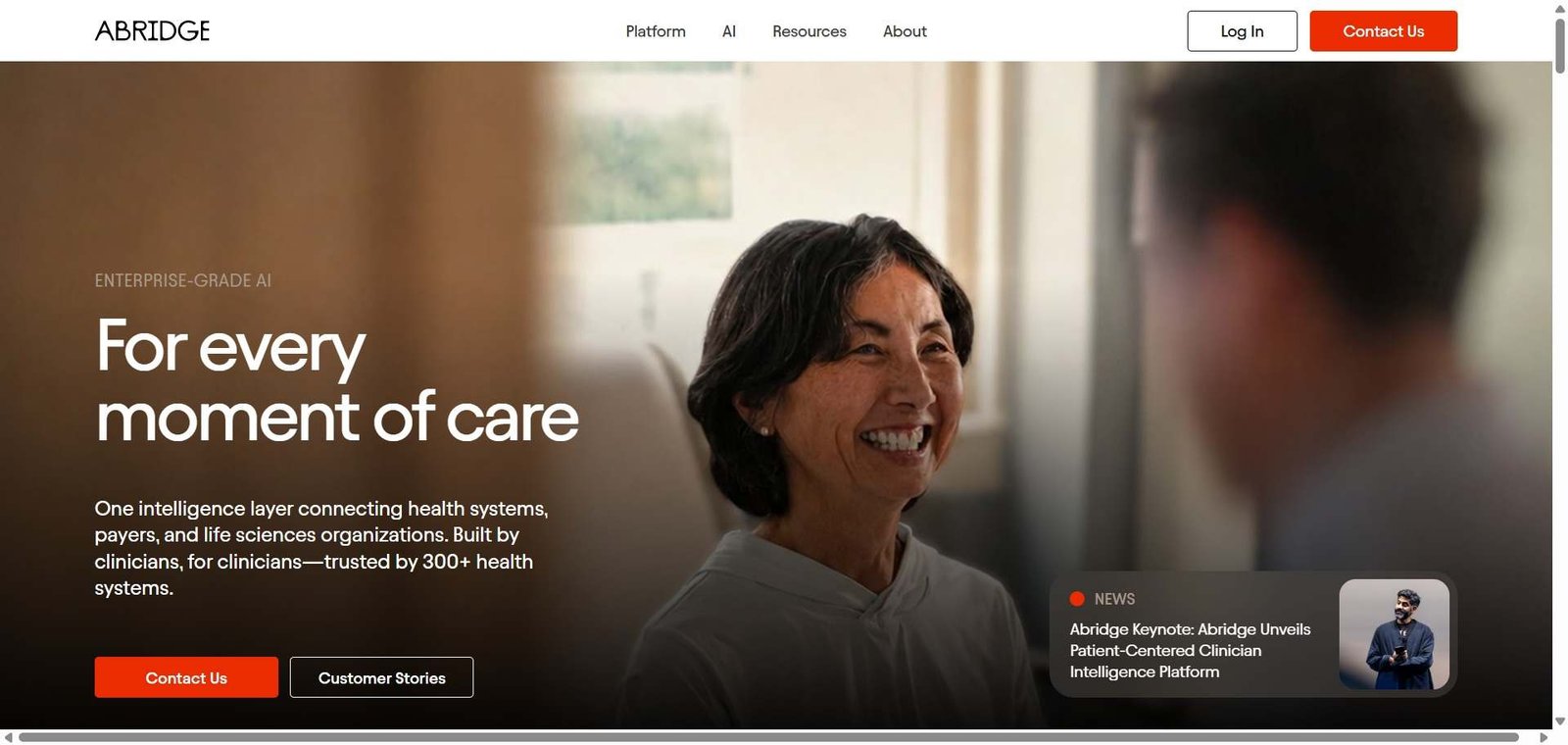
Every ambient AI medical scribe solves the same problem — reducing the time physicians spend on documentation after patient visits. Abridge solves it more completely than most by generating structured clinical notes in real time during the conversation rather than only after it ends, and by living natively inside Epic’s interface rather than requiring physicians to work in a separate application. For health systems already running Epic, Abridge is not a parallel tool — it is an embedded capability that surfaces directly in the workflow physicians already use every day.
Abridge is the most decorated ambient AI scribe on the market — Best in KLAS for Ambient AI in both 2025 and 2026, deployed at Mayo Clinic, Duke Health, Johns Hopkins, Kaiser Permanente, and 250 plus other health systems. Abridge raised a $300M Series E led by Andreessen Horowitz in June 2025 at a $5.3B valuation, and an additional $316M Series E extension in April 2026.
Is it worth using? Yes for large enterprise health systems running Epic who want the most validated, deeply integrated ambient AI scribe on the market.
Who should use it? Large Epic health systems that want documentation and coding intelligence at scale — Abridge is the benchmark.
Who should avoid it? Solo and small independent practices — Abridge is effectively unavailable with no self-serve trial and enterprise-only pricing.
Best for
Not for
Rating
⭐⭐⭐⭐½ 4.7 / 5
Abridge focuses primarily on ambient documentation and revenue cycle intelligence with deep Epic integration. The company has expanded into nursing documentation and real-time prior authorisation, but remains an enterprise product sold through health system contracts.
Abridge’s enterprise-grade technology transforms patient-clinician conversations into structured clinical notes in real-time with deep EMR integrations. Powered by Linked Evidence and auditable AI, Abridge is the only company that maps AI-generated summaries to ground truth, helping providers quickly trust and verify the output.
With support for 28 plus languages and 50 plus specialties, Abridge supports a wide range of clinician and patient encounters.
| Pros | Cons |
|---|---|
| Best in KLAS Ambient AI 2025 and 2026 — strongest independent validation in the category | Effectively unavailable to solo and small independent practices |
| Deepest native Epic integration in the market — works end-to-end inside Epic | No self-serve trial — enterprise procurement required with multi-month timeline |
| Linked Evidence auditable AI builds faster physician trust than black-box note generation | No public pricing — negotiated enterprise contracts only |
| 28 plus languages and 50 plus specialties cover diverse health system populations | Much less practical for Canadian clinics or international practices outside US enterprise context |
| Expanded into nursing documentation and real-time prior authorisation in 2026 | Priced at approximately $2,500 per clinician per year — significant budget commitment |
Abridge does not publish pricing. Buyers report negotiated enterprise pricing around $2,500 per clinician per year or $200 to $800 per provider per month — with no public pricing and no self-serve trial.
Contact Abridge at abridge.com through your health system’s procurement process for a custom quote.
Abridge is an enterprise-grade ambient AI scribe built primarily for large hospital systems with deep Epic deployment — offering real-time documentation, multi-specialty coverage, and Epic integration across Haiku, Canto, and Hyperdrive, backed by 2026 KLAS Market Leader recognition in Ambient AI.
Abridge does not publish pricing. Reported enterprise pricing is around $2,500 per clinician per year or $200 to $800 per provider per month, negotiated through health system contracts with no self-serve option
Linked Evidence is Abridge’s auditable AI feature that maps every AI-generated note element to the specific ground-truth conversation moment that supports it — helping providers quickly trust and verify output rather than reading a black-box summary.
No — there is no self-serve trial, no public pricing, and no individual-clinician path. Abridge is sold exclusively through health system enterprise contracts. Individual physicians should evaluate Nabla, Suki, or Freed AI instead.
Abridge’s deepest integration is native Epic — working end-to-end inside Epic. It also integrates with athenahealth, Cerner, and others, but the Epic native experience is its primary differentiator.
Abridge is priced at approximately $2,500 per clinician per year while Nabla is positioned at $119 per month — reflecting their different market targets. Abridge is the enterprise health system standard with the deepest Epic integration and most robust research validation. Nabla is more accessible for individual physicians and smaller clinics with self-serve onboarding.
Abridge is the Best in KLAS ambient AI scribe for both 2025 and 2026 — deployed at Mayo Clinic, Duke Health, Johns Hopkins, Kaiser Permanente, and 250 plus other health systems with research validation that no competitor can currently match. For large U.S. health systems that want research-backed ambient documentation, Epic depth, and an enterprise rollout, Abridge delivers validated ambient documentation at a scale and reliability that the category’s newer entrants cannot replicate. For individual clinicians and small practices, Nabla provides a more accessible entry point into AI ambient scribing.
Next steps