214 million plus academic papers, AI-generated summaries, and citation mapping — completely free, no subscription required.
Academic research has a discovery problem. Google Scholar returns results ranked primarily by citation count — meaning older, highly cited papers dominate while newer research, niche topics, and interdisciplinary work gets buried. Library databases require institutional subscriptions that individual researchers, independent consultants, and students at under-resourced institutions cannot access. Semantic Scholar solves both problems simultaneously — an AI-powered search engine that understands the semantic meaning of research queries rather than just matching keywords, indexes 214 million plus papers, surfaces AI-generated summaries that let researchers evaluate relevance in seconds, and provides everything entirely free without registration requirements.
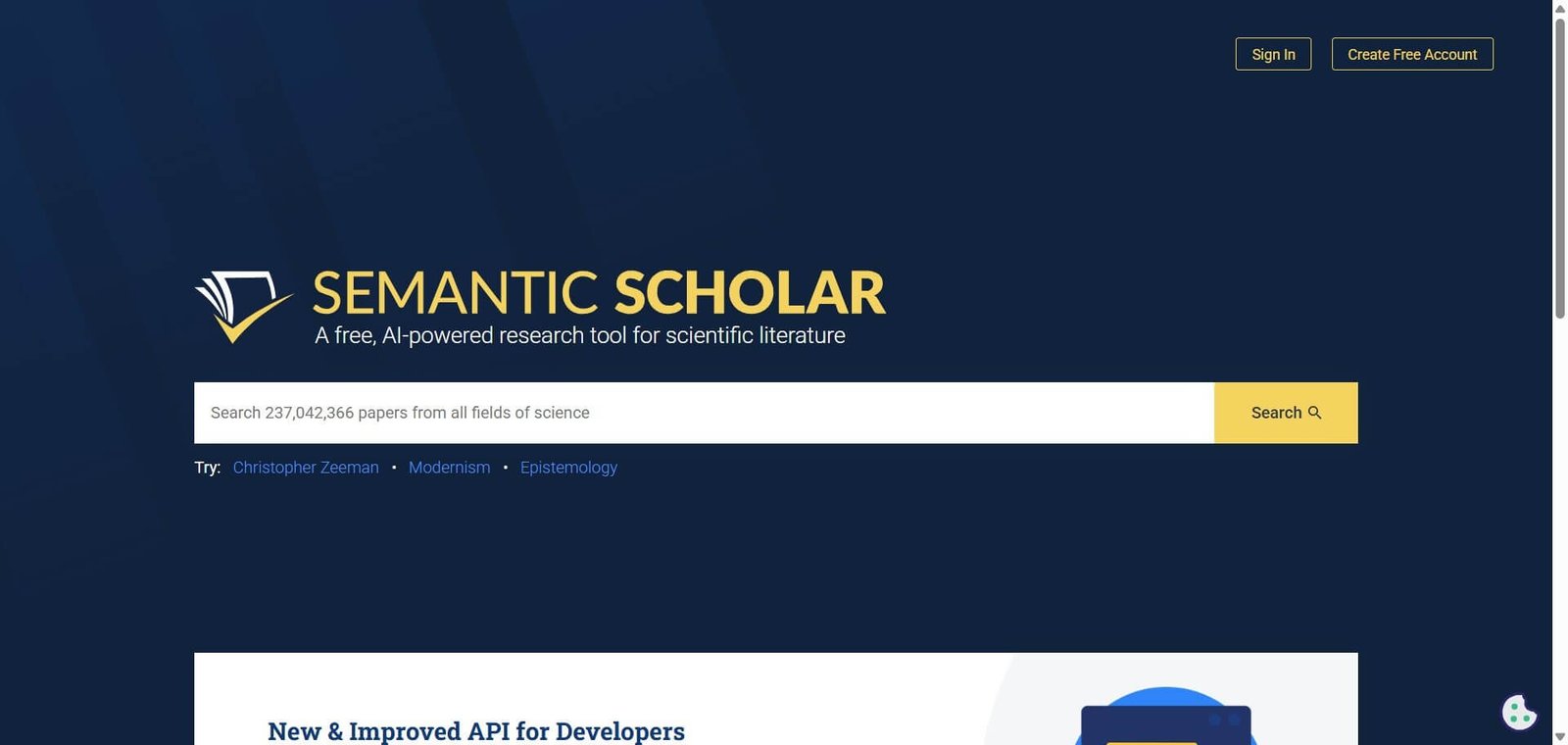
Semantic Scholar is a free AI-powered academic search engine from the Allen Institute for AI indexing 214 million plus scholarly papers — featuring AI TLDR summaries, Highly Influential Citations classification, Semantic Reader augmented PDF viewer, personalised Research Feeds, citation graph visualisation, and a free API — with strongest coverage in computer science, AI, and biomedicine.
Is it worth using? Yes for researchers, students, clinicians, consultants, and business professionals who need to search academic literature systematically without institutional database subscriptions.
Who should use it? Academic researchers, graduate students, medical professionals, evidence-based consultants, and anyone who needs to find and evaluate scholarly papers efficiently — particularly those without institutional access to Scopus, Web of Science, or Elsevier databases.
Who should avoid it? Teams needing comprehensive social science, humanities, or law coverage where Semantic Scholar’s indexing is less complete than JSTOR or LexisNexis.
Best for
Not for
Rating
⭐⭐⭐⭐½ 4.6 / 5
Semantic Scholar is a research tool for scientific literature developed at the Allen Institute for AI and publicly released in 2015. Its AI uses natural language processing to understand the meaning and context of research queries rather than matching keywords — retrieving papers that discuss relevant topics even when the exact query terms do not appear in the title or abstract.
The platform’s AI-generated TLDR summaries are its most time-saving feature for practical research — a one-sentence summary of each paper’s contribution that lets researchers assess relevance without reading the full abstract, compressing the time required to scope a literature review dramatically. Its citation graph visualisation identifies the most influential papers in any research area and maps how ideas have propagated through the literature over time.
| Pros | Cons |
|---|---|
| Completely free — all features including API access available at no cost with no registration required | Coverage weaker in social sciences, humanities, and law compared to specialised databases |
| TLDR summaries dramatically reduce literature review time for large result sets | Does not support Boolean search operators — researchers needing structured query syntax must use alternatives |
| 214 million plus papers indexed — one of the largest freely accessible academic literature databases | English-language papers best covered — non-English literature indexing less comprehensive |
| Semantic search surfaces relevant interdisciplinary work that keyword search misses | Mobile browser access only — no dedicated mobile app |
| Highly Influential Citations classification helps identify foundational papers without manual citation analysis | Real-time alerting on specific journals less granular than specialised academic database subscriptions |
Semantic Scholar is entirely free — there are no paid plans.
Semantic Scholar is a free AI-powered academic search engine from the Allen Institute for AI indexing 214 million plus scholarly papers — with AI TLDR summaries, Highly Influential Citations classification, Semantic Reader, Research Feeds, and a free API.
Yes — Semantic Scholar is entirely free with no registration required for search and no paid plans. All features including Research Feeds, Semantic Reader, citation graph, and API access are available at no cost.
Semantic Scholar uses semantic AI search that understands meaning and context — surfacing relevant papers that keyword matching misses, particularly for interdisciplinary topics. AI TLDR summaries, Highly Influential Citations classification, and the Semantic Reader augmented PDF viewer add features that Google Scholar does not provide. Google Scholar has broader coverage including grey literature and patents.
TLDR is an AI-generated one-sentence summary of each paper’s main contribution — allowing researchers to evaluate relevance in seconds without reading the full abstract. The feature dramatically accelerates the scoping phase of large literature reviews.
Yes — Semantic Scholar provides a free REST API with search endpoints, recommendations, paper metadata, citation networks, and SPECTER2 document embeddings. The free API has rate limits; a private key increases throughput.
Semantic Scholar has strongest coverage in computer science, artificial intelligence, and biomedicine — the fields where its index is most comprehensive. Social sciences, humanities, and law are less complete, and researchers in those fields typically need JSTOR or specialised databases as primary sources.
Semantic Scholar is the best free AI academic search tool available for researchers and knowledge workers who need systematic access to scholarly literature without institutional database subscriptions. The TLDR summaries, semantic relevance ranking, Highly Influential Citations classification, and Semantic Reader create an academic research experience that meaningfully improves on keyword-based search for anyone working with scientific literature. The fact that every feature — including the API — is completely free makes it the default starting point for any evidence-based research workflow, regardless of whether institutional alternatives are available.
Next steps