
Suki AI
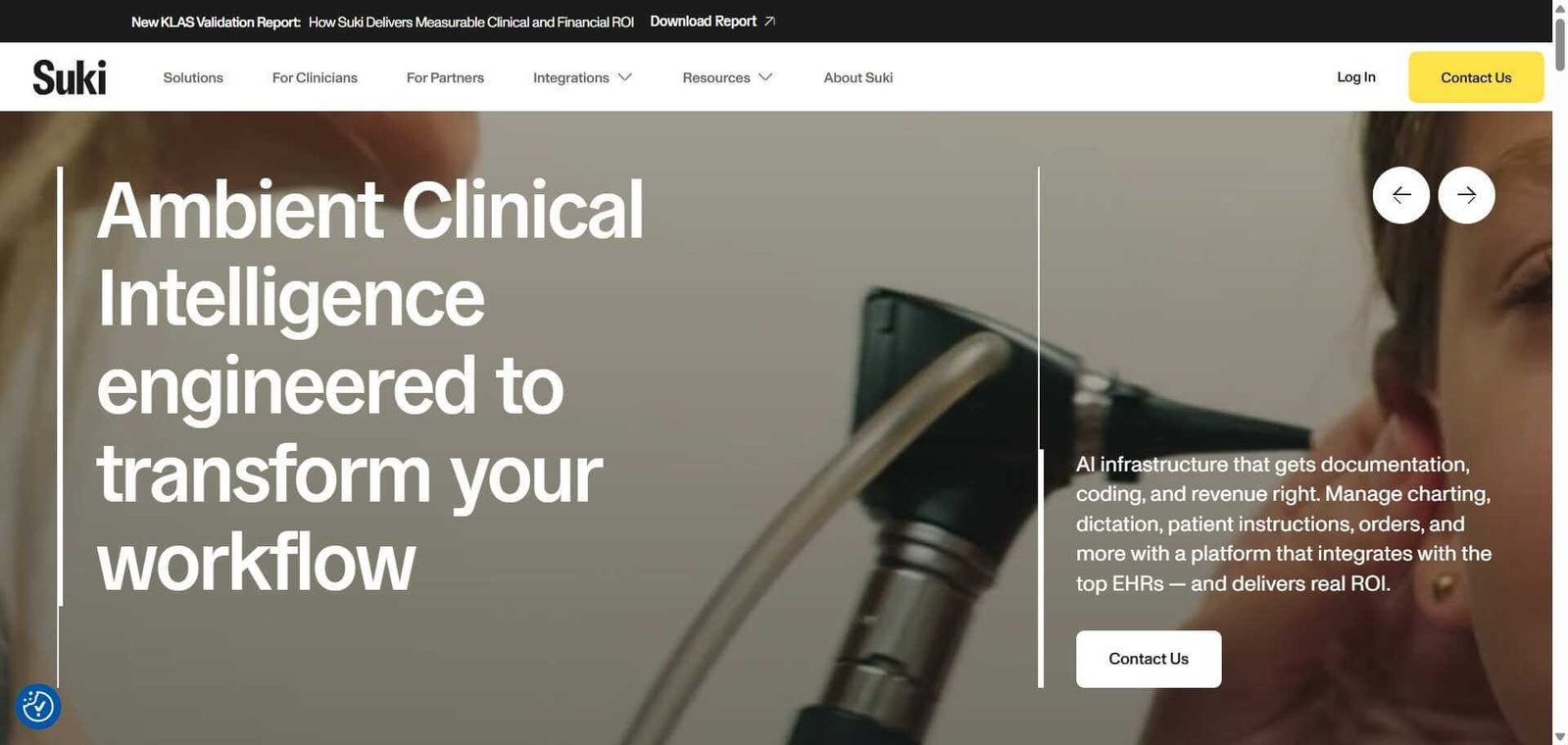
Voice-first AI clinical assistant — ambient scribing, ICD-10 coding, order staging, and chart Q&A across 100 plus specialties.
Suki AI Review: The AI Clinical Assistant That Goes Beyond Scribing to Full Voice Control of the EHR
Most ambient AI medical scribes do one thing — listen to patient conversations and generate clinical notes. Suki AI does this and then keeps going. Its voice assistant layer allows clinicians to speak commands directly to Suki while charting — ordering medications, adding diagnoses, querying patient records, staging prescriptions, and navigating the EHR — all by voice, without touching a keyboard or clicking through menus. This dual-mode operation, ambient scribing combined with voice command control, makes Suki the most feature-rich clinical AI platform in the category across its 100 plus supported medical specialties.
Quick Summary
Suki AI is a voice-first ambient clinical documentation platform and EHR voice assistant — combining ambient AI scribing that converts patient conversations into structured clinical notes with voice commands for charting, ICD-10 and E/M coding, order staging, pre-visit summaries, and chart Q&A — working bidirectionally with Epic, Oracle Health, athenahealth, and MEDITECH across 100 plus medical specialties, with raised $168 million in funding and serving 400 plus healthcare organisations.
Is it worth using? Yes for physician groups, specialty practices, and health systems who want the most feature-rich AI clinical assistant in the category — combining ambient documentation with full voice EHR control across the broadest specialty coverage available.
Who should use it? Physicians, specialist practices, and health systems in primary care, cardiology, orthopedics, dermatology, psychiatry, and 95 plus other specialties who want to eliminate both documentation burden and keyboard-based EHR interaction.
Who should avoid it? Individual clinicians and small practices whose budget makes $299 to $399/month per provider prohibitive — Freed AI provides accessible ambient scribing from $39/month as a more accessible alternative.
Verdict: Detailed Summary
Best for
- Multi-specialty physician groups and health systems who want one platform covering ambient scribing and voice EHR control across all their specialties rather than deploying specialty-specific tools
- Clinicians who spend significant time on both documentation and EHR navigation — Suki eliminates both through one voice interface rather than only reducing note creation time
- Practices in cardiology, orthopedics, dermatology, and other specialties where specialty-aware documentation models significantly improve note accuracy compared to generic ambient scribes
Not for
- Individual clinicians and small practices where $299 to $399/month per provider is disproportionate to budget — Freed AI from $39/month or Nabla from $119/month are more accessible alternatives
- Health systems whose primary EHR is not Epic, Oracle Health, athenahealth, or MEDITECH — Suki’s bidirectional integration depth depends on these four systems
- Practices that primarily need enterprise governance, organisation-wide audit trails, and health system deployment infrastructure — Abridge is more appropriate for large enterprise health system rollouts
Rating
⭐⭐⭐⭐ 4.4 / 5
What Is Suki AI?
Suki AI is an AI voice assistant for clinicians founded in 2017 by Punit Soni — a former Google and Flipkart executive who built Suki with the specific insight that documentation burden is only part of the EHR problem. The other part is the keyboard and mouse navigation burden — the constant clicking through screens, typing orders, and searching for patient information that fragments the clinical workflow throughout every encounter. Suki addresses both by combining ambient scribing with a voice command interface that understands clinical natural language for the full range of EHR interaction tasks.
The company has raised $168 million from investors including Venrock, First Round Capital, and Flare Capital — and in 2024 launched the Suki Platform that enables other healthcare software vendors to embed Suki’s voice and ambient capabilities inside their own products, extending the platform’s reach beyond direct deployment.
How Suki Works
- Open Suki before the patient encounter. Launch the Suki app on iOS or Android. Suki begins ambient listening mode — processing the conversation between clinician and patient without requiring the clinician to interact with the app during the visit.
- Speak directly to Suki during the encounter. At any point during the visit, the clinician can speak commands directly to Suki — “Suki, add to assessment: hypertension, well controlled” or “Suki, order metformin 500mg twice daily” — and Suki executes the command in the connected EHR.
- Note generated from ambient conversation. At the end of the encounter, Suki presents a structured clinical note generated from the ambient conversation — in SOAP, H&P, progress note, or custom template format — for review and sign-off.
- Review and sign off quickly. The note review typically takes under two minutes — Suki’s specialty-aware models produce notes that require minimal editing, particularly for established specialties.
- ICD-10 and E/M coding suggested automatically. Suki suggests ICD-10, HCC, and E/M codes based on the documented encounter — tying documentation to revenue capture without separate coding workflow.
- Query patient records by voice. During or between encounters, clinicians can query patient records verbally — “Suki, what medications is this patient on?” or “Suki, when was the last HbA1c?” — without navigating through the EHR manually.
Key Features
- Dual-mode operation — ambient listening during patient conversations combined with active voice commands for EHR interaction
- Structured note generation in SOAP, H&P, progress note, and custom template formats
- Specialty-aware documentation models across 100 plus medical specialties
- Bidirectional real-time EHR integration with Epic, Oracle Health, athenahealth, and MEDITECH
- Voice commands for charting, diagnosis entry, medication ordering, and order staging
- ICD-10, HCC, CPT, and E/M coding suggestions from documented encounters
- Pre-visit summary generation for prepared encounter starts
- Chart Q&A by voice — query patient records without keyboard navigation
- Telehealth and in-person visit support through iOS and Android apps
- HIPAA compliant, SOC 2 Type II certified
- Supports ambulatory, telehealth, inpatient, skilled nursing, and emergency department settings
- 80 plus languages for multilingual patient encounters
Real-World Use Cases
- Cardiology clinic efficiency: A cardiologist uses Suki across 25 daily patient encounters — ambient listening captures the clinical conversation and generates cardiology-specific notes, while voice commands stage medication orders and add diagnoses during the encounter rather than after. Post-clinic documentation drops from 90 minutes to 10 minutes.
- Multi-specialty group deployment: A 50-physician multi-specialty group deploys Suki across primary care, dermatology, rheumatology, and gastroenterology — one platform serving all specialties with specialty-aware documentation models rather than separate tools for each department.
- Voice EHR navigation: An orthopedic surgeon uses Suki’s voice command layer to query patient imaging results, check medication lists, and add post-operative orders between procedures — eliminating the keyboard interaction that previously required scrubbing out between cases.
- Pre-visit preparation: A primary care physician uses Suki’s pre-visit summary for each scheduled patient — the AI generates a brief covering recent visits, outstanding labs, and active care plan items before the encounter, allowing the physician to walk in prepared without reviewing the full chart.
Pros and Cons
| Pros | Cons |
|---|---|
| Dual-mode ambient scribing plus voice EHR commands is genuinely differentiated — no other ambient scribe eliminates both documentation and keyboard navigation burden simultaneously | $299 to $399/month per provider is 7 to 10 times more expensive than accessible alternatives like Freed AI |
| 100 plus specialty coverage is the broadest in the ambient AI scribe category | No self-serve free tier — enterprise sales process required for evaluation |
| Bidirectional EHR integration with Epic, Oracle Health, athenahealth, and MEDITECH covers the major systems | Implementation complexity higher than simpler ambient scribes — requires EHR integration setup |
| ICD-10 and E/M coding suggestions tie documentation directly to revenue capture | Individual clinicians and small practices will find Freed AI or Nabla more practically accessible |
| Raised $168 million — financial stability for enterprise healthcare commitments | Suki Platform API pricing for embedded deployments adds complexity for vendor integrations |
Pricing & Plans
- Suki Compose — approximately $299/month per user (note generation and documentation focus)
- Suki Assistant — approximately $399/month per user (full ambient experience with voice commands, coding, and EHR integration)
- Enterprise volume pricing — negotiated discounts for multi-provider health system deployments
- No free tier available — structured pilots and proofs of concept available through Suki sales
Pricing figures drawn from 2026 third-party reseller and trade listings — contact suki.ai for current pricing and enterprise quotes.
Best Alternatives & Comparisons
- Freed AI — Better for individual clinicians and small practices at $39 to $119/month with self-serve setup
- Nabla — Better for clinics and mid-size practices at approximately $119/month with Epic and Cerner EHR integration
- Abridge — Better for large enterprise health system deployment with the deepest Epic integration and Best in KLAS recognition
- Nuance DAX Copilot — Better for Microsoft and Epic-integrated enterprise deployment at health system scale
Frequently Asked Questions (FAQ)
Suki AI is a voice-first AI clinical assistant combining ambient scribing with voice commands for charting, ICD-10 coding, order staging, and chart Q&A — working bidirectionally with Epic, Oracle Health, athenahealth, and MEDITECH across 100 plus medical specialties.
Suki Compose (note generation) is approximately $299/month per user. Suki Assistant (full ambient and voice command experience) is approximately $399/month per user. Enterprise volume discounts are available. No free tier is offered.
Suki’s dual-mode operation — ambient listening during patient conversations combined with active voice commands for EHR interaction — is its primary differentiator. While most ambient scribes only generate notes from conversations, Suki also allows clinicians to order medications, add diagnoses, query patient records, and navigate the EHR by voice during and between encounters.
Suki provides bidirectional real-time integration with Epic, Oracle Health (Cerner), athenahealth, and MEDITECH — covering the major EHR systems across US healthcare. Suki is part of Epic’s Toolbox program.
Suki supports 100 plus medical specialties including primary care, cardiology, orthopedics, dermatology, rheumatology, psychiatry, gastroenterology, emergency medicine, oncology, pediatrics, OB/GYN, and many others — with specialty-aware documentation models for each.
Suki’s pricing at $299 to $399/month per provider is designed for physician groups and health systems rather than individual clinicians. Solo practitioners typically find better value in Freed AI ($39 to $119/month) or Nabla ($119/month) — both of which provide capable ambient scribing at significantly lower cost with self-serve setup.
Final Recommendation
Suki AI is the most feature-rich AI clinical assistant available for physician groups and health systems who want to eliminate both documentation burden and EHR keyboard navigation simultaneously. The combination of ambient scribing, voice command EHR control, ICD-10 coding suggestions, and 100 plus specialty coverage in one platform delivers a clinical workflow improvement that goes significantly further than note generation alone. For any medical group or health system whose physicians are spending meaningful time on both documentation and EHR navigation, Suki provides the most comprehensive AI solution to both problems from one platform.
Next steps