500 million learners study smarter with Quizlet — AI flashcards from your notes, Q-Chat tutor, and spaced repetition that actually works.
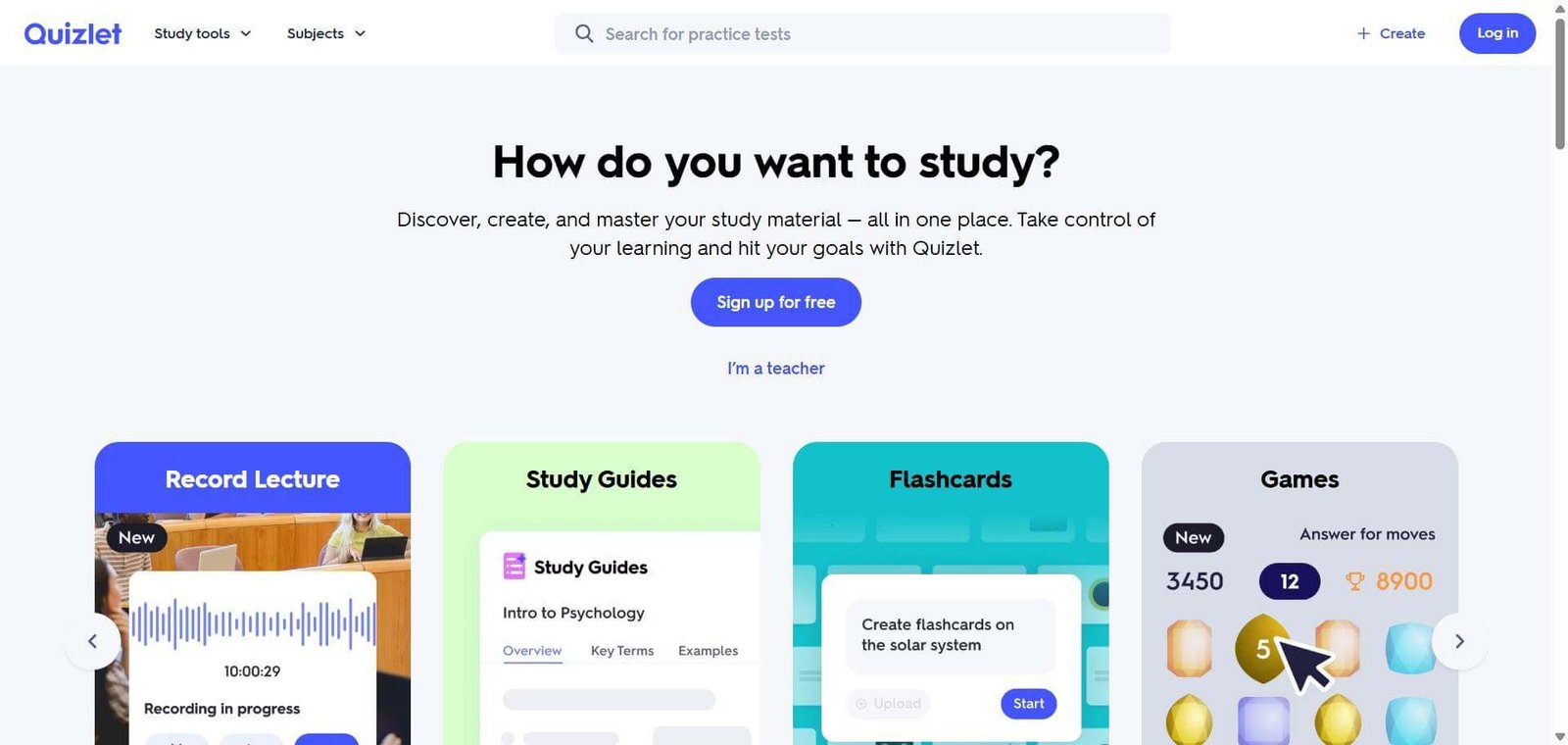
Quizlet began as a digital flashcard app built by a 15-year-old studying French vocabulary in 2005. In 2026, it is the world’s most widely used study platform — with over 500 million learners, 700 million plus community-created study sets, and an AI layer that has transformed it from a flashcard repository into a personalised study coach. Q-Chat, Quizlet’s AI tutor, uses the Socratic method — asking guiding questions rather than providing direct answers — to push learners toward genuine understanding rather than passive memorisation. Magic Notes converts uploaded class notes and PDFs into flashcard sets, practice tests, and summaries automatically. Together these features make Quizlet the most accessible AI study platform available at any price point.
Quizlet is an AI-powered study platform used by 500 million plus learners — offering 700 million plus community-created study sets, Q-Chat AI tutor using the Socratic method, Magic Notes for automatic flashcard generation from uploaded documents, personalised spaced repetition, multiple study modes, and a free tier that provides meaningful access without payment.
Is it worth using? Yes for students at every level who need to memorise information across any subject — Quizlet’s combination of community study sets, AI flashcard generation, and spaced repetition delivers measurable retention improvement at a price point that makes it accessible to every learner.
Who should use it? High school and university students studying for exams, medical and law students memorising large knowledge bases, professional certification candidates, and any learner who needs to retain a large volume of information efficiently.
Who should avoid it? Learners who need multi-step mathematical problem solving, worked derivations, or STEM problem-solving practice — Quizlet is built around term-definition pairs and does not support complex procedural learning.
Best for
Not for
Rating
⭐⭐⭐⭐ 4.3 / 5
Quizlet is a digital learning platform that transformed from a flashcard website into a full AI-powered study suite — with a community library of 700 million plus study sets, AI tools for generating and studying content, and a spaced repetition algorithm that adapts to each learner’s retention patterns. In February 2026, Quizlet acquired Coconote, an AI note-taking app, deepening its AI study tool capabilities.
Its free tier provides meaningful access — creating and studying flashcard sets is free — but AI features including Q-Chat and Magic Notes require Quizlet Plus at approximately $35.99/year. For the 60 million learners who use Quizlet monthly, this pricing makes the AI study tools accessible at a cost that most students can justify.
| Pros | Cons |
|---|---|
| 700 million plus community study sets — the largest shared knowledge library for student learners in existence | AI features (Q-Chat and Magic Notes) require Quizlet Plus — free tier increasingly limited as features move behind paywall |
| Magic Notes generates flashcard sets from uploaded content automatically — eliminating the most time-consuming part of flashcard studying | Not suitable for multi-step mathematical or procedural STEM learning — term-definition structure is the foundational model |
| Q-Chat’s Socratic method produces deeper understanding than passive flashcard review | Community-created content quality varies — sets from classmates may contain errors or incomplete coverage |
| Spaced repetition algorithm concentrates study time where it improves retention most efficiently | Advanced learners who need speaking fluency or essay writing development need supplemental tools |
| $35.99/year pricing makes AI study features accessible to most students | Paywall creep has moved features that were previously free — including full Learn and Test mode access — behind paid subscriptions |
Quizlet is an AI-powered study platform used by 500 million plus learners — featuring Q-Chat AI tutor, Magic Notes for automatic flashcard generation from uploaded documents, personalised spaced repetition, and 700 million plus community study sets.
Yes — Quizlet’s core flashcard creation and study features are free. AI features including Q-Chat and Magic Notes require Quizlet Plus at $35.99/year ($7.99/month).
Q-Chat is Quizlet’s AI tutor — a conversational study assistant that uses the Socratic method, asking guiding questions about study material rather than providing direct answers, to encourage active recall and deeper understanding rather than passive memorisation.
Magic Notes is Quizlet’s AI feature that automatically generates flashcard sets from uploaded class notes, lecture slides, or PDFs — extracting key terms and definitions to create a ready-to-study set without manual entry.
Quizlet’s 700 million plus community study sets cover virtually every subject — languages, history, science, medicine, law, mathematics, and professional certifications. The community library is particularly strong for university-level courses across all major disciplines.
Quizlet is more accessible with a community library, AI features, and a polished interface. Anki is more powerful for advanced spaced repetition with full algorithm customisation and is free on desktop. Medical students who need deep spaced repetition often prefer Anki for its algorithm control. Students who want community content, AI tools, and ease of use typically prefer Quizlet.
Quizlet is the most accessible and widely validated AI study platform available — and the combination of Magic Notes, Q-Chat, and 700 million plus community study sets creates a study tool that serves learners from high school through professional certification at a price point that removes the access barrier for most students. For any student spending hours manually creating flashcard sets or rereading notes passively before exams, Quizlet’s Magic Notes and spaced repetition deliver immediate, measurable improvement in study efficiency. At $35.99/year for Plus, the AI features represent one of the highest-value academic investments available.
Next steps