
Tempus AI
The world’s largest clinical and molecular data library, an AI that turns it into oncology decisions — used by oncologists, researchers, and pharma globally.
Tempus AI Review: The AI Precision Medicine Platform That Is Making Personalised Cancer Care a Clinical Reality
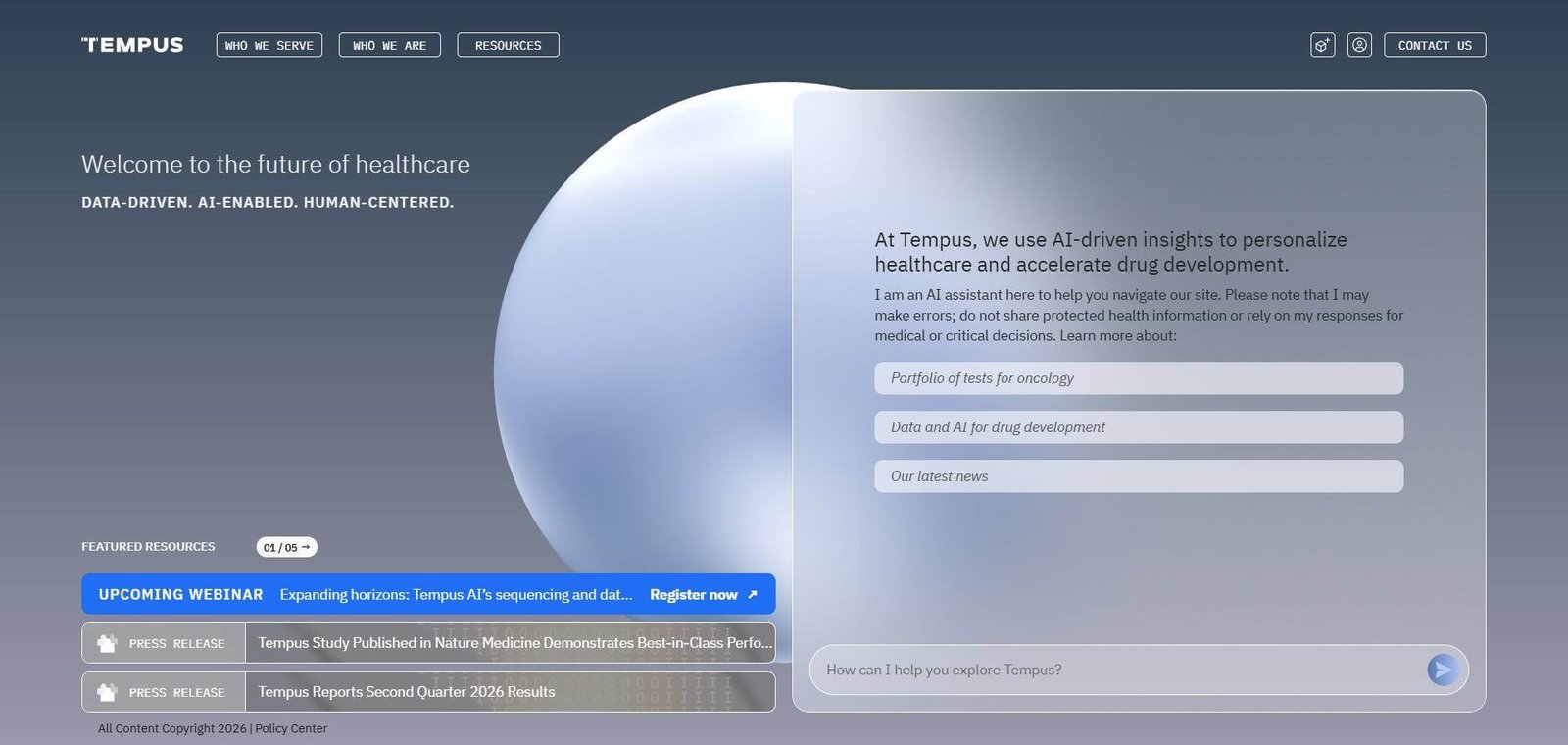
The premise behind precision medicine is straightforward — cancer treatment should be based on the specific molecular characteristics of each patient’s tumour, not on broad population averages. The execution has always been the hard part: the molecular data generated by genomic sequencing is complex, the clinical context that makes it actionable is scattered across EHRs, and the evidence base linking specific mutations to specific treatments requires synthesising thousands of studies. Tempus AI has spent a decade building the infrastructure to solve this — accumulating what it describes as the world’s largest library of clinical and molecular data, and building AI that turns that data into real-time clinical intelligence for oncologists at the point of care.
Quick Summary
Tempus AI is a publicly traded precision medicine company (NASDAQ: TEM) with an $8 billion plus market cap — combining genomic sequencing services, the world’s largest clinical and molecular data corpus, and AI-powered clinical decision support across oncology, cardiology, depression, and diabetes. Its platforms include Next for real-time clinical intelligence, Lens for drug development research, Pixel for radiology AI, and Hub for physician access to sequencing reports and trial matching.
Is it worth using? Yes for oncologists, cancer centres, and pharmaceutical companies who want AI to make genomic insights actionable at the point of care — Tempus’s combination of sequencing depth, data breadth, and clinical AI integration is unmatched in the category.
Who should use it? Oncologists, hematologists, clinical researchers, cancer centres, and pharmaceutical companies using real-world evidence for drug development and clinical trial recruitment.
Who should avoid it? General practitioners and non-oncology specialists whose clinical needs fall outside Tempus’s primary oncology and precision medicine focus — general EHR AI tools are more appropriate for non-specialty care.
Verdict: Detailed Summary
Best for
- Oncologists at cancer centres who want AI to surface treatment options, flag missed biomarker testing, and match patients to relevant clinical trials in real time at the point of care — Tempus Next delivers this through EHR integration without requiring the physician to leave their existing workflow
- Pharmaceutical companies who want the richest real-world evidence dataset in oncology for drug development, biomarker discovery, and clinical trial design — Tempus’s 45 million plus de-identified patient journeys represent a data advantage that no competitor can replicate
- Researchers and cancer centres participating in the PRECISION Challenge who want to build on Tempus’s multimodal foundation models — the largest molecularly-grounded biological dataset available to the research community
Not for
- General practitioners and non-oncology specialists whose clinical work falls outside Tempus’s precision medicine focus
- Small clinics and individual practitioners without the infrastructure to integrate genomic sequencing into their standard of care workflow
- Organisations looking for general AI healthcare documentation tools — Suki AI, Freed AI, and Nabla serve that need
Rating
⭐⭐⭐⭐½ 4.6 / 5
What Is Tempus AI?
Tempus AI is a Chicago-based technology company founded by Eric Lefkofsky in 2015 with the thesis that the primary bottleneck in cancer care is not scientific knowledge but the failure to integrate molecular, imaging, and clinical data at scale. The company built the infrastructure to bridge this gap — genomic sequencing services that generate molecular data, EHR integrations that connect clinical context, and AI that synthesises both into actionable decisions.
Listed on NASDAQ as TEM with an $8 billion plus market cap, Tempus has accumulated more than 500 petabytes of rich, molecularly grounded data — over 45 million total de-identified patient journeys, 1.5 million with sequenced data, and over 400,000 records in cancer with full genomic, transcriptomic, imaging, and clinical data. In July 2026, Tempus announced the acquisition of Personalis for $1.5 billion — adding tumor-informed minimal residual disease detection to the platform.
How Tempus AI Works
- Genomic sequencing through Tempus testing. Oncologists order Tempus genomic tests — xT for solid tumors, xF for liquid biopsy, xE for RNA expression, and others — from their standard clinical workflow. Tempus sequences the sample and generates a comprehensive molecular report.
- Next delivers real-time clinical intelligence. Tempus Next is an AI-enabled clinical decision support system integrated directly into the physician’s EHR — surfacing biomarker testing gaps, treatment option alerts, and clinical trial matches in real time as the physician reviews the patient chart.
- Hub provides physician access. Physicians access Tempus sequencing reports, treatment insights, and trial matching through the Hub platform — a smart physician interface that aggregates molecular and clinical data without requiring multiple system logins.
- Pixel analyses radiology images. Tempus Pixel is an FDA-cleared AI radiology platform that analyses CT, MRI, and pathology images — providing quantitative measurements, lesion tracking, and AI-assisted interpretation for radiologists.
- Lens accelerates drug development. Pharmaceutical companies access Tempus’s de-identified patient data through Lens — using the platform for biomarker discovery, real-world evidence generation, and clinical trial design and recruitment.
- Foundation models enable research. Tempus’s multimodal foundation models — built on genomic, transcriptomic, imaging, and clinical data — are accessible to the research community through the PRECISION Challenge, enabling novel insight generation at scale.
Key Features
- Genomic testing portfolio including xT solid tumour sequencing, xF liquid biopsy, xE RNA expression, and pharmacogenomics through OneOme
- Tempus Next real-time clinical intelligence — AI-enabled decision support for biomarker testing, treatment options, and trial matching integrated into physician EHR workflows
- Tempus Hub physician platform for accessing sequencing reports, molecular insights, and trial matching
- Tempus Pixel FDA-cleared AI radiology platform for CT, MRI, and pathology image analysis
- Tempus Lens agentic AI platform for pharmaceutical drug development and real-world evidence research
- World’s largest clinical and molecular data library — 45 million plus de-identified patient journeys, 500 plus petabytes of data
- Multimodal foundation models for novel biological insight generation
- PRECISION Challenge providing the research community access to foundation model work
- Acquisition of Personalis (July 2026) adding tumor-informed MRD detection
- NASDAQ listed (TEM) with $8 billion plus market cap
- Collaborations with Merck, Angiosarcoma Awareness, and other pharma and research partners
Real-World Use Cases
- Biomarker testing improvement: A multi-centre prospective study of 662 early-stage non-small cell lung cancer patients deployed Tempus Next — the AI-enabled clinical decision support system significantly improved rates of ALK, EGFR, and PD-L1 biomarker testing, connecting patients to targeted therapies they would otherwise have missed due to testing gaps.
- Real-time trial matching: An oncologist treating a patient with a rare mutation uses Tempus Hub to match the patient to an ongoing clinical trial they were not aware of — the AI surfaces the trial match from the patient’s molecular profile during the standard clinical visit rather than requiring a separate research query.
- Drug development acceleration: A pharmaceutical company uses Tempus Lens to identify biomarker signatures associated with response to their investigational compound — accessing 1.5 million sequenced patient journeys to find real-world evidence patterns that would have required years of prospective data collection to assemble independently.
- Radiology workflow improvement: A cancer centre deploys Tempus Pixel for lung cancer screening — the FDA-cleared AI analyses CT images to detect and characterise pulmonary nodules, improving diagnostic consistency and reducing radiologist workload on high-volume screening programmes.
Pros and Cons
| Pros | Cons |
|---|---|
| World’s largest clinical and molecular data library — 45 million plus patient journeys and 500 plus petabytes of molecularly-grounded data | Oncology and precision medicine focus — not appropriate for general practice or non-specialty clinical workflows |
| Tempus Next real-time clinical intelligence integrates into existing EHR workflows — no new interface for oncologists | Pricing for genomic testing and platform access is not publicly listed — institutional partnerships and ordering through clinical workflows |
| Publicly traded on NASDAQ with $8 billion plus market cap — financial transparency and stability not common in health AI | Requires institutional integration for full clinical intelligence benefit — not accessible for individual practitioners without hospital or cancer centre infrastructure |
| Multimodal foundation models available to the research community through PRECISION Challenge | Data advantage is in oncology — coverage in other therapeutic areas (cardiology, depression, diabetes) is growing but less dominant |
| $1.5 billion Personalis acquisition adds MRD detection — expanding from diagnosis to cancer monitoring | Implementation complexity for health system integration requires IT and clinical informatics involvement |
Pricing & Plans
Tempus AI pricing is institutional and not publicly listed. Genomic testing services are ordered through clinical workflows and billed through standard laboratory billing channels. Platform access for pharmaceutical and research use through Lens is contract-based. Contact Tempus at tempus.com for institutional partnership and platform access discussions.
Best Alternatives & Comparisons
- Foundation Medicine — Direct competitor in comprehensive genomic profiling for oncology with Roche backing
- Guardant Health — Better for liquid biopsy specialisation and early cancer detection blood tests
- Flatiron Health — Better for oncology real-world evidence research with Roche backing, less genomic depth
- PathAI — Better for AI-powered pathology specifically without the full multimodal data platform
Frequently Asked Questions (FAQ)
Tempus AI is a publicly traded precision medicine company (NASDAQ: TEM) combining the world’s largest clinical and molecular data library with AI to deliver genomic testing, real-time clinical intelligence through Tempus Next, radiology AI through Pixel, and drug development acceleration through Lens.
Tempus Next is an AI-enabled clinical decision support system integrated directly into physician EHR workflows — surfacing biomarker testing gaps, treatment option alerts, and clinical trial matches in real time at the point of care without requiring the physician to leave their existing system.
Tempus has accumulated more than 500 petabytes of clinical and molecular data — over 45 million total de-identified patient journeys, 1.5 million with sequenced data, and over 400,000 records in cancer with full genomic, transcriptomic, imaging, and clinical data.
Yes — Tempus Pixel, its AI radiology platform, is FDA cleared. Multiple Tempus genomic tests also have FDA clearance or approval, including the xT CDx Tumor Only companion diagnostic approved in May 2026.
In July 2026, Tempus announced the acquisition of Personalis for $1.5 billion — adding Personalis’s tumor-informed minimal residual disease detection technology, specifically the NeXT Personal MRD test, to the Tempus precision oncology platform.
Both are comprehensive genomic profiling companies for oncology. Tempus’s primary differentiation is its multimodal data integration — combining genomic sequencing with radiology imaging, clinical records, and real-world evidence at a scale Foundation Medicine does not match. Foundation Medicine has Roche’s global distribution backing. Tempus for multimodal AI and real-world evidence breadth. Foundation Medicine for Roche-backed global clinical genomics scale.
Final Recommendation
Tempus AI is the most data-rich and clinically integrated AI precision medicine platform available — and for oncologists, cancer centres, and pharmaceutical companies working at the frontier of precision oncology, the combination of world’s largest molecular data library, real-time EHR-integrated clinical intelligence, and multimodal foundation models creates capabilities that no other platform in the category can match. The mission — making precision medicine a reality for every patient rather than a research abstraction — is being delivered at scale, and the July 2026 Personalis acquisition extending the platform into cancer monitoring signals that Tempus’s ambition continues to expand as its data and AI capabilities compound.
Next steps