Vectra AI
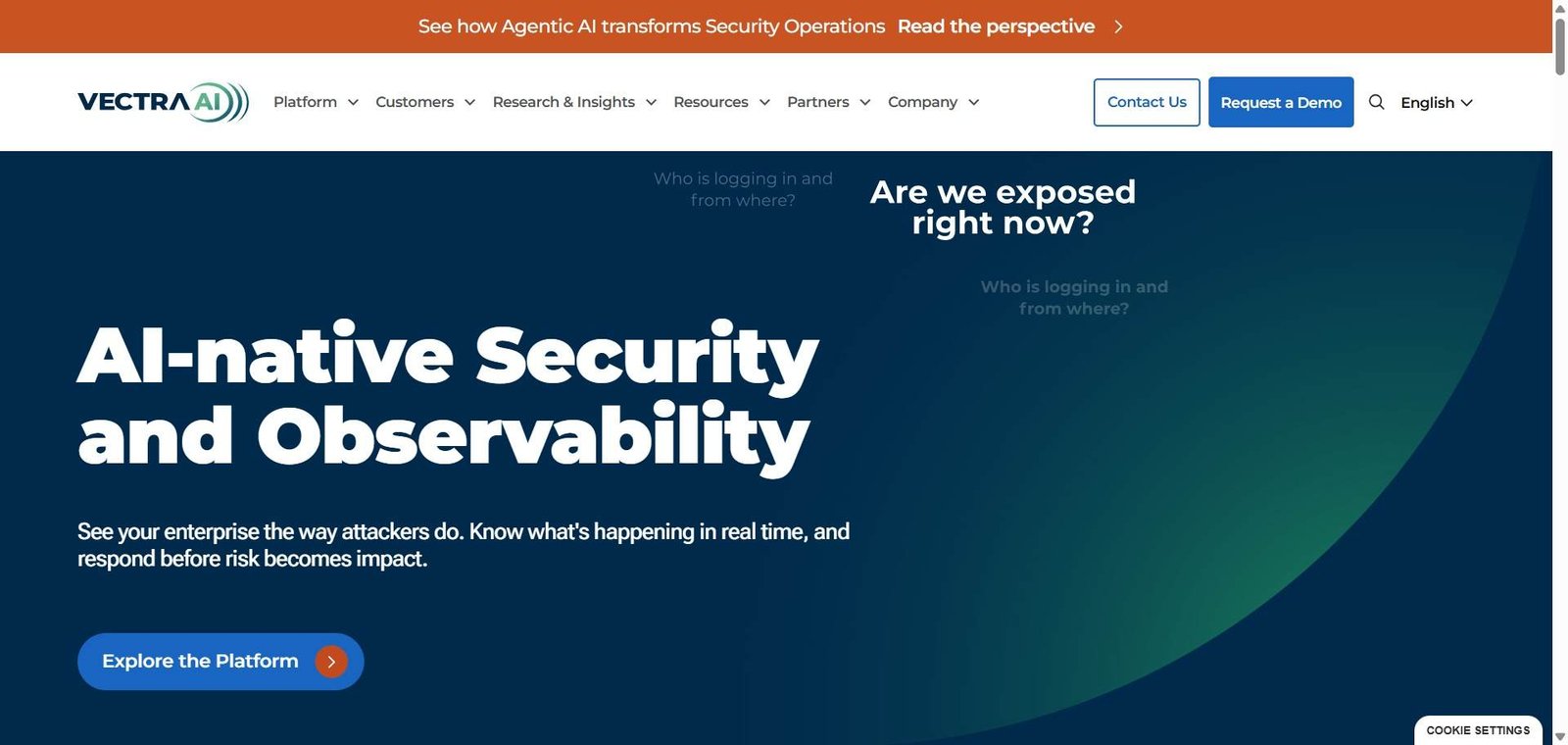
150 AI models that detect attacker behaviour across network, identity, cloud, and AI workloads — 80% less alert noise, named Gartner NDR Leader 2026.
Vectra AI Review: The AI Network Detection Platform That Finds the Attackers Who Got Past Prevention
Endpoint protection, MFA, and firewall rules are prevention tools — they stop known attack patterns at the perimeter. Sophisticated attackers bypass prevention. They phish a credential, log in as a legitimate user, move laterally through the network using valid protocols, and access sensitive data over weeks without triggering a signature-based alert. Vectra AI is built for this scenario — using 150 AI models trained on actual attacker behaviour to detect the anomalies in network traffic, identity activity, and cloud API calls that indicate an attacker is present and moving, regardless of whether they are using malware or just abusing legitimate access. Named a Gartner Magic Quadrant Leader for Network Detection and Response in both 2025 and 2026 — ranked highest for Ability to Execute in 2026 — Vectra AI is the market validation of the behavioural AI approach to threat detection.
Quick Summary
Vectra AI is an AI network detection and response platform — named Gartner Magic Quadrant Leader for NDR in 2025 and 2026 with the highest Ability to Execute ranking — using Attack Signal Intelligence with 150 AI models and 36 patents to process 10 billion network sessions per hour, detect lateral movement and attacker behaviour across data centres, cloud, identity, SaaS, and AI workloads, and reduce alert noise by 80% while dramatically reducing investigation time. Used by Globe Telecom, Blackstone, and GMMH NHS Foundation Trust.
Is it worth using? Yes for enterprise security operations teams whose threat model includes sophisticated attackers who can bypass perimeter controls and endpoint protection — Vectra AI detects the lateral movement and privilege escalation that signature-based tools miss.
Who should use it? CISOs, SOC managers, and security operations teams at mid-market and enterprise organisations with hybrid cloud environments who want AI to detect sophisticated insider threats, credential-based attacks, and lateral movement that prevention tools do not stop.
Who should avoid it? Very small organisations whose security needs are met by endpoint protection and basic monitoring, or teams without sufficient security operations maturity to act on the signals Vectra AI surfaces.
Verdict Summary
Best for
- Enterprise SOC teams at organisations with Microsoft 365, Azure Active Directory, and hybrid cloud environments where identity-based attacks are the primary concern — Vectra AI’s integrated AI for Microsoft Identity Security analysis is specifically named in Microsoft’s Security Excellence Awards
- Financial services, healthcare, and critical infrastructure organisations where sophisticated persistent threats and insider risks require detection capabilities that go beyond what endpoint and perimeter tools provide
- Security operations teams drowning in alert fatigue who need AI to triage, correlate, and prioritise threats before they reach an analyst — 80% alert noise reduction means analysts spend time on real threats
Not for
- Very small organisations without dedicated security operations teams to act on the intelligence Vectra surfaces — the platform’s value requires a team to investigate and respond to findings
- Organisations whose primary security gap is endpoint detection rather than network and identity threat detection — CrowdStrike and SentinelOne are more appropriate for endpoint-first security
- Teams with primarily on-premises, non-cloud infrastructure where Vectra’s strongest coverage areas in cloud and hybrid environments are less applicable
Rating
⭐⭐⭐⭐ 4.3 / 5
What Is Vectra AI?
Vectra AI is a San Jose, California-based cybersecurity company founded in 2012 — building AI-powered network detection and response technology based on the insight that sophisticated attackers can bypass prevention but cannot avoid behaving like attackers. Every lateral movement, every privilege escalation, every unusual data staging activity leaves behavioural traces in network traffic and identity logs — and Vectra’s Attack Signal Intelligence detects those traces using AI models trained on real attacker behaviour patterns from thousands of real incidents.
In 2026, Vectra’s coverage has extended from its traditional network detection origins to cover the full hybrid attack surface — on-premises networks, Microsoft Azure and Office 365, AWS, Google Cloud, Oracle Cloud, identity providers, SaaS applications, and AI workloads. The 2026 Gartner Magic Quadrant for NDR positioned Vectra AI as the Leader with the highest Ability to Execute score — reflecting both the technical capability of the platform and the operational reliability that enterprise customers require.
How Vectra AI Works
- Connect to network and cloud telemetry. Vectra connects to network infrastructure, Microsoft 365 and Azure AD, AWS, Azure, Google Cloud, and OCI — ingesting network traffic, identity logs, cloud API calls, and SaaS activity without requiring agents on every workload.
- Attack Signal Intelligence analyses behaviour. 150 AI models process the telemetry in real time — analysing 10 billion network sessions per hour — looking for the behavioural patterns that indicate attacker presence, including lateral movement, privilege escalation, command and control communications, and data staging.
- AI automatically triages and correlates. AI assistants automatically triage detected behaviours, correlate related events across multiple data sources and time windows, and prioritise the threats that represent the greatest risk — reducing the alert volume that reaches analysts by 80%.
- Analysts investigate prioritised findings. Security analysts receive a prioritised list of high-confidence threats rather than thousands of individual alerts — each finding includes the correlated evidence, timeline, and recommended next steps to accelerate investigation.
- Integrate with SIEM and SOAR. Vectra integrates with existing SIEM and SOAR platforms — Microsoft Sentinel, Splunk, IBM QRadar, Palo Alto XSOAR — feeding prioritised detections into existing investigation workflows rather than replacing them.
- AI-powered identity threat detection. Vectra ITDR — Identity Threat Detection and Response — monitors Active Directory, Azure AD, Okta, and other identity providers for attacker techniques including credential stuffing, pass-the-hash, and Kerberoasting that bypass MFA.
Key Features
- Attack Signal Intelligence — 150 AI models and 36 patents processing 10 billion network sessions per hour for behavioural threat detection
- Coverage across data centres, campus networks, remote work, cloud environments, identity providers, SaaS, and AI workloads
- 80% reduction in alert noise — AI triages and correlates threats before reaching analysts
- AI-powered identity threat detection for Active Directory, Azure AD, and Okta
- Cloud coverage across AWS, Azure, Google Cloud, and Oracle Cloud — announced unified coverage June 2026
- Agentless design — no agents, packet mirroring infrastructure, or additional cloud tools required for cloud coverage
- Integration with Microsoft Sentinel, Splunk, IBM QRadar, and SOAR platforms
- Named Gartner Magic Quadrant Leader for NDR in 2025 and 2026 — highest Ability to Execute in 2026
- Named Microsoft Security Customer Champion in the Microsoft Security Excellence Awards 2023
- IDC MarketScape Leader for NDR 2024
- GigaOm NDR Leader 2025
Real-World Use Cases
- Credential-based attack detection: A threat actor gains access to a legitimate employee account through phishing. The attacker logs in using valid credentials — bypassing MFA and endpoint tools. Vectra detects the anomalous authentication location, the unusual lateral movement to servers the account has never accessed before, and the data staging activity — alerting the SOC 6 hours into the attack rather than 6 weeks later during a post-breach investigation.
- Insider threat detection: A privileged user with legitimate access to sensitive financial data begins accessing files outside their normal work pattern — larger volumes, at unusual hours, to systems adjacent to their normal workflow. Vectra’s behavioural AI detects the deviation from the established baseline and alerts the security team before the data leaves the organisation.
- Microsoft 365 attack detection: An attacker compromising a Microsoft 365 account uses legitimate Microsoft tools for lateral movement — Azure AD manipulation, mail rule creation for persistence, and SharePoint enumeration for data discovery. Vectra ITDR detects these techniques as attacker behaviours even though each uses legitimate Microsoft protocols.
- Cloud threat detection: Globe Telecom uses Vectra AI across their hybrid environment — the platform provides the lateral visibility inside their network that they were never able to achieve with previous tools, detecting cross-environment attacks that span on-premises and cloud infrastructure without requiring separate tools for each environment.
Pros and Cons
| Pros | Cons |
|---|---|
| Gartner Magic Quadrant Leader for NDR 2025 and 2026 — highest Ability to Execute in 2026 — the most validated NDR platform by independent analyst recognition | Enterprise-only custom pricing with no published tiers — evaluation requires a full sales engagement |
| 80% alert noise reduction — analysts spend time on real threats rather than false positive triage | Requires sufficient security operations maturity to act on the intelligence surfaced — not suitable for teams without dedicated SOC resources |
| Attack Signal Intelligence processes 10 billion sessions per hour — AI scale that manual analysis cannot approach | Network detection focus means endpoint-level behaviour inside workloads is less visible than in endpoint-first platforms like CrowdStrike |
| Coverage extended to OCI in June 2026 — unified cloud network observability across all four major clouds from one platform | Integration complexity with existing SIEM and SOAR platforms requires configuration investment before Vectra findings flow cleanly into existing workflows |
| Microsoft Security Excellence Award — the deepest Microsoft ecosystem integration for Microsoft-centric enterprise environments | Some reviewers note the platform’s depth requires time to tune for maximum detection accuracy in each specific environment |
Pricing & Plans
Vectra AI does not publish pricing. All quotes are custom-based on environment size, coverage scope, and modules selected. Contact vectra.ai to request a demo and custom pricing based on network scale and threat surface coverage requirements.
Best Alternatives & Comparisons
- Darktrace — Better for self-learning AI with autonomous response across network, email, cloud, and OT — different AI approach with broader multi-domain autonomous response
- CrowdStrike — Better for endpoint-first XDR with the strongest MITRE benchmark results alongside network and cloud coverage
- Wiz — Better for cloud infrastructure posture management and runtime protection — Vectra AI for network detection, Wiz for cloud security posture
- ExtraHop — Direct NDR competitor with comparable network detection capabilities at enterprise scale
Frequently Asked Questions (FAQ)
Vectra AI is an AI network detection and response platform — named Gartner Magic Quadrant Leader for NDR in 2025 and 2026 with the highest Ability to Execute — using Attack Signal Intelligence with 150 AI models to detect attacker behaviour across network, identity, cloud, and AI workloads while reducing alert noise by 80%.
Vectra AI uses 150 AI models trained on real attacker behaviour to analyse network traffic, identity activity, and cloud API calls for behavioural patterns that indicate attacker presence — including lateral movement, privilege escalation, data staging, and command and control — regardless of whether attackers use malware or just valid credentials.
Vectra AI covers AWS, Azure, Google Cloud, and Oracle Cloud — with unified cloud network observability across all four major clouds announced in June 2026, alongside on-premises networks, Microsoft 365, Azure Active Directory, Okta, and SaaS environments.
Vectra AI’s Attack Signal Intelligence automatically triages, correlates, and prioritises threats before they reach security analysts — reducing the volume of alerts that require analyst attention by 80% compared to raw detection tools, focusing analyst time on the threats that actually require investigation.
Yes — Vectra AI’s cloud coverage is agentless, requiring no agents, packet mirroring infrastructure, or additional cloud security tools. Network detection in on-premises environments uses network sensors at the tap/span level rather than host-based agents.
Both use AI for threat detection based on behavioural anomaly detection rather than signatures. Vectra AI has the Gartner Magic Quadrant Leader position for NDR specifically and deeper Microsoft ecosystem integration. Darktrace covers more domains including email and OT and has autonomous response capabilities through its Respond module. Vectra for the strongest validated NDR position with Microsoft-centric environments. Darktrace for broader autonomous response across more attack surfaces.
Final Recommendation
Vectra AI is the most validated AI network detection and response platform for enterprise security operations teams whose threat model includes sophisticated attackers who can bypass perimeter controls and endpoint tools through credential-based lateral movement. The 2026 Gartner Magic Quadrant Leader position with the highest Ability to Execute score, 80% alert noise reduction, and coverage across hybrid cloud environments from one platform make Vectra AI the clearest recommendation for SOC teams who need to detect the attacks that signature-based tools miss. For any security operations leader whose analysts spend more time chasing false positives than investigating real threats, Vectra AI’s Attack Signal Intelligence is the prioritisation layer that changes what SOC productivity looks like.
Next steps