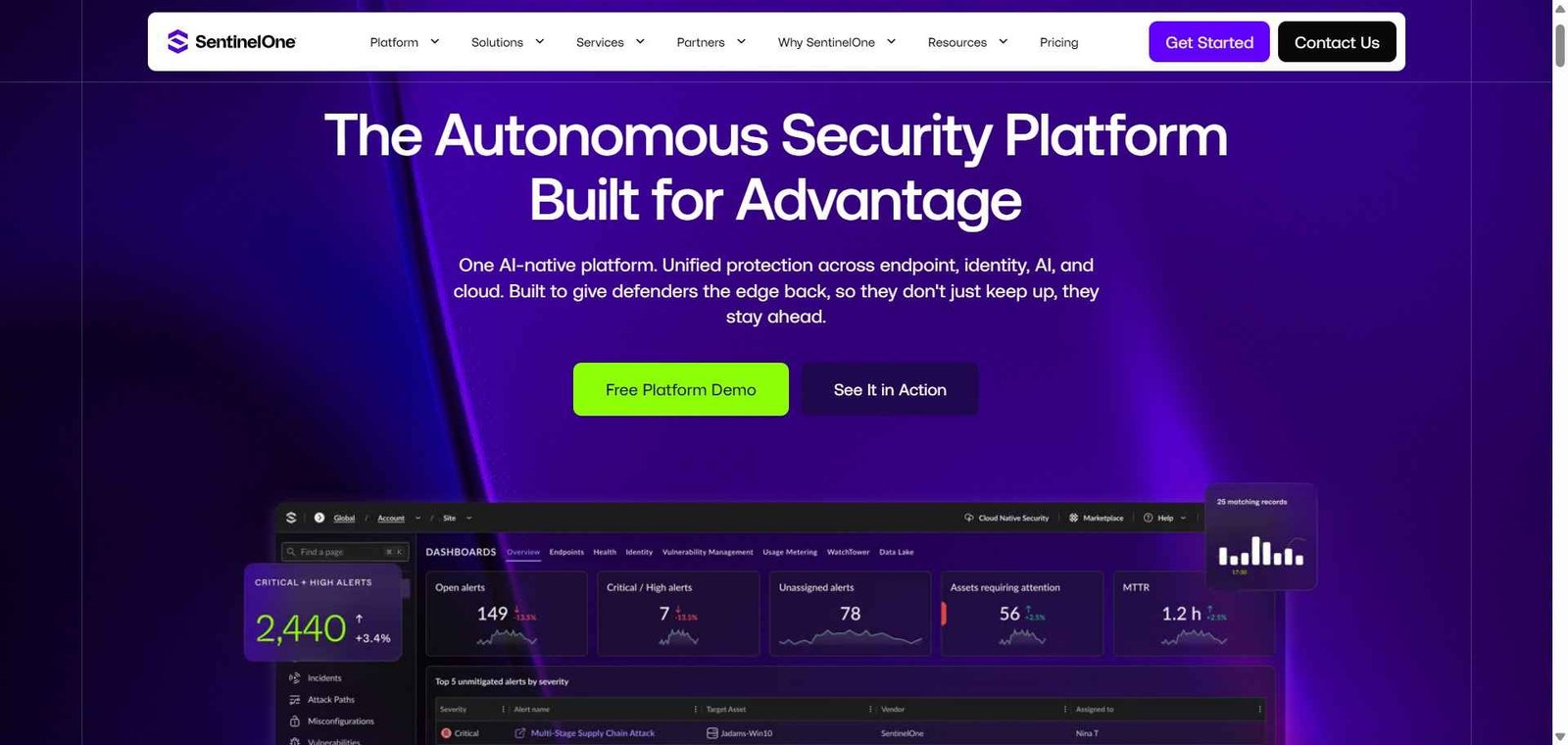
SentinelOne
AI that detects, responds to, and rolls back ransomware autonomously — Purple AI for natural language threat hunting, 5 consecutive Gartner EPP Leader recognitions.
SentinelOne Review: The Autonomous AI Endpoint Security Platform That Operates Without Human Intervention
Legacy endpoint security has a speed problem — human analysts cannot match the pace of modern cyberattacks. Ransomware encrypts files in minutes, lateral movement completes in hours, and by the time a security team investigates an alert, the damage is done. SentinelOne was built to close this speed gap by removing the human from the detection-to-response loop entirely. Its behavioral AI autonomously detects threats, kills malicious processes, isolates endpoints, and rolls back encrypted files — all without waiting for an analyst to review an alert and approve a response. Named a Leader in the Gartner Magic Quadrant for Endpoint Protection Platforms for five consecutive years, SentinelOne is the benchmark AI-native autonomous endpoint security platform for enterprise security teams who cannot afford to lose the race against automated attacks.
Quick Summary
SentinelOne is an AI-native cybersecurity platform — Singularity — combining autonomous endpoint protection with Purple AI generative security analyst, XDR, cloud security, and identity threat detection. It autonomously prevents, detects, responds to, and remediates cyberattacks in real time without human intervention, across Windows, macOS, Linux, cloud, and IoT. Five consecutive Gartner Magic Quadrant Leader recognitions. Pricing from $69.99/endpoint/year (Core) to $229.99/endpoint/year (Commercial) with custom Enterprise tiers.
Is it worth using? Yes for mid-market and enterprise security teams who want the strongest autonomous endpoint threat response with AI-powered investigation capabilities — particularly teams without 24/7 SOC coverage who need AI to act autonomously when threats occur outside business hours.
Who should use it? CISOs, security operations teams, and IT security leaders at mid-market and enterprise organisations who need autonomous endpoint protection with AI-powered threat hunting, XDR, and rollback capability that operates without constant human oversight.
Who should avoid it? Very small organisations under 25 endpoints where the annual commitment and enterprise orientation are disproportionate — simpler SMB endpoint tools are more appropriate at this scale.
Verdict Summary
Best for
- Enterprise security teams who want AI to handle the detect-respond-remediate loop autonomously — SentinelOne rolls back ransomware encryption, kills malicious processes, and isolates compromised endpoints without requiring analyst approval, closing the window of exposure that manual response cannot match
- Security operations teams who want Purple AI to compress investigation time — analysts query the full threat telemetry dataset in natural language rather than writing complex search queries, accelerating threat hunting from hours to minutes
- Mixed-OS enterprise environments where Windows, macOS, and Linux endpoints need equal, consistent protection — SentinelOne treats all platforms with parity that native tools like Microsoft Defender cannot provide
Not for
- Microsoft 365 E5 organisations where Defender for Endpoint is already included in the licence at significantly lower incremental cost — evaluate whether the autonomous response advantage justifies the additional per-endpoint spend
- Very small teams under 25 endpoints where Falcon Go or simpler SMB-focused tools provide adequate protection at lower cost
- Organisations whose primary security gap is email or cloud posture rather than endpoint detection
Rating
⭐⭐⭐⭐ 4.4 / 5
What Is SentinelOne?
SentinelOne was founded in 2013 by Tomer Weingarten and Almog Cohen — building on the premise that signature-based antivirus was obsolete and that AI behavioral detection running on the endpoint itself was the only architecture capable of stopping modern attacks at speed. The company went public on the NYSE in 2021 and has grown to protect Fortune 500 and Global 2000 organisations globally.
The Singularity Platform is SentinelOne’s unified security architecture — covering endpoint protection, EDR, XDR, cloud workload security, identity threat detection, and the Singularity Data Lake for centralised log management and AI SIEM. Purple AI — SentinelOne’s generative AI security analyst — sits across all of these, enabling natural language queries against the full threat telemetry dataset without requiring analysts to learn complex query languages.
How SentinelOne Works
- Deploy the lightweight agent. SentinelOne’s agent installs on endpoints — Windows, macOS, Linux, and cloud workloads — and immediately begins monitoring process behaviour, file system activity, network connections, and registry changes using on-device AI.
- Behavioral AI detects threats autonomously. Rather than matching signatures, SentinelOne’s AI monitors the full behavioural chain — identifying when a sequence of actions constitutes an attack even when no individual action is inherently malicious. Zero-day exploits, fileless attacks, and ransomware are detected by behaviour, not by prior knowledge.
- Autonomous response activates immediately. When a threat is detected, SentinelOne responds autonomously — killing the malicious process, quarantining the affected file, isolating the endpoint from the network, and initiating rollback of any changes the attack made to the file system, including reversing ransomware encryption.
- Purple AI investigates in natural language. Security analysts use Purple AI to investigate threats — asking “what processes did this endpoint run in the past 24 hours that made external connections?” and receiving structured answers from the telemetry rather than manually constructing search queries in the Singularity Data Lake.
- XDR correlates across the environment. Singularity XDR correlates endpoint telemetry with cloud, identity, and network signals — providing cross-environment threat visibility that endpoint-only tools cannot deliver.
- Vigilance MDR provides 24/7 coverage. SentinelOne’s optional Vigilance managed detection and response service provides around-the-clock human analyst coverage for organisations without an in-house SOC.
Key Features
- Behavioral AI autonomous threat detection — identifies attacks by behaviour rather than signatures, covering zero-days, fileless attacks, and ransomware
- Autonomous response — kills processes, quarantines files, isolates endpoints, and rolls back ransomware encryption without human approval
- Purple AI generative security analyst — natural language threat hunting and investigation across the full telemetry dataset
- Singularity Platform — unified EPP, EDR, XDR, CWPP, ITDR, and AI SIEM in one architecture
- Rollback capability — reverses file system changes made by ransomware, restoring endpoints to pre-attack state
- On-device AI — runs threat detection locally without cloud dependency, remaining effective when offline
- Cross-platform parity — equal protection for Windows, macOS, Linux, and cloud workloads
- Singularity Data Lake — centralised log storage and AI SIEM for historical threat analysis
- Vigilance MDR — optional managed detection and response for 24/7 expert coverage
- Named Gartner Magic Quadrant Leader for Endpoint Protection Platforms for five consecutive years
- Outperformed Microsoft Defender with zero missed detections in multiple MITRE ATT&CK evaluations
Real-World Use Cases
- Autonomous ransomware response: An enterprise endpoint at 2am begins encrypting files — a ransomware attack initiated after a phishing credential compromise. SentinelOne’s behavioral AI detects the encryption pattern within seconds, kills the ransomware process, isolates the endpoint from the network, and rolls back the encrypted files to their pre-attack state — all autonomously before any analyst has been paged. The attacker’s window of impact: under two minutes.
- Purple AI threat investigation: A SOC analyst receives an alert about suspicious network connections from a Linux server. Rather than manually querying log tables, the analyst asks Purple AI “show me all external connections from this host in the last 48 hours, grouped by destination country” — Purple AI returns a structured table from the Singularity Data Lake in 15 seconds, revealing a pattern of connections to known C2 infrastructure that confirms the compromise.
- Mixed-OS fleet protection: A technology company running Windows for corporate endpoints, macOS for engineers, and Linux for servers deploys SentinelOne across all three — the same behavioural AI model, the same detection capability, and the same autonomous response applies to all three platforms from one agent and one console, eliminating the per-platform security gap that tools optimised for a single OS create.
- MITRE ATT&CK validation: An enterprise security team evaluates endpoint security platforms using the MITRE ATT&CK evaluation results — SentinelOne’s 100% detection rate with zero delayed detections and zero missed detections across recent evaluations, compared to Microsoft Defender’s 24 missed detections in the same evaluation, drives the procurement decision.
Pros and Cons
| Pros | Cons |
|---|---|
| Autonomous rollback reverses ransomware encryption without human intervention — the most impactful single capability in endpoint security for ransomware-exposed organisations | Per-endpoint per-year pricing plus add-ons (Vigilance MDR, extended retention, AI SIEM) can significantly exceed headline plan pricing at full deployment |
| Purple AI natural language threat hunting compresses investigation from hours to minutes — the most accessible threat hunting interface in the category | Microsoft 365 E5 organisations have Defender for Endpoint included — the SentinelOne premium requires a clear justification against the included Microsoft tooling |
| Five consecutive Gartner EPP Leader recognitions and 100% MITRE ATT&CK detection — the most sustained independent validation in the endpoint security category | Data Lake / AI SIEM component uses consumption-based pricing tied to GB/day ingested — budgeting requires modelling log volume to avoid unexpected costs |
| On-device AI operates without cloud connectivity — endpoints remain protected during network outages or when agents cannot reach the cloud | Platform breadth creates procurement complexity — EPP, EDR, XDR, CWPP, and ITDR are separate licence considerations requiring careful scoping |
| Cross-platform parity for Windows, macOS, and Linux — consistent protection without per-platform capability gaps | Smaller than CrowdStrike by revenue and headcount — some enterprise procurement teams prefer the established scale of larger vendors |
Pricing & Plans
Singularity Core — $69.99/endpoint/year (~$5.83/month)
- Next-generation antivirus with AI static analysis
- Basic threat prevention and detection
- Entry tier — limited EDR capability
Singularity Control — ~$80/endpoint/year (~$6.67/month)
- All Core features
- Firewall management
- Device control
- USB and peripheral management
Singularity Complete — ~$99–$180/endpoint/year (~$8.25–$15/month)
- All Control features
- Full EDR — endpoint detection and response
- Purple AI generative threat hunting
- Threat intelligence
- Forensics and remote script execution
- Rollback capability
Enterprise — Custom pricing
- Full Singularity platform
- Agentic AI SOC Analyst
- Custom data retention
- Flexible deployment models
- Managed onboarding and advisory
Add-ons (separate pricing):
- Vigilance MDR: approximately $17 to $50/endpoint/year on top of platform licence
- Singularity Data Lake / AI SIEM: consumption-based per GB/day ingested
- Extended retention: custom pricing
Best Alternatives & Comparisons
- CrowdStrike — Better for the broadest module coverage, Charlotte AI conversational security, and the largest enterprise customer base — comparable autonomous detection at higher per-endpoint cost
- Wiz — Better for cloud infrastructure security posture — SentinelOne for endpoint, Wiz for cloud CNAPP
- Darktrace — Better for network behavioral detection and OT security alongside endpoint coverage
- Microsoft Defender — Better for Microsoft 365 E5 organisations where Defender is included in the existing licence at zero incremental cost
Frequently Asked Questions (FAQ)
SentinelOne is an AI-native autonomous cybersecurity platform — detecting, responding to, and remediating endpoint threats without human intervention through behavioral AI, with Purple AI for natural language threat hunting. Named Gartner EPP Leader for five consecutive years. Pricing from $69.99/endpoint/year.
Purple AI is SentinelOne’s generative AI security analyst — enabling natural language queries against the full threat telemetry dataset in the Singularity Data Lake. Analysts ask questions in plain English and receive structured answers rather than writing complex query language, dramatically accelerating threat hunting and investigation.
SentinelOne’s Volume Shadow Copy and Windows rollback capabilities reverse file system changes made by ransomware — restoring encrypted files to their pre-attack state without paying a ransom or restoring from backup, when the attack is detected early enough in the encryption process.
Singularity Core starts at $69.99/endpoint/year. Singularity Complete — the tier most security teams purchase for full EDR — lists at approximately $99 to $180/endpoint/year. Commercial is $229.99/endpoint/year. Enterprise is custom-priced. Volume and multi-year discounts apply below list pricing.
Yes — SentinelOne’s on-device AI runs threat detection locally without requiring cloud connectivity. Endpoints remain protected during network outages or when the agent cannot reach the SentinelOne cloud backend.
SentinelOne is approximately 20% cheaper per endpoint than CrowdStrike at comparable tiers, with stronger autonomous rollback capability and cross-platform parity. CrowdStrike has the largest enterprise customer base, the most extensive module catalogue, and Charlotte AI for conversational security analysis. Both are Gartner EPP Leaders. Evaluate both through parallel proof-of-concept pilots for any enterprise procurement decision.
Final Recommendation
SentinelOne is the most capable autonomous AI endpoint security platform for enterprise organisations whose threat model requires detection-to-response measured in seconds rather than hours — and whose security posture cannot depend on analyst availability at 2am when ransomware strikes. The autonomous rollback capability, Purple AI natural language investigation, and five consecutive Gartner EPP Leader recognitions create a security infrastructure that eliminates the human speed disadvantage that attackers exploit. For any CISO whose current endpoint security requires human analyst approval before containment, SentinelOne’s autonomous response model closes the exposure window that manual processes cannot.
Next steps