
Retell AI
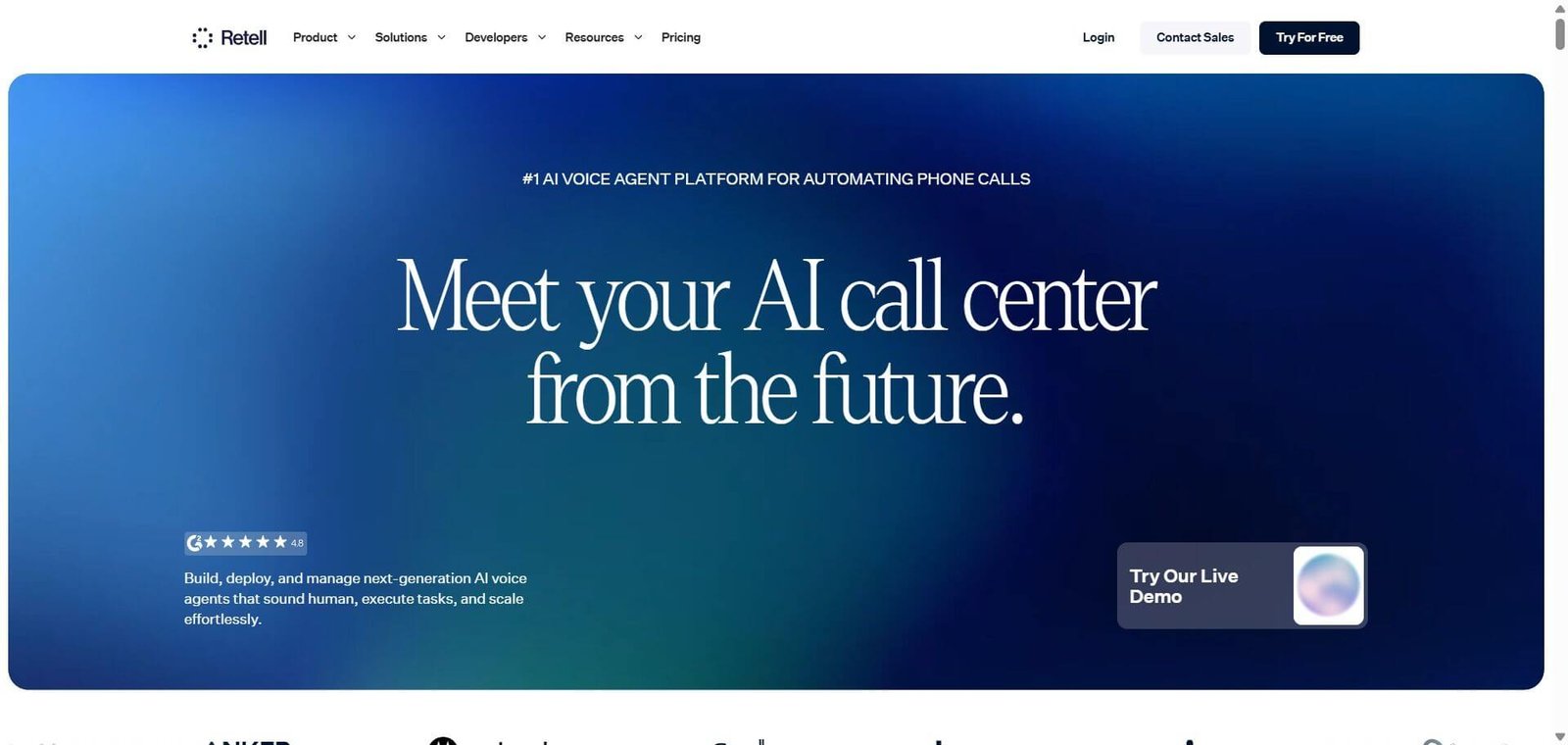
Retell AI helps businesses automate inbound and outbound calls using AI voice agents, CRM integrations, appointment booking and conversational workflows.
Retell AI Review: Features, Pricing and Alternatives
Retell AI is an AI voice agent platform that helps businesses automate inbound and outbound phone conversations. It allows companies to build voice agents that answer customer questions, qualify leads, schedule appointments, transfer calls to employees and interact with connected business applications. Unlike traditional IVR systems, which rely on predefined menus, Retell agents can respond to natural spoken requests and perform actions during conversations.
Is Retell AI worth using? It is worth evaluating if your business handles repetitive phone calls and needs automation that connects with existing CRM, telephony and scheduling systems. Developers and automation agencies will benefit from its API access and customization options. However, small businesses with occasional calls or limited technical resources may find simpler alternatives easier to manage. Its usage-based pricing also requires careful calculation before deployment.
Quick Verdict
Retell AI is designed for businesses that want to automate phone conversations without building an entire voice AI infrastructure independently.
Its strongest capabilities are real-time voice interactions, inbound and outbound calling, call transfers, CRM integrations and post-call analysis. Rather than limiting automation to answering questions, businesses can configure agents to retrieve customer information, book appointments and update connected systems.
The platform is particularly interesting for developers and automation agencies because it supports APIs, custom integrations and configurable conversation workflows.
However, Retell is not a plug-and-play replacement for a complete customer support department. Agents require clear instructions, reliable integrations, testing and ongoing monitoring. Voice quality also depends on the selected models, configuration and telephony setup.
Best for: Developers, AI automation agencies, sales teams, customer support departments and businesses handling regular phone enquiries.
Not for: Individuals looking for a basic answering service, businesses with very low call volumes or teams unwilling to configure and maintain AI workflows.
Pricing: $0.07 to $0.31 per minute for voice agents, depending on configuration. New accounts receive $10 in free credits.
User ratings:
G2: 4.8/5 from 2,651 reviews.
Product Hunt: 4.8/5 from 10 reviews.
What Is Retell AI?
Retell AI is a platform for building AI-powered voice agents that make and receive phone calls. Businesses can use these agents to answer customer enquiries, schedule appointments, qualify leads, transfer calls to employees and connect conversations with CRM systems and other business applications.
The main problem Retell addresses is the amount of repetitive work involved in handling business phone calls.
Consider a company receiving hundreds of calls every week. Employees might spend a considerable amount of time answering the same questions, checking appointment availability, collecting customer details and transferring callers to different departments.
Traditional automated phone systems handle some of these tasks through predefined menus. However, callers often need to navigate several options before reaching the right department.
Retell takes a conversational approach.
A caller can explain what they need in ordinary language. The AI agent interprets the request, retrieves relevant information and follows the configured workflow.
For example, a customer calling an automotive service centre might ask whether a particular service is available next Saturday. A properly configured Retell agent can check the connected scheduling system, retrieve availability, collect vehicle details and confirm an appointment.
This requires an integration with the actual scheduling system. The AI should not independently invent availability or confirm bookings without receiving a successful response from the connected application.
What makes Retell different from a regular chatbot?
A conventional chatbot primarily handles text-based conversations. Retell focuses on real-time voice interactions, where speech recognition, response timing, interruptions and turn-taking affect the quality of the experience.
It also connects conversational AI with telephony infrastructure and external business applications.
Its capabilities include:
Inbound and outbound voice agents.
Conversational call handling.
Custom agent instructions and workflows.
Call transfers and human handoffs.
CRM and calendar integrations.
Knowledge base connections.
APIs and SDKs.
Call recordings, transcripts and post-call analysis.
Retell is therefore better understood as voice automation infrastructure than simply an AI receptionist.
It can support an entire phone-based workflow, but businesses remain responsible for configuring the logic, providing accurate information and establishing appropriate escalation procedures.
How Does Retell AI Work?
Retell combines speech processing, language models, voice generation, telephony and external integrations to manage conversations.
A typical implementation involves the following steps:
Create a voice agent: Define the agent’s responsibilities, communication style and instructions. For example, an agent might handle appointment enquiries rather than general customer support.
Design the conversation: Configure how the agent responds to common questions, collects information and handles unexpected requests.
Connect a knowledge base: Provide relevant business information, such as service descriptions, operating hours, policies and frequently asked questions.
Select voice and language models: Choose the appropriate voice generation and language model based on conversation quality, speed and cost requirements.
Configure telephony: Purchase a supported phone number or connect an existing telephony provider through supported SIP integration.
Connect external applications: Integrate CRMs, calendars, automation platforms and custom APIs to allow the agent to retrieve information and perform actions.
Test before deployment: Simulate conversations, test interruptions, validate API responses and check call transfer behaviour.
Monitor actual conversations: Review transcripts, call outcomes and quality reports to identify problems and improve agent instructions.
The distinction between answering and completing a task is important.
An agent that tells customers appointment timings is different from one that checks live availability and actually books an appointment. The second requires a functioning integration and correctly configured action handling.
Key Features
Retell offers several capabilities that matter when moving from experimental voice bots to business phone automation.
1. Real-Time AI Voice Conversations
Retell supports real-time voice conversations with natural turn-taking and interruption handling.
In a traditional automated phone system, callers often have to wait until the system finishes speaking before responding. Conversational agents need to recognize when someone interrupts, pauses or changes their request.
Retell’s voice orchestration is designed to handle these situations.
The company advertises approximately 600ms latency. This is a vendor-stated performance figure, not an independently reproduced measurement in this review.
2. Visual Agent and Conversation Builder
Businesses can configure voice agents and create conversation workflows using a visual interface.
This helps teams organize different stages of a conversation, including greetings, customer identification, information collection and escalation.
For developers, APIs and custom logic provide additional control when the visual workflow is insufficient.
3. Call Transfers and Human Handoffs
AI agents can transfer conversations to human employees when a request needs additional attention.
A useful handoff should include relevant context, such as the caller’s reason for contacting the business, information already collected and actions attempted.
This reduces the need for customers to repeat their requests.
For complaints, sensitive financial questions and unusual customer situations, human escalation should be part of the original workflow rather than an afterthought.
4. Outbound Calling Campaigns
Retell supports batch calling and outbound campaign management.
Businesses can upload contact lists, schedule campaigns, manage call pacing and configure retries.
Sales teams can use this for lead qualification, follow-ups and appointment reminders.
However, automation does not remove the need for consent management, calling restrictions and appropriate contact-list practices.
5. CRM and Third-Party Integrations
Retell integrates with several business applications, including HubSpot, GoHighLevel, Zoho CRM, Twilio, Vonage and automation platforms.
Its integrations can help agents retrieve customer records before a call and update information after the conversation.
For example, a sales agent can collect a prospect’s requirements and update the corresponding CRM record with the conversation outcome.
Retell also supports custom integrations through APIs and webhooks.
6. Knowledge Base Integration
Businesses can provide agents with relevant information so they can answer questions using approved business content.
This is useful for companies with recurring enquiries about services, products, policies and appointments.
However, a knowledge base does not guarantee accurate answers. Outdated information, incomplete documents and ambiguous instructions can still produce incorrect responses.
7. Post-Call Analysis and AI Quality Assurance
After conversations finish, businesses can examine transcripts, extract information and evaluate call outcomes.
For example, a team can review whether an agent successfully qualified a lead, completed an appointment request or transferred a customer to the correct department.
Retell also provides AI quality assurance capabilities for evaluating conversations at scale.
These tools are valuable when teams need to identify recurring problems rather than manually reviewing every call.
Real-World Use Cases
Retell works best when businesses have recurring conversations with clearly defined objectives.
For sales teams
Qualify incoming leads.
Collect prospect information.
Schedule follow-up conversations.
Route qualified leads to sales representatives.
For customer support teams
Answer common customer enquiries.
Retrieve customer information.
Handle routine service requests.
Escalate complicated issues to human representatives.
For healthcare providers
Handle appointment enquiries.
Schedule routine consultations.
Provide administrative information.
Send appointment reminders.
Healthcare businesses must verify the applicable privacy, security and contractual requirements before processing protected patient information.
For recruitment agencies
Conduct initial candidate screening.
Collect experience and availability details.
Schedule recruiter follow-ups.
Record candidate responses in recruitment systems.
For real estate businesses
Answer property enquiries.
Collect buyer requirements.
Schedule property visits.
Route serious enquiries to agents.
For logistics companies
Handle delivery enquiries.
Collect shipment details.
Route operational complaints.
Provide routine status information using connected systems.
For automation agencies and developers
Build customized voice agents for clients.
Connect telephony with existing CRMs.
Create appointment automation workflows.
Build custom voice applications using APIs and webhooks.
Pros and Cons
Retell has a useful combination of voice automation, integration flexibility and call management. However, the overall experience depends on the quality of implementation.
| Pros | Cons |
|---|---|
| Natural conversational voice capabilities | Requires testing and configuration |
| Supports inbound and outbound calls | Costs increase with call duration and selected components |
| Call transfers and human escalation | Incorrect workflows can affect customer experience |
| CRM and automation integrations | Complex integrations may require developers |
| APIs and custom agent logic | External services introduce dependencies |
| Call analytics and quality assurance | Analytics cannot automatically fix poor agent behaviour |
What users appreciate: G2’s published feedback highlights its interface, voice quality, customization and ability to automate routine tasks.
What users criticize: G2’s review analysis also identifies concerns about costs, occasional technical difficulties and limitations in advanced or niche customization requirements.
Retell AI Limitations and Risks
The most important consideration when choosing a voice AI platform is what happens when the conversation does not go according to plan.
Retell can automate phone workflows, but businesses should account for several operational risks.
1. Incorrect AI responses
Language models can misunderstand questions or produce incorrect information. Businesses should restrict agents to approved information and configure clear fallback responses.
2. Speech recognition errors
Background noise, regional accents, speaking speed and poor telephone connections can affect transcription accuracy.
Agents should be tested with the actual customer audience rather than only with employees using clear microphones.
3. External API failures
Appointment booking, CRM updates and customer lookups depend on external systems.
If an API request fails, the agent should not tell a customer that an action was completed. It should retry where appropriate, explain the problem or transfer the call.
4. Delays during conversations
A voice agent may need to contact a CRM, retrieve information or execute an API action before responding.
These additional operations can increase response time even when the underlying voice infrastructure performs well.
5. Ongoing maintenance
Business information, service prices, appointment availability and operating policies change.
Agents need updated instructions, knowledge sources and integration configurations. Deployment is not the end of the implementation process.
6. Privacy and recording requirements
Businesses handling personal information should establish appropriate consent, retention, access-control and data-processing policies.
Retell advertises HIPAA, SOC 2 Type II, GDPR and ISO 27001 compliance. However, a platform’s compliance status does not automatically make every customer deployment compliant.
Pricing & Plans
Retell uses usage-based pricing. Businesses pay according to call duration and the selected voice, language model, telephony and additional features.
The advertised voice agent pricing range is approximately $0.07 to $0.31 per minute.
New accounts receive $10 in free credits to test the platform.
Current pricing components
| Component | Published price |
|---|---|
| Retell voice infrastructure | $0.055/min |
| Retell platform voices | $0.015/min |
| ElevenLabs voices | $0.040/min |
| Cartesia voices | $0.015/min |
| OpenAI voices | $0.015/min |
| GPT-5.6 Terra | $0.064/min |
| GPT-5.4 | $0.080/min |
| GPT-5.4 mini | $0.024/min |
| GPT-6 Astra | $0.320/min |
| GPT-6 Luna | $0.0032/min |
| Telephony example | $0.015/min |
| Knowledge base add-on | $0.005/min |
| Batch calling | $0.005/dial |
These prices represent individual components, not a single mandatory package.
Retell’s pricing page also lists other model options and additional charges for features such as branded calling, advanced denoising, safety guardrails and AI quality assurance.
Check the live pricing page before selecting a model because rates and available options can change.
How much does Retell AI cost for 1,000 calls?
Call volume alone is not enough to estimate cost. Average call duration matters.
For a practical estimate, assume the following:
1,000 calls per month.
Average call duration: 3 minutes.
Total monthly usage: 3,000 minutes.
Assumed combined rate: $0.15 per minute.
The estimated monthly cost would be:
3,000 × $0.15 = $450.
This is an illustrative scenario, not an official Retell quote.
Monthly cost at different usage levels
Using the same hypothetical $0.15 per-minute configuration:
| Monthly minutes | Estimated cost |
|---|---|
| 500 | $75 |
| 1,000 | $150 |
| 5,000 | $750 |
| 10,000 | $1,500 |
Actual costs can be higher or lower depending on model selection, voice provider, telephony, add-ons and additional subscription charges.
Who should pay for Retell AI?
Businesses with recurring customer calls.
Agencies building voice automation for clients.
Sales teams with repetitive lead qualification workflows.
Customer support teams handling routine enquiries.
Developers building voice-enabled applications.
Who should avoid upgrading immediately?
Businesses still experimenting with voice automation should begin with free credits and a limited workflow. There is little reason to commit to substantial usage before validating conversation quality and the cost per successful outcome.
Retell AI for Global Businesses
Retell AI is designed for businesses that want to automate phone conversations across different markets, customer groups and business operations. However, deploying a voice agent internationally involves more than selecting a language and connecting a phone number.
Telephony availability, local regulations, language support and international calling charges can differ considerably between countries.
1. International Phone Numbers and Telephony
Retell supports telephony integrations and custom SIP configurations, allowing businesses to explore different calling arrangements.
However, the availability of local, national and toll-free phone numbers depends on the country, carrier and applicable regulations.
Before deployment, confirm:
Whether Retell offers phone numbers in your target countries.
Whether your existing business number can be connected.
Which SIP trunking providers are supported.
Whether local number registration or business verification is required.
Domestic and international inbound and outbound calling rates.
Businesses operating across multiple countries should calculate telephony expenses separately rather than assuming one universal per-minute rate.
2. Multilingual Conversations and Regional Accents
Businesses serving international customers need voice agents that can understand different languages, accents and speaking styles.
Retell’s language and voice capabilities depend on the selected speech recognition, language model and voice provider.
Before choosing a configuration, test the languages your customers actually speak. Include regional accents, mixed-language conversations, different speaking speeds and industry-specific terminology.
A voice agent that performs well in American English may require additional configuration and testing for British English, Australian English or other regional varieties.
3. International Calling Costs
Retell’s published per-minute starting price does not represent the total cost of every international deployment.
The final bill depends on:
Retell’s platform usage.
Selected language model.
Voice generation provider.
Country-specific telephony charges.
Optional features and integrations.
Outbound calling requirements.
Businesses should request or calculate country-specific rates before estimating the cost of large-scale calling campaigns.
4. Privacy, Security and Regulatory Compliance
International deployments may involve several privacy and telecommunications frameworks.
Depending on the countries and industries involved, businesses may need to consider:
GDPR and applicable European data protection requirements.
HIPAA requirements for eligible US healthcare deployments.
Call recording and customer consent rules.
Data residency and cross-border data transfers.
Local direct marketing and automated calling regulations.
Data retention and deletion requirements.
Retell advertises HIPAA, SOC 2 Type II, GDPR and ISO 27001 compliance. However, businesses must independently confirm the applicable contractual arrangements, configuration requirements and responsibilities for their own deployments.
5. Integrations Across International Business Systems
Global companies often use different CRMs, scheduling systems and customer databases across regions.
Retell’s APIs, SDKs and integrations can help connect these systems to voice workflows.
For example, a multinational support team could configure agents to retrieve customer records from its CRM and route callers according to region or department.
The reliability of that workflow still depends on the external systems, API permissions and integration logic.
Our recommendation: Businesses planning international deployments should test one market first, verify local telephony availability, validate language performance and calculate the full cost per completed call. Expand only after the workflow performs reliably with real customers.
Best Alternatives & Comparisons
Retell competes with several voice AI platforms. The differences become clearer when comparing setup, provider flexibility, telephony, call management and pricing.
| Platform | Best suited for | Main buying consideration |
|---|---|---|
| Retell AI | Production voice workflows | Integrated agent building and call management |
| Vapi | Developers | Flexible voice pipeline and provider configuration |
| Bland AI | Business calling | Consolidated AI usage pricing |
| ElevenLabs Agents | Voice-focused applications | Voice ecosystem and managed agent plans |
| Synthflow | Managed business automation | Sales-led deployment and packaged workflows |
1. Retell AI vs Vapi
Vapi is a developer-focused voice AI platform that provides control over transcription, language models, voice providers and telephony.
Its published pricing includes a $0.05-per-minute Vapi hosting fee, with model and provider costs charged separately. It also offers optional paid support packages.
Retell is worth considering when you want an integrated agent-building and call-management environment. Vapi is attractive when developers want to configure individual components of their voice pipeline.
Choose Retell for its integrated workflows and call-management features.
Choose Vapi if provider flexibility and developer control are more important.
2. Retell AI vs Bland AI
Bland AI offers a more consolidated AI calling price.
Its published Start plan is $0.14 per minute, while its Build plan is $0.12 per minute with a $299 monthly platform fee. Telephony charges may be separate.
Retell provides more granular component selection, allowing businesses to choose different models and voice providers.
The trade-off is that Retell requires more attention when calculating the final operating cost.
Choose Retell when you want configurable voice components.
Choose Bland AI when a more predictable AI usage rate is a priority.
3. Retell AI vs ElevenLabs Agents
ElevenLabs Agents combines conversational agents with ElevenLabs’ voice technology.
Its published plans include free usage and paid subscriptions, with additional call minutes, language model costs and telephony charges depending on configuration.
Retell is worth evaluating for businesses prioritizing phone-based workflows, CRM operations and call transfers.
ElevenLabs is attractive when voice quality, multilingual speech and its broader voice ecosystem are major considerations.
Choose Retell for business phone automation.
Choose ElevenLabs if its voice ecosystem and conversational agent features better match your application.
4. Retell AI vs Synthflow
Synthflow focuses on managed voice AI automation for businesses.
Its enterprise-oriented offering includes call workflows, telephony, analytics and implementation support. Current pricing is sales-led and depends on expected usage, integrations and deployment requirements.
Retell offers a more granular usage-based approach and developer-facing customization options.
Choose Retell if you want to manage agent configuration and integrations more directly.
Choose Synthflow if you prefer a managed deployment with sales-led implementation support.
5. Retell AI vs Twilio
Twilio is programmable communications infrastructure rather than a direct equivalent to Retell.
It provides telephony APIs, messaging and communication services. Developers can build voice AI workflows by connecting speech recognition, language models, voice generation and their own application logic.
Retell already provides much of the voice agent orchestration needed for conversational phone automation.
Choose Retell if your main requirement is deploying AI voice agents.
Choose Twilio if you want to build and control a more customized communications infrastructure.
Who Should Use Retell AI?
The decision depends on your call volume, technical resources and the type of conversations you want to automate.
| User type | Recommendation |
|---|---|
| Developers | Worth evaluating |
| AI automation agencies | Strong candidate |
| Small businesses | Depends on call volume |
| Enterprise support teams | Worth evaluating |
| Sales teams | Good fit for structured qualification |
| Non-technical individuals | Compare managed alternatives |
| Businesses with occasional calls | May not justify the cost |
If you are building voice automation for multiple clients, Retell deserves a closer look because its integrations and APIs allow different workflows to be configured for different businesses.
For a small business that receives only a few calls per week, a simpler answering solution may offer better value.
Is Retell AI Worth It?
Retell AI is worth considering if your business receives enough repetitive phone calls to justify automated conversations.
Its combination of inbound and outbound calling, customizable agents, CRM integrations, call transfers and post-call analysis makes it more capable than a basic automated answering service.
The strongest reason to evaluate Retell is its ability to connect phone conversations with actual business operations. However, this advantage depends on properly configured integrations and reliable workflows.
The pricing model also requires attention. A low advertised starting rate does not necessarily represent the final cost of a production deployment.
Before making a decision, compare the estimated monthly cost against the current cost of handling those calls manually. Also consider the time required to configure, test and maintain agents.
For developers who need greater control over individual voice components, Vapi is worth comparing. For teams that prefer a consolidated AI calling price, Bland AI is another option.
Frequently Asked Questions (FAQ)
Retell AI is used to build AI-powered voice agents that handle inbound and outbound calls. Common applications include customer support, appointment scheduling, lead qualification, reception and automated follow-ups.
Retell AI provides $10 in free credits for new accounts. After the credits are used, voice agent calls are billed according to usage, selected models, voice providers, telephony and additional features.
Retell AI advertises voice agent usage between $0.07 and $0.31 per minute. The final rate depends on the selected language model, voice, telephony and optional features.
Retell supports telephony integrations and custom SIP configurations, but phone number availability, registration requirements and calling rates vary by country. Businesses should verify supported numbers and carrier arrangements before deployment.
Neither platform is universally better. Retell is worth considering for integrated agent-building and call-management workflows, while Vapi is attractive to developers who want greater control over individual voice infrastructure components.
Final Recommendation
Retell AI is best suited for businesses, developers and automation agencies that want to automate repetitive phone conversations while connecting voice interactions to existing business systems.
Its combination of voice agents, outbound campaigns, CRM integrations, call transfers and post-call analysis makes it a serious candidate for businesses moving beyond traditional IVR systems.
However, it is not a completely hands-off solution. Agent accuracy, external API reliability, telephony configuration and ongoing maintenance all affect the customer experience. Usage-based pricing also means businesses should calculate the total cost before deploying at scale.
If you need more control over your voice infrastructure, compare Vapi. If you prefer a more consolidated AI calling price, evaluate Bland AI. If voice technology is your main priority, consider ElevenLabs Agents.
The sensible starting point is to create one agent, test a real business workflow and measure the cost per successfully completed call.
Visit the official website: https://www.retellai.com/
You can also compare similar voice AI platforms or explore more AI tools on itirupati.com.