Cartesia Review: The AI Voice API That Solves the Latency Problem in Conversational AI
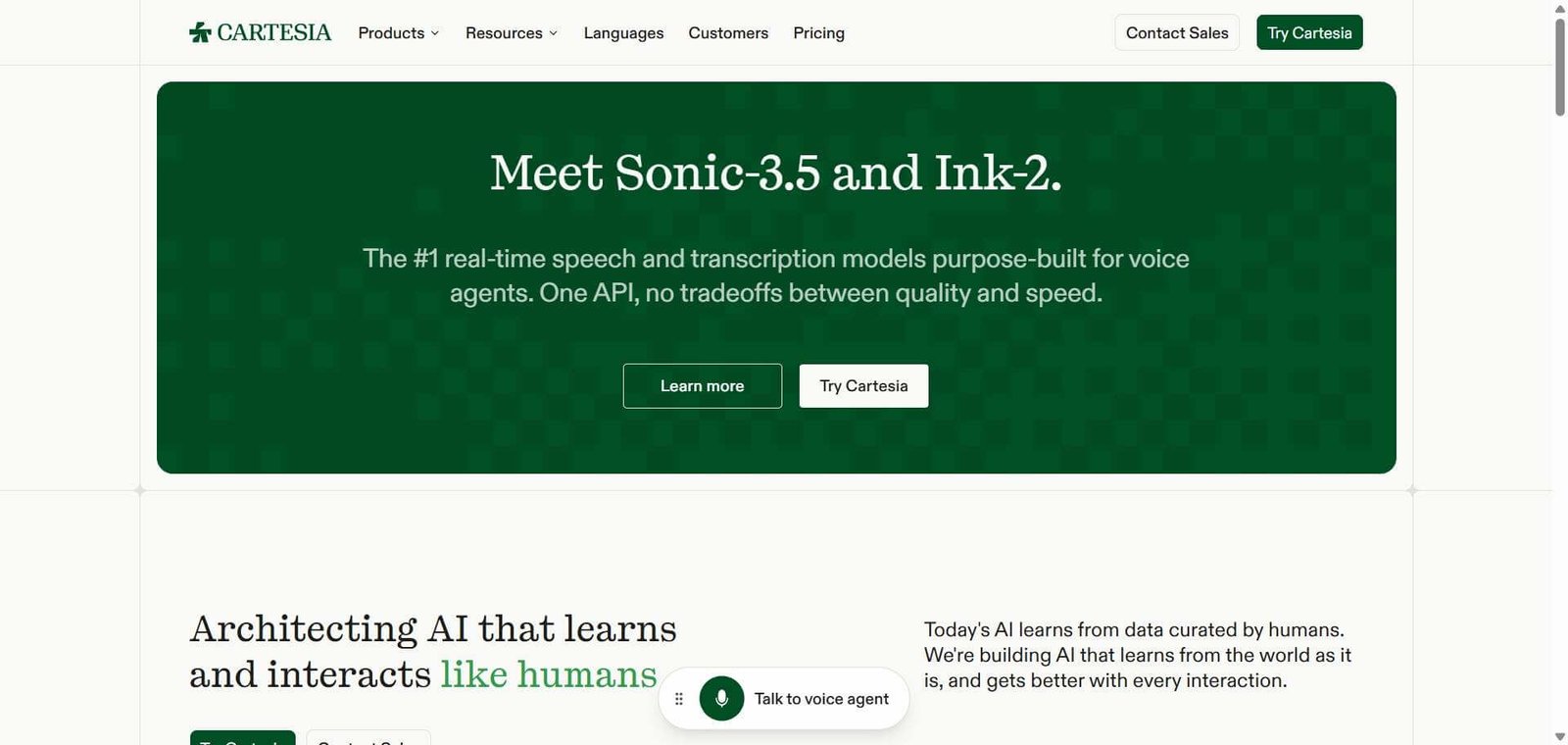
Most text-to-speech APIs were built for content production — generating audio files from scripts where a 2-second processing delay is irrelevant because nobody is waiting in real time. Conversational AI has fundamentally different requirements. When a user is speaking with a voice agent, a 500ms delay between the LLM response and the first audio output sounds unnatural and robotic. At 300ms it is still perceptible. Under 100ms, the conversation flows naturally. Cartesia is purpose-built for this constraint — its Sonic model uses a state space architecture to deliver streaming audio output with end-to-end latency under 80ms, enabling voice agents and conversational AI applications that sound and feel genuinely natural rather than mechanically delayed.
Quick Summary
Cartesia is a real-time speech synthesis API engineered for latency-critical conversational applications — delivering sub-80ms time-to-first-audio through its Sonic state space model, with streaming output, voice cloning, on-device processing capability, and deep integration with voice agent frameworks including Vapi, Retell AI, and LiveKit.
Is it worth using? Yes for developers building voice agents, AI phone systems, real-time conversational AI, and interactive voice applications where latency is a hard technical requirement — not a preference. Who should use it? Developers and engineering teams building AI phone agents, voice assistants, customer support voice automation, gaming voice systems, and any real-time interactive application where speech synthesis latency directly affects user experience quality. Who should avoid it? Content creators and podcasters who need a library of diverse voices and a non-technical interface — ElevenLabs or Murf AI are more appropriate for content production without API integration.
Verdict: Detailed Summary
Best for
Developers building AI phone agents and voice bots where sub-100ms speech synthesis latency is the difference between a conversation that sounds natural and one that sounds robotic
Engineering teams building real-time voice assistants and embedded voice experiences who need a TTS layer that can keep pace with LLM token streaming without introducing perceptible delay
Product teams integrating voice into existing conversational AI stacks using Vapi, Retell AI, or custom WebRTC pipelines who need a reliable, low-latency speech output layer
Not for
Content creators who need a broad voice library with a non-technical web interface for voiceover and podcast production
Teams whose voice needs are primarily batch audio generation where latency is irrelevant
Non-technical users who want to produce audio without API integration
Rating ⭐⭐⭐⭐ 4.4 / 5
What Is Cartesia?
Cartesia is a real-time voice AI platform founded in 2023 that has positioned itself specifically at the latency problem in conversational AI — the gap between a language model finishing a sentence and the user hearing it, which determines whether an AI voice application sounds like a natural conversation or a slow call centre system. Its Sonic model uses a state space model architecture rather than transformer-based diffusion, specifically because SSMs process sequential audio data more efficiently for real-time streaming — achieving sub-80ms time-to-first-audio that is benchmarked at the 90th percentile under load.
The platform has become a standard TTS layer in professional voice agent stacks alongside speech recognition providers like Deepgram, and is directly integrated into Vapi, Retell AI, LiveKit, and other voice infrastructure frameworks.
How Cartesia Works
Send text to the API. Integrate Cartesia’s API into the voice application — sending text either as complete sentences or as streaming tokens from the LLM as they are generated, without waiting for the full response to complete.
Sonic model generates streaming audio. Cartesia’s Sonic model begins streaming PCM or Opus audio back immediately — the first audio output arrives within 80ms of the first text input, enabling the user to start hearing the response before the LLM has finished generating it.
Integrate into your voice stack. Connect Cartesia to the speech input layer — typically a speech recognition provider like Deepgram — to complete a full duplex voice pipeline where the user speaks, the LLM responds, and Cartesia streams audio back in real time.
Clone voices from short samples. Use Cartesia’s voice cloning — Instant Voice Cloning from short samples for quick deployment or Pro Voice Cloning for higher fidelity — to create branded or character voices for the application.
Customise voice parameters. Adjust pitch, speed, emotion, and pronunciation parameters to match specific application requirements — controlling voice characteristics beyond what preset voices provide.
Deploy on-device if required. Cartesia’s models can run on-device for applications where cloud dependency creates privacy concerns or connectivity constraints — maintaining the latency advantage in edge deployments.
Key Features
Sub-80ms time-to-first-audio through Sonic state space model architecture
Real-time streaming audio output over WebSocket API
Instant and Pro Voice Cloning from short audio samples
On-device model deployment for privacy-sensitive and offline applications
Multilingual support across major languages with consistent quality
Real-time speech-to-text integration for complete conversational pipeline
Native integration with Vapi, Retell AI, LiveKit, and other voice frameworks
SDKs for Python, JavaScript, and other languages with comprehensive documentation
Real-World Use Cases
AI phone agent: A customer service team builds an AI phone agent using Cartesia as the TTS layer — callers interact with an AI that responds within the natural rhythm of conversation because Cartesia’s sub-80ms latency keeps pace with the LLM output, producing a call experience that field tests confirm most callers cannot distinguish from a human agent in the first 30 seconds.
Real-time voice assistant: A productivity software company integrates Cartesia into their voice assistant feature — users speak commands and hear responses with latency low enough that the interaction feels like talking to a person rather than waiting for a machine to process.
Interactive gaming: A game developer uses Cartesia’s on-device deployment for NPC voice responses — characters respond to player dialogue in real time without cloud API calls, maintaining immersion without connectivity dependence or cloud processing costs at scale.
Voice agent infrastructure: A developer building on Vapi integrates Cartesia as the selected TTS provider — the sub-100ms latency benchmark is a hard requirement for the client’s sales call automation use case, and Cartesia is the only provider that consistently meets it under production load.
Sub-80ms time-to-first-audio is genuinely differentiated and benchmarked under load — not marketing claims
Purpose-built for developers — no non-technical content creation interface
State space model architecture provides the latency advantage that transformer-based TTS cannot match at equivalent quality
Voice library breadth narrower than ElevenLabs for content production use cases
On-device deployment covers privacy-sensitive and offline application requirements
Credit-based pricing becomes less predictable at very high production volumes
Direct integration with Vapi, Retell AI, and LiveKit reduces voice stack assembly complexity
Growth plan pricing starts to show limits at scale requiring enterprise negotiation
Voice cloning from short samples enables quick branded voice deployment
Less suitable for non-real-time batch audio generation where latency irrelevant
Pricing & Plans
Free — $0/month
20,000 credits per month
Personal and non-commercial use
Evaluation and prototyping
Starter — $5/month
Modest character allowance
Small projects and side builds
Core API access
Pro — $49/month
Higher credit quota
Voice cloning access
Priority API throughput
Commercial use
Scale — $299/month
High-volume production quota
Dedicated support
SLA commitments
Enterprise — Custom pricing
Custom volume and infrastructure
Dedicated support
Custom integrations
Best Alternatives & Comparisons
ElevenLabs — Better for highest voice realism and broadest voice library for content production, higher latency for conversational use
Murf AI — Better for content creators wanting a non-technical interface and video studio editor
Synthflow — Better for no-code AI phone agent building using voice AI without direct API integration
Vapi — Better for complete voice agent infrastructure as a service rather than TTS layer specifically
Frequently Asked Questions (FAQ)
What is Cartesia?
Cartesia is a real-time AI voice API delivering sub-80ms speech synthesis through its Sonic state space model — purpose-built for voice agents, phone automation, and conversational AI applications where latency determines whether the experience sounds natural.
How fast is Cartesia's voice generation?
Cartesia’s Sonic model delivers sub-80ms time-to-first-audio benchmarked at the 90th percentile under load — meaning the first audio output arrives within 80 milliseconds of receiving text input, enabling genuinely natural conversational pacing.
Can Cartesia run on-device?
Yes — Cartesia’s models support on-device deployment for applications where cloud dependency creates privacy concerns or connectivity constraints, maintaining the latency advantage in edge deployments.
How does Cartesia's voice cloning work?
Cartesia offers two voice cloning tiers — Instant Voice Cloning from very short audio samples for quick deployment, and Pro Voice Cloning for higher fidelity branded voice creation with more consistent reproduction of specific vocal characteristics.
What frameworks integrate with Cartesia?
Cartesia integrates directly with Vapi, Retell AI, LiveKit, and other voice infrastructure frameworks — reducing the assembly complexity of building a complete voice agent stack with Cartesia as the TTS output layer.
How does Cartesia compare to ElevenLabs?
Cartesia is purpose-built for real-time conversational AI where sub-100ms latency is a hard requirement. ElevenLabs is optimised for highest voice realism and content production with the broadest voice library. Cartesia for voice agent developers where latency is the constraint. ElevenLabs for content creators where realism is the priority.
Final Recommendation
Cartesia is the right AI voice API for any developer building real-time conversational voice applications where latency is not a preference but a technical requirement for the application to work as intended. The sub-80ms time-to-first-audio, state space model architecture, on-device capability, and direct framework integrations make it the most technically appropriate TTS layer for voice agents and conversational AI at the current state of the market. For developers whose applications suffer from the robotic pacing that higher-latency TTS introduces, Cartesia delivers the latency performance that makes the difference between an application that users tolerate and one they actually want to use.