Triple Whale
Triple Whale combines ecommerce analytics, marketing attribution and Moby AI to help online brands understand performance and manage marketing workflows.
Triple Whale Review: Features, Pricing, Moby AI & Alternatives
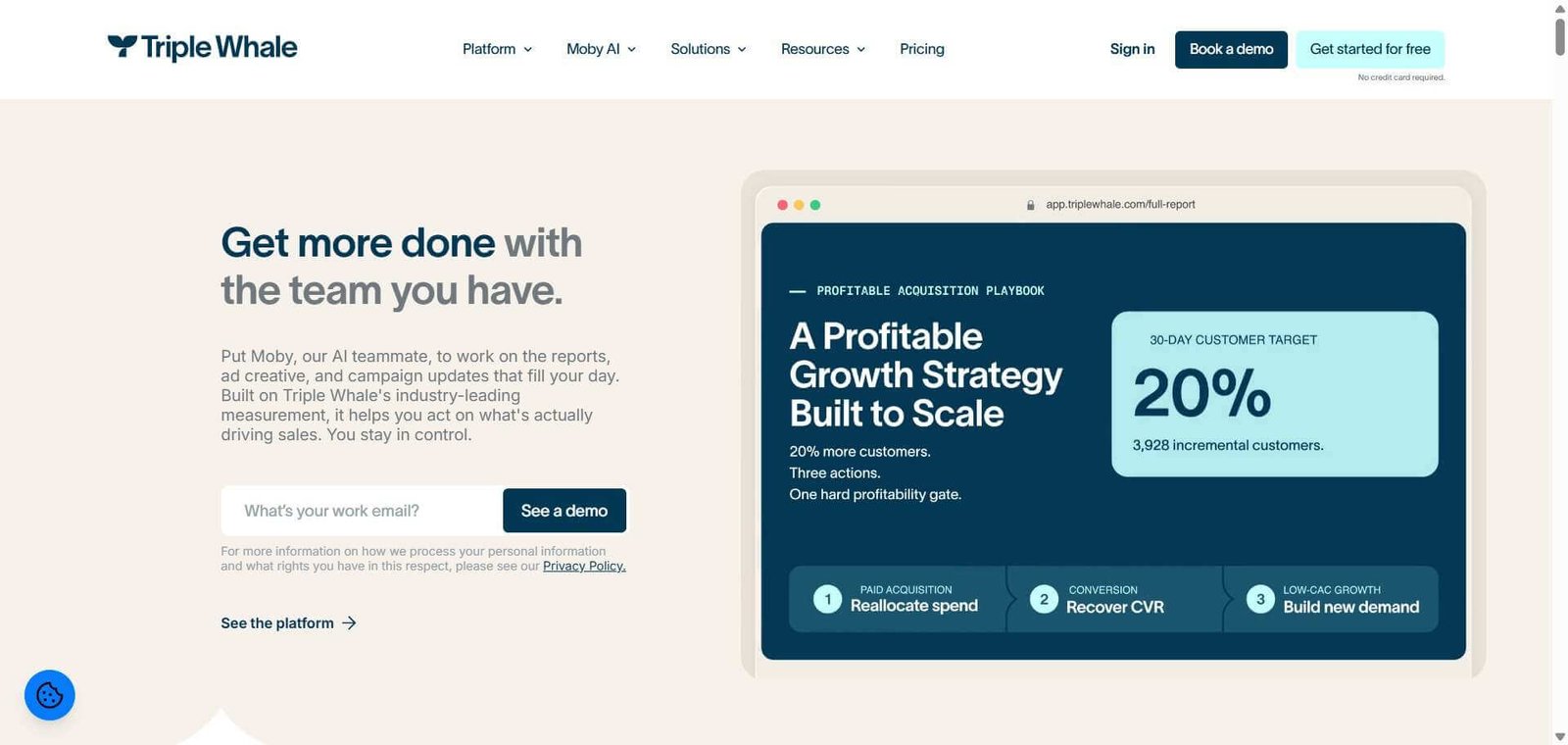
Triple Whale brings ecommerce sales, advertising performance and profitability data into one platform. Built primarily for Shopify and direct-to-consumer brands, it helps marketing teams understand how different channels contribute to revenue rather than relying entirely on the numbers reported by Meta or Google Ads.
Its Moby AI assistant adds another layer by helping teams investigate performance changes, generate reports and manage selected advertising workflows.
But the real question is whether its attribution and automation features provide enough value to justify the subscription. A consolidated dashboard can save reporting time, but it does not automatically make attribution accurate or advertising more profitable.
Triple Whale is worth considering for growing ecommerce businesses managing several marketing channels. Smaller stores with limited advertising activity may find Shopify Analytics, Google Analytics 4 and the free Triple Whale plan sufficient.
Here’s what businesses should understand before choosing Triple Whale, including its features, pricing, measurement limitations and alternatives.
Quick Verdict: Triple Whale Review
Triple Whale is a capable ecommerce analytics and marketing measurement platform. Its strongest advantage is bringing first-party tracking, attribution, business reporting and AI-assisted workflows together.
| Evaluation | Assessment |
|---|---|
| Best for | Shopify and DTC brands managing multiple advertising channels |
| Primary use | Ecommerce analytics and marketing attribution |
| Standout feature | Moby AI and governed advertising actions |
| Analytics | Custom dashboards, SQL and multi-touch attribution |
| Automation | Scheduled reporting and advertising actions |
| Integrations | Ecommerce, advertising and marketing platforms |
| Free plan | Available |
| Paid pricing | Custom quotation based on business requirements |
| G2 rating | 4.5/5 (482 reviews) |
| Editorial rating | 8.0/10 |
Best for: Ecommerce founders, performance marketers, marketing agencies and data teams that need consolidated reporting and more control over advertising decisions.
Not for: New stores with limited advertising activity, businesses needing only website analytics, or teams looking for a low-cost standalone AI assistant.
Our verdict: Triple Whale offers a strong combination of analytics and execution. However, businesses should evaluate its attribution methodology, integration requirements and annual subscription cost before upgrading.
What Is Triple Whale?
Triple Whale is an ecommerce analytics and marketing measurement platform that helps businesses understand how advertising, customer interactions and other sales channels contribute to revenue.
For an online store, the problem is not necessarily a lack of data. It is having too many disconnected reports.
Meta Ads reports advertising conversions. Google Ads reports its attributed sales. Shopify provides order and revenue information. Email marketing platforms measure their own campaign performance.
These numbers may not match because each platform uses different attribution windows, tracking methods and reporting rules.
Triple Whale attempts to bring these information sources into a shared analytics environment.
Its main capabilities include:
Ecommerce performance reporting: Consolidates sales, advertising expenditure, customer information and other business metrics into dashboards.
First-party tracking: Triple Pixel captures customer and conversion information to support attribution and performance measurement.
Marketing attribution: Provides different attribution models to help businesses understand how marketing touchpoints contribute to purchases.
Business intelligence: Offers custom metrics, customer segments, dashboards and SQL-based analysis.
AI-assisted analysis: Moby AI allows users to ask questions about connected business information and generate reports or other analytical outputs.
Marketing execution: Higher-tier subscriptions provide scheduled workflows and actions across supported connected platforms.
What makes Triple Whale different from other ecommerce analytics tools?
Its differentiation comes from combining analytics with operational capabilities.
A traditional reporting tool primarily helps teams understand what happened. Triple Whale also aims to help them investigate why performance changed and take action through Moby.
That distinction matters for marketing teams managing multiple campaigns daily. However, it does not mean Triple Whale replaces every analytics, business intelligence or experimentation platform.
How Triple Whale Works
Triple Whale follows a five-stage workflow.
Connect your platforms: Integrate your ecommerce store, advertising accounts, email marketing applications and other supported data sources.
Collect and organise data: Bring sales, customer activity, campaign expenditure and conversion information into a central reporting environment.
Measure performance: Use Triple Pixel, attribution models, custom dashboards and customer segments to investigate marketing performance.
Analyse with Moby AI: Ask questions about revenue changes, advertising performance, customer behaviour and other connected business metrics.
Take action: Depending on your subscription and permissions, use Moby to prepare advertising changes, schedule recurring reports or execute supported workflows.
Illustrative example
A Shopify store spends $15,000 monthly across Meta, Google and TikTok advertising.
Each advertising platform reports its own conversions, but the combined conversion numbers do not match the revenue recorded in Shopify.
The marketing team can use Triple Whale to consolidate available reporting, examine attribution differences and investigate which channels contribute to sales.
Moby can assist with analysing the available information and preparing recommendations.
The team still needs to validate the results before making significant budget changes. The scenario illustrates a possible workflow, not a documented Triple Whale customer result.
Key Features
1. Moby AI: Ecommerce Analytics Assistant
Moby is Triple Whale’s AI assistant, designed to work with connected ecommerce and marketing information.
Instead of manually preparing reports, users can ask questions about business performance.
For example:
Why did advertising expenditure increase this week?
Which campaigns generated the most attributed revenue?
How did new customer acquisition change compared with last month?
Which products contributed most to sales?
Are we spending within our planned advertising budget?
Moby can analyse available business information, generate reports and create analytical outputs.
Its usefulness depends on the quality of connected data, available permissions and the complexity of the question.
Who benefits: Founders and marketing managers who regularly analyse multiple reporting sources.
2. Triple Pixel and Marketing Attribution
Triple Pixel is Triple Whale’s proprietary tracking technology.
It is designed to capture shopper behaviour and conversion information that conventional advertising pixels may not fully observe.
The platform uses this information to support attribution and reporting.
This becomes relevant when businesses want to investigate customer journeys across multiple advertising channels.
However, first-party tracking does not guarantee complete visibility. Consent restrictions, browser limitations, incomplete customer journeys and data-matching problems can still affect tracking.
Businesses should evaluate Triple Whale’s reporting against their actual order records rather than assuming every attributed conversion represents an independently verified sale.
3. Compass: Advanced Marketing Measurement
Compass combines three measurement approaches:
Multi-touch attribution (MTA): Examines how different marketing touchpoints contribute to customer conversions.
Marketing mix modelling (MMM): Estimates the contribution of marketing channels to overall business outcomes using aggregated historical data.
Incrementality testing: Investigates whether marketing activities generated additional sales that would not otherwise have occurred.
These methods answer different questions.
| Measurement method | What it helps answer |
|---|---|
| First-click attribution | Which interaction introduced the customer? |
| Last-click attribution | Which interaction preceded the conversion? |
| Multi-touch attribution | How did different touchpoints contribute? |
| Marketing mix modelling | How effective are marketing channels overall? |
| Incrementality testing | Did the marketing activity generate additional results? |
Compass is particularly relevant for established brands with sufficient data and advertising investment to support more sophisticated measurement.
It is included in Enterprise, with separate availability potentially offered to eligible customers.
4. Moby Actions: Advertising Execution
Moby Actions moves beyond reporting by allowing Moby to prepare or execute supported changes in connected advertising platforms.
Depending on account permissions and configured approval settings, actions can include:
Identifying underperforming campaigns.
Preparing advertising budget changes.
Pausing selected advertisements.
Increasing budgets for stronger performers.
Explaining the evidence behind proposed changes.
Executing approved or otherwise authorised actions.
An important distinction is that approval requirements depend on the configured action settings and guardrails.
Businesses should establish clear spending thresholds, campaign exclusions and action limits before allowing automation to affect live advertising accounts.
Moby Actions can change real advertising accounts. They should not be treated as an unrestricted automatic media buyer.
5. Moby Automations
Moby Automations allows teams to schedule recurring analysis and operational workflows.
Examples include:
Daily advertising performance monitoring.
Weekly revenue and ROAS summaries.
Campaign budget-pacing checks.
KPI threshold notifications.
Scheduled reports through Slack or email.
Recurring business performance reviews.
This is particularly useful for teams that spend considerable time preparing the same reports every week.
The value comes from reducing repetitive work, not removing the need for marketing oversight.
6. Creative Studio and Landing Pages
Triple Whale provides different creative capabilities across its subscriptions.
Foundation includes Moby image and video generation.
Automate adds the fuller Creative Studio experience, including editing images, updating advertising text, refining compositions and creating variations.
Automate also includes landing-page creation capabilities for Shopify-native ecommerce experiences.
These features may be useful for performance marketers who want to connect campaign insights with creative production.
However, AI-generated advertising assets still require brand, factual and quality checks before publication.
7. Custom Dashboards and SQL Analytics
Triple Whale provides no-code dashboards, custom metrics, customer segmentation and SQL analysis.
This makes the platform useful beyond everyday advertising reporting.
For example, a data analyst can create a dashboard combining revenue, customer acquisition and product performance.
Users comfortable with SQL can investigate specific business questions without relying entirely on predefined reports.
Less technical teams can use the dashboard editor and Moby’s analytical capabilities instead.
8. First-Party Data Activation and Integrations
Triple Whale supports first-party data activation with selected platforms, including Meta, Google, TikTok and Klaviyo, depending on account configuration.
This allows businesses to send selected high-intent customer signals to supported destinations.
The purpose is to give advertising and marketing platforms additional information for optimisation.
Before subscribing, check whether your actual store platform, advertising accounts, subscription applications and reporting destinations are supported.
An integration appearing in a product ecosystem does not necessarily mean every feature works identically across every platform.
Moby AI: What Can It Actually Automate?
Moby is one of the more interesting parts of Triple Whale, but its analytical and operational capabilities should be evaluated separately.
| Workflow | What Moby can do | Human involvement |
|---|---|---|
| Daily monitoring | Analyse campaign performance and identify changes | Review important alerts |
| Weekly reporting | Prepare recurring business summaries | Validate conclusions |
| Budget management | Recommend or execute supported budget changes | Configure guardrails and approval settings |
| Creative production | Generate and edit advertising assets | Review brand consistency |
| Campaign management | Prepare or perform supported advertising actions | Supervise consequential changes |
A business should not assume that asking Moby to optimise campaigns will automatically improve ROAS.
The assistant works with the available business context and configured instructions. Poor tracking, incomplete data or inappropriate campaign targets can lead to poor recommendations.
Triple Whale Attribution: Accuracy and Limitations
Attribution is one of the most important reasons businesses consider Triple Whale.
It is also an area where buyers should be particularly careful.
Meta, Google, TikTok and Shopify can report different sales numbers without any single platform necessarily being completely wrong.
The differences can come from:
Different attribution windows.
Click-through and view-through conversion rules.
Duplicate or overlapping conversion reporting.
Consent and browser tracking restrictions.
Cross-device customer journeys.
Incomplete customer identity matching.
Differences between gross sales, net sales and refunds.
Time-zone and reporting-date differences.
Triple Whale provides additional tracking and attribution models to help investigate these differences.
However, attribution is not the same as causal measurement.
A platform assigning credit to an advertising interaction does not prove that the advertisement created an additional purchase.
For that reason, businesses should distinguish between three questions:
Which marketing interaction received conversion credit?
Which marketing channel appears to contribute to overall revenue?
Did the advertising activity generate sales that would not otherwise have happened?
MTA helps investigate the first question. MMM helps estimate the second. Incrementality testing is designed to investigate the third.
This is why combining measurement methods can be useful for larger advertising operations.
Important limitation: No attribution platform can guarantee perfect visibility into every customer journey or eliminate all measurement uncertainty.
Real-World Use Cases
Triple Whale is most relevant when ecommerce teams regularly make decisions using information from several platforms.
For ecommerce founders: Monitor revenue, advertising expenditure and customer acquisition performance without preparing multiple reports.
For performance marketers: Investigate campaign performance, compare advertising channels and identify opportunities for budget adjustments.
For marketing agencies: Consolidate reporting across client accounts and reduce repetitive reporting work.
For creative teams: Analyse successful advertising assets and create additional variations for testing.
For data analysts: Build custom dashboards, define metrics and investigate business performance using SQL.
For subscription businesses: Examine customer and subscription information using supported integrations and reporting capabilities.
For enterprise brands: Combine attribution, MMM and incrementality testing to improve marketing measurement and budget planning.
Our Practical Assessment: Where Triple Whale Adds Value
1. Is the consolidated dashboard useful for multi-channel advertisers?
Yes, particularly when teams spend considerable time comparing reports from Meta, Google, Shopify and other marketing platforms.
Having these sources available in one reporting environment can reduce manual work.
However, consolidation alone does not guarantee that all numbers are comparable. Teams still need to understand metric definitions, attribution settings and reporting periods.
2. Why might Triple Whale report a different ROAS from Meta Ads?
The two platforms may use different attribution models, conversion windows and tracking methods.
Meta may attribute a conversion to an advertising interaction based on its own reporting rules, while Triple Whale may assign credit differently.
The correct response is to investigate the methodology rather than automatically choosing whichever number looks better.
3. When does first-party tracking become valuable?
It becomes more relevant as a business expands its advertising channels, increases marketing expenditure and needs a better understanding of customer journeys.
For a store with limited traffic and few advertising campaigns, the additional tracking infrastructure may offer less immediate value.
4. Is Moby AI useful for everyday campaign management?
ts documented reporting, monitoring and automation capabilities can help reduce repetitive tasks.
However, teams need reliable data, clear campaign objectives and appropriate action permissions.
For businesses that already have a structured media-buying process, Moby may improve operational efficiency. It should not replace strategic campaign management.
5. When are Shopify Analytics and GA4 sufficient?
They may be sufficient when a business primarily needs basic order reporting, website traffic, conversion analysis and standard marketing reports.
Triple Whale becomes more relevant when the business needs dedicated ecommerce attribution, consolidated marketing measurement, advanced dashboards and AI-assisted operational workflows.
Pros and Cons
| Pros | Cons |
|---|---|
| Consolidates ecommerce and advertising data | Reporting differences can require additional investigation |
| Moby AI helps analyse connected business data | Advanced features have a learning curve |
| Multiple attribution and measurement approaches | Attribution results should not be treated as absolute truth |
| Custom dashboards and SQL capabilities | Paid subscription costs may be difficult to justify for smaller stores |
| Marketing automation can reduce repetitive work | Some advanced capabilities are restricted to higher plans |
| First-party data activation supports marketing workflows | Tracking limitations and data quality still affect results |
Pricing & Plans
Triple Whale currently offers four main subscription tiers: Free, Foundation, Automate and Enterprise.
The company does not provide a single universal starting price for all paid subscriptions. Pricing and available features may vary according to annual GMV, contract and account configuration.
| Plan | Best suited for | Main capabilities |
|---|---|---|
| Free | Smaller stores exploring analytics | Triple Pixel, basic attribution, business reporting and Moby |
| Foundation | Growing ecommerce brands | Multi-touch attribution, custom dashboards, SQL and Moby analytics |
| Automate | Active marketing teams | Moby Actions, scheduled automations, Creative Studio and landing pages |
| Enterprise | Larger ecommerce businesses | Compass, MMM, incrementality and enterprise capabilities |
Free
The Free plan provides an entry point for businesses exploring ecommerce analytics.
Its advertised capabilities include:
Up to 10 users.
12 months of data retention.
Triple Pixel.
First-click and last-click attribution.
Moby AI access.
Consolidated business reporting.
Best for: New and smaller ecommerce businesses that want to explore the platform without immediately committing to a paid subscription.
Foundation
Foundation adds more advanced measurement and analytical capabilities.
Its documented features include:
Multi-touch attribution.
Configurable attribution windows.
Custom dashboards and metrics.
Customer and audience segmentation.
SQL analysis.
First-party data activation.
Moby analytical reports.
Moby image and video generation.
Monthly Moby usage allowance.
Best for: Growing brands that need deeper marketing measurement and more flexible business reporting.
Automate
Automate builds on Foundation by adding operational and creative capabilities.
Its features include:
Moby Actions.
Scheduled Moby Automations.
Creative Studio.
Landing-page creation.
Industry and peer benchmarks.
Deeper conversion and retention capabilities.
Larger monthly Moby usage allowances.
Access to the wider Moby model library.
Best for: Active marketing teams that want to move from analysing reports to automating recurring work and supported advertising actions.
Enterprise
Enterprise is designed for businesses with more complex measurement and operational requirements.
Its additional capabilities include:
Compass.
Marketing mix modelling.
Incrementality testing.
GeoLift testing.
Custom integrations.
Multi-brand and multi-region capabilities.
Retail and wholesale data support.
Dedicated success coverage.
Enterprise security options.
Triple Whale generally recommends Enterprise for businesses with approximately $10 million or more in annual GMV. This is a recommendation, not a universal eligibility requirement.
Best for: Established ecommerce brands with sufficient data, multiple sales channels and more advanced measurement requirements.
Important pricing considerations
Paid subscription pricing depends on annual GMV and selected plan.
Paid subscriptions have a 12-month term.
Monthly billing or annual prepayment options may be available.
Moby usage allowances differ across plans.
Additional Moby usage may incur charges.
Certain capabilities, including Compass and Data Warehouse Sync, may require separate entitlements or add-ons.
Foundation also includes Moby image and video generation. Do not confuse this with the fuller Creative Studio capabilities included in Automate.
Before subscribing, request a written quotation covering the annual commitment, included Moby usage, add-ons, integrations and cancellation terms.
Is Triple Whale Worth It for Small Businesses?
Triple Whale can be useful for small businesses, but the decision depends on how complicated their marketing operations have become.
Consider three situations.
A new Shopify store: If the business has a small product catalogue, limited advertising expenditure and only a few marketing channels, the Free plan or existing Shopify and GA4 reporting may be sufficient.
A growing ecommerce brand: If the team is managing Meta, Google, TikTok and email marketing simultaneously, Foundation may provide useful attribution and reporting capabilities.
An established DTC brand: If the business has substantial advertising expenditure, recurring reporting requirements and multiple team members managing campaigns, Automate may offer more operational value.
A simple way to evaluate the subscription is to compare its annual cost against:
Time spent preparing reports.
Cost of existing analytics subscriptions.
Manual campaign monitoring requirements.
Potential operational improvements.
Additional insights needed for budget decisions.
Do not upgrade simply because a plan includes more AI features. Choose the plan that solves an existing business problem.
Triple Whale vs Shopify Analytics and Google Analytics 4
Triple Whale, Shopify Analytics and Google Analytics 4 have overlapping but different purposes.
| Platform | Primary purpose | Best reason to use it |
|---|---|---|
| Triple Whale | Ecommerce measurement and marketing attribution | Consolidated marketing performance and Moby workflows |
| Shopify Analytics | Store and sales reporting | Orders, products, customers and store performance |
| Google Analytics 4 | Website and app analytics | Traffic sources, engagement and conversion journeys |
Triple Whale vs Shopify Analytics
Shopify Analytics is useful for understanding store activity, orders, products and revenue.
Triple Whale adds dedicated marketing attribution, additional measurement methods, cross-platform reporting and AI-assisted workflows.
Triple Whale vs Google Analytics 4
GA4 is designed for website and app measurement. It helps businesses understand acquisition, engagement and user journeys.
Triple Whale focuses more directly on ecommerce performance, marketing attribution and advertising operations.
These tools are not necessarily alternatives to one another. Some businesses may benefit from using them together.
Best Alternatives & Comparisons
Triple Whale competes with several analytics and attribution platforms, but their capabilities are not identical.
| Tool | Core strength | Best reason to choose it |
|---|---|---|
| Triple Whale | Ecommerce analytics and AI execution | Unified measurement and Moby |
| Northbeam | Marketing attribution | Advanced marketing measurement |
| Polar Analytics | Ecommerce business intelligence | Consolidated reporting |
| Lifetimely | Profitability and customer lifetime value | Profit and retention analysis |
| Daasity | Ecommerce data and BI | Complex data operations |
| Google Analytics 4 | Website analytics | General website measurement |
Northbeam
Northbeam focuses on marketing attribution and measurement for ecommerce businesses.
Consider it when advanced attribution and marketing performance analysis are the main priorities.
Polar Analytics
Polar Analytics focuses on bringing ecommerce data together for reporting and business intelligence.
It is worth comparing when a business needs consolidated dashboards and broader business performance analysis.
Lifetimely
Lifetimely focuses on Shopify profitability, customer lifetime value and cohort analysis.
It may be a better fit for stores prioritising profit tracking and customer retention rather than advertising automation.
Daasity
Daasity provides ecommerce data integration, analytics and business intelligence capabilities.
It is worth considering for brands managing complex data environments across ecommerce and retail operations.
Google Analytics 4
GA4 is a general-purpose website and app analytics platform.
It is a practical starting point for businesses that primarily need traffic, engagement and conversion reporting.
Which should you choose?
Choose Triple Whale when ecommerce measurement, attribution and AI-assisted execution are important together.
Choose Northbeam when advanced marketing measurement is your main requirement.
Choose Polar Analytics or Daasity when broader ecommerce reporting and business intelligence are the priority.
Choose Lifetimely when customer profitability and lifetime value are more important than campaign automation.
Choose GA4 when website analytics is your primary requirement.
Who Should and Shouldn't Use Triple Whale?
Triple Whale is a good fit for:
Shopify and DTC brands advertising across multiple channels.
Performance marketing teams managing numerous campaigns.
Agencies responsible for ecommerce marketing reporting.
Businesses that need custom attribution and reporting.
Teams looking to automate recurring analytics workflows.
Established brands requiring advanced marketing measurement.
Triple Whale may not be the right choice for:
New ecommerce stores with limited advertising activity.
Businesses that only need basic website analytics.
Teams already satisfied with their existing reporting setup.
Companies without sufficient data to benefit from advanced measurement.
Businesses unwilling to commit to a paid annual subscription.
Teams looking for an AI assistant without ecommerce-specific functionality.
The important consideration is not the number of features available. It is whether those features solve problems your business currently faces.
Frequently Asked Questions (FAQ)
Triple Whale is an ecommerce analytics and marketing attribution platform that helps businesses track sales, advertising performance, customer behaviour and profitability. It combines data from ecommerce stores and marketing platforms to provide consolidated reporting and AI-powered analysis through Moby.
Yes. Triple Whale offers a Free plan with basic attribution, Triple Pixel, up to 10 users and 12 months of data retention. Advanced features such as multi-touch attribution, Moby Actions and marketing automation are available through paid plans.
Moby is Triple Whale’s AI assistant designed for ecommerce businesses. It analyses connected business data, answers performance questions, generates reports and supports selected advertising actions and automated workflows.
Triple Whale provides first-party tracking and multiple attribution models to help businesses understand customer journeys. However, attribution accuracy can be affected by consent restrictions, browser limitations, incomplete tracking and differences in reporting methodologies. Businesses should validate attribution results against their actual sales data.
Yes. Triple Whale integrates with Shopify and supports other ecommerce platforms, including WooCommerce and BigCommerce. It also connects with advertising, email marketing and other business applications. Available features may vary depending on the integration.
Popular alternatives include Northbeam for marketing attribution, Polar Analytics for ecommerce business intelligence, Lifetimely for profitability and customer lifetime value, and Daasity for ecommerce data analytics. Google Analytics 4 is another option for businesses primarily interested in website analytics.
Final Recommendation
Triple Whale is best suited for ecommerce businesses that need more than basic sales and advertising reports. Its combination of Triple Pixel, attribution, custom analytics and Moby AI makes it a relevant option for brands managing several marketing channels.
Foundation is worth considering when measurement and reporting are the main requirements. Automate becomes more relevant when the team wants Moby to handle recurring workflows and supported advertising actions. Enterprise is intended for businesses with more complex measurement needs, including MMM and incrementality testing.
However, Triple Whale is not essential for every online store. Businesses with limited advertising activity may get sufficient insights from Shopify Analytics, Google Analytics 4 and the free Triple Whale plan.
Before choosing a subscription, compare the annual cost with your reporting requirements, validate the attribution methodology and check whether the integrations you depend on are supported.
If the platform matches your requirements, start with the free option or request a walkthrough of the paid plans.