
Ashby
Ashby combines applicant tracking, candidate sourcing, AI-assisted recruitment, interview scheduling, and analytics for growing hiring teams.
Ashby Review : Features, Pricing, AI Capabilities and Alternatives
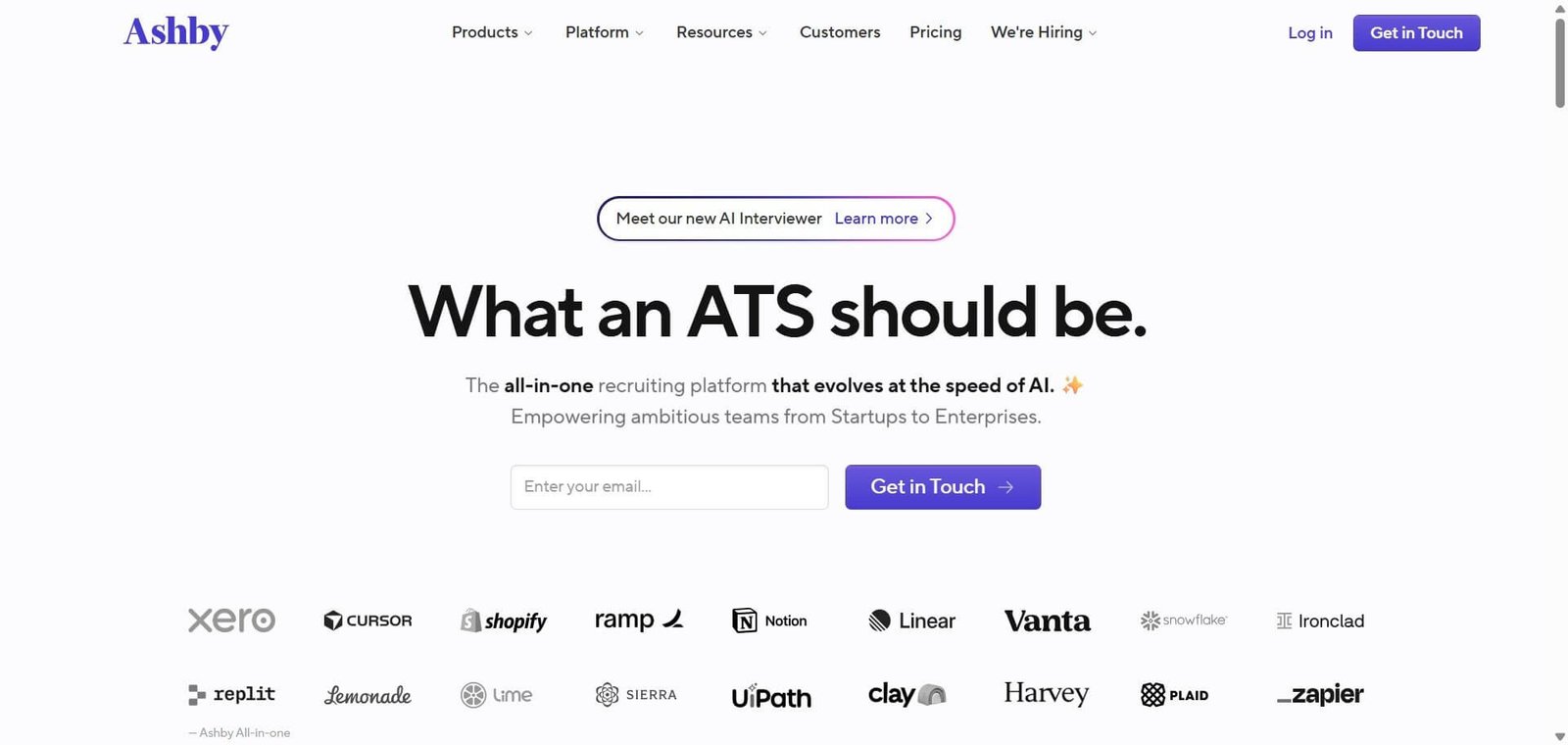
Ashby is a recruiting platform that combines applicant tracking, candidate sourcing, interview scheduling, recruiting CRM, and analytics in one system. Its AI capabilities help recruiters review applications, rediscover previous candidates, generate interview summaries, and conduct structured candidate interviews.
What makes Ashby interesting is its focus on connecting recruitment operations with detailed reporting. Instead of managing applications, candidate relationships, and hiring metrics across separate tools, recruiting teams can work within a shared platform.
However, Ashby isn’t designed for every business. Its Foundations plan starts at $400 per month, and some advanced capabilities require additional purchases. It’s worth considering for growing businesses with continuous hiring requirements, particularly those that need more control over recruitment workflows and performance data.
This Ashby review examines its features, AI capabilities, pricing, limitations, and alternatives to help you decide whether the platform is worth considering.
Verdict: Detailed Summary
Ashby is an all-in-one applicant tracking and recruiting platform designed for companies that need more than basic candidate management.
Its strongest advantage is the combination of ATS, CRM, interview scheduling, and recruiting analytics. The platform also has a growing collection of AI features, including application review, candidate assistance, talent rediscovery, and its recently released AI Interviewer.
Our assessment
| Decision factor | Verdict |
|---|---|
| Best for | Growing companies and established talent acquisition teams |
| Not ideal for | Businesses with occasional hiring requirements |
| Starting price | $400/month |
| Free plan | No permanent free plan listed |
| AI capabilities | Application review, interview assistance, sourcing and reporting |
Ashby is worth considering if recruitment is a continuous business operation and your team needs detailed hiring reports alongside candidate management.
However, its pricing and configuration requirements make it less attractive for smaller companies that only need a straightforward ATS.
User rating: G2 rated Ashby 4.7/5 based on 202 reviews. Users praise its reporting, customization, and support, while some find it complex to learn.
What Is Ashby?
Ashby is an applicant tracking and talent acquisition platform that helps companies organize their recruitment operations, from sourcing candidates to managing interviews and evaluating hiring performance.
Unlike traditional ATS products that primarily focus on tracking applications, Ashby combines several recruitment functions.
Its platform has four central components.
1. Applicant Tracking System (ATS)
The ATS manages job openings, candidate applications, recruitment stages, interview feedback, and offers.
Recruiters can configure hiring workflows, assign interviewers, create application forms, and manage candidate progression.
2. Candidate Relationship Management (CRM)
Ashby’s CRM helps recruiters maintain relationships with potential candidates before they apply for a specific position.
It includes candidate search, sourcing projects, email sequences, talent pools, and candidate rediscovery capabilities.
This is particularly useful for companies that frequently recruit for similar positions and want to maintain a pipeline of potential applicants.
3. Interview Scheduling
The scheduling system coordinates interviewer availability, candidate booking, interview reminders, and feedback collection.
Recruiters can use automated scheduling workflows to reduce the administrative work involved in coordinating multiple interview rounds.
4. Recruiting Analytics
Ashby provides dashboards and reporting tools that help teams understand recruitment performance.
Reports can cover candidate pipelines, sourcing channels, interview activity, offers, and hiring progress.
This is an important distinction because recruitment reporting often becomes more complicated as organizations add departments, hiring managers, and locations.
Ashby ATS vs Ashby Analytics
These are two different offerings.
Ashby All-in-One combines applicant tracking, sourcing, CRM, scheduling, and analytics within its broader recruitment platform.
Ashby Analytics is designed for organizations that want advanced recruitment reporting while continuing to use their existing ATS.
Companies that are happy with their current recruitment system but struggle with reporting may find Ashby Analytics worth evaluating before considering a complete platform migration.
How Ashby Works
Ashby follows a connected recruitment workflow. Recruiters configure their hiring process, manage candidate applications, coordinate interviews, and monitor recruitment performance within the platform.
A typical process looks like this:
Create job openings: Set up positions, define hiring stages, configure application forms, and assign hiring team members.
Find candidates: Publish job advertisements, search candidate profiles, build talent pools, and manage sourcing campaigns.
Review applications: Organize incoming applications and use predefined screening criteria with AI-assisted evaluations.
Schedule interviews: Create interview plans, coordinate calendars, send booking links, and collect interviewer feedback.
Manage candidate communication: Send emails, automate follow-ups, and maintain candidate records throughout recruitment.
Monitor hiring performance: Use dashboards and custom reports to identify recruitment bottlenecks and evaluate hiring activity.
The important distinction is that candidate records, interview feedback, and recruitment activity are connected.
For example, a recruiter reviewing an application can access relevant candidate information without maintaining separate tracking spreadsheets for every hiring stage.
Ashby also allows administrators to enable or disable supported AI features through organization settings. This provides some control over which AI capabilities become part of the recruitment process.
Key Features
Ashby’s feature set extends beyond traditional applicant tracking. Its AI tools serve different purposes, and understanding those differences is important when evaluating the platform.
1. Applicant Tracking System
The ATS organizes job openings, applications, candidate profiles, interview stages, and hiring decisions.
Recruiters can configure application forms, automate recruitment activities, manage feedback, and collaborate with hiring managers.
Its value comes from keeping candidate information and hiring activity within a shared system.
2. AI-Assisted Application Review
Ashby’s AI-assisted application review evaluates candidates against criteria configured by the hiring team.
Recruiters can define requirements based on resumes and application responses. The system then provides evaluations that help organize the initial application review process.
This can be useful when a position attracts hundreds of applications and recruiters need a more consistent way to assess candidates.
However, the quality of the assessment depends on the criteria configured for the role. Ashby also recommends reviewing the original application alongside the AI evaluation and flagging inaccurate results.
3. Candidate Sourcing and Recruiting CRM
Ashby includes candidate search, sourcing projects, outreach sequences, and talent pools.
Recruiters can organize potential candidates, create multi-stage outreach campaigns, and maintain relationships with people who have not applied yet.
This is useful for companies that frequently recruit for specialized positions, particularly when suitable candidates are difficult to find through inbound applications alone.
4. AI Talent Rediscovery
AI Talent Rediscovery searches an organization’s existing Ashby candidate database for people who may be suitable for newly opened positions.
Instead of starting every recruitment campaign from scratch, recruiters can identify previous applicants, silver medalists, and other candidates whose experience matches a new role.
One important limitation is availability: Ashby’s documentation lists Talent Rediscovery for Plus and Enterprise plans, not Foundations.
It also consumes AI credits based on returned candidates, with a limit of 250 credits per search.
5. Interview Scheduling Automation
Ashby’s scheduling system helps recruiters coordinate candidate availability and interviewer calendars.
Features include direct booking links, visual scheduling, calendar integrations, interview reminders, and automated interview plans.
Advanced Scheduling is available as an additional product, with capabilities such as automated interviewer replacement and more complex scheduling workflows.
For teams arranging multiple interview rounds every week, these features can reduce coordination work.
6. AI Notetaker
Ashby’s AI Notetaker records, transcribes, and summarizes interviews and debriefs.
It can also help generate feedback summaries, giving interviewers more time to focus on conversations rather than writing notes.
The feature is available as a paid add-on across its plans.
Ashby provides a trial allocation of 500 interview recordings per plan. During the trial, access to recordings is limited to 14 days, subject to the applicable retention rules.
Organizations should review recording consent, access permissions, and data retention policies before enabling it.
7. AI Interviewer
It conducts structured, job-specific interviews that candidates can complete asynchronously through a browser.
Recruiters define the interview questions, sections, and evaluation criteria. The AI conducts the conversation and can adapt follow-up questions based on candidate responses.
After completion, the hiring team can review:
Interview transcripts.
Recordings.
Per-topic evaluations.
Supporting evidence.
Interview participation and completion information.
The purpose is to provide an additional screening stage without requiring recruiters to conduct every initial conversation themselves.
8. Recruiting Analytics and AI Reporting
Recruitment analytics is one of Ashby’s most important capabilities.
The platform offers dashboards and reports covering hiring pipelines, sourcing performance, interview activity, offers, and recruitment metrics.
Its AI-assisted reporting tools can help users build reports through natural-language instructions and interpret report results.
This is particularly relevant for talent acquisition leaders who need to explain recruitment performance to company leadership.
However, AI-generated report interpretations should be checked against the underlying figures. A clear explanation is useful only when the source data and reporting definitions are correct.
9. Integrations and Ashby MCP Server
Ashby offers integrations, API access, and an MCP server for connecting recruitment data with compatible external applications.
Its MCP server, announced in June 2026, supports AI clients such as ChatGPT, Claude, and Cursor.
Depending on permissions and supported operations, connected AI clients can retrieve recruiting information and perform selected actions within Ashby.
The integration respects user-level permissions and supports approval controls for actions.
This is a useful distinction for technical teams interested in incorporating recruitment information into broader AI workflows.
AI in Recruitment: Limitations and Human Oversight
AI-assisted recruitment can reduce repetitive work, but candidate evaluation requires particular care.
Ashby’s AI features are not interchangeable:
| Capability | What it does | Important consideration |
|---|---|---|
| AI Application Review | Evaluates applications against job criteria | Recruiters must verify assessments |
| AI Talent Rediscovery | Identifies potentially suitable previous candidates | Depends on existing candidate records |
| AI Interviewer | Conducts structured asynchronous interviews | Human review is required |
| AI Notetaker | Records and summarizes interviews | Consent and retention policies matter |
| AI Report Interpretation | Explains recruiting reports | Verify interpretations against source data |
| AI Candidate Assistant | Answers questions using candidate information | Outputs should be checked for accuracy |
| Ashby MCP | Connects recruiting information with compatible AI clients | Requires appropriate permissions and configuration |
What about candidate consent and fairness?
Ashby’s AI Interviewer identifies itself as AI during candidate onboarding and obtains consent before recording begins. Candidates can decline or request an alternative format.
The evaluation process also provides supporting evidence for human reviewers.
Ashby states that its post-interview evaluations do not rely on audio or video signals, facial recognition, emotion detection, accent, pitch, or similar voice characteristics.
Nevertheless, employers remain responsible for ensuring that their recruitment processes comply with applicable employment, privacy, recording, and discrimination laws.
AI should support structured assessments, not replace accountable hiring decisions.
Who Should Use Ashby?
Ashby is most suitable for organizations that need structured recruitment operations and want greater visibility into hiring performance.
| Business requirement | Recommendation |
|---|---|
| Frequent recruitment across departments | Strong fit |
| Advanced recruitment reporting | Strong fit |
| Candidate sourcing and relationship management | Strong fit |
| Existing ATS with reporting limitations | Consider Ashby Analytics |
| Structured asynchronous screening | Evaluate AI Interviewer |
| Basic applicant tracking | Compare simpler ATS products |
| Occasional hiring | Likely excessive |
| Very limited recruitment budget | Compare lower-cost alternatives |
For startups: Foundations offers a way to introduce a more structured recruitment system, although the monthly cost needs to be justified by hiring activity.
For talent acquisition leaders: Reporting and workflow customization are useful for monitoring recruitment performance and identifying operational bottlenecks.
For recruiters: Candidate management, sourcing, communication, and scheduling automation can reduce repetitive administrative work.
For enterprise teams: Advanced permissions, reporting, integrations, and organizational configuration support more complicated hiring operations.
Pros and Cons
| Pros | Cons |
|---|---|
| Combines ATS, CRM, scheduling, and analytics | Higher starting price than basic ATS products |
| Detailed recruitment reporting | Advanced configuration takes time |
| AI-assisted application review and screening | AI assessments require human oversight |
| Flexible workflows and automation | Learning curve for hiring managers |
| Candidate sourcing and rediscovery | Some AI capabilities are restricted by plan |
| Integrations and API access | Advanced products can increase subscription costs |
Pricing & Plans
Ashby uses company-size and usage-based pricing. Its Foundations plan has published starting pricing, while Plus and Enterprise require custom quotations.
| Plan | Pricing | Intended company size |
|---|---|---|
| Foundations | $400/month | Up to 100 employees |
| Plus | Custom quote | 101-1,000 employees |
| Enterprise | Custom quote | 1,000+ employees |
| Ashby Analytics | Usage-based | Existing ATS users, generally 100+ employees |
Annual commitments receive a published 10% discount on Foundations pricing. Ashby also mentions emerging-market pricing.
What is included?
Foundations
$400 per month at the displayed pricing configuration.
1,500 AI credits per month.
200 sourcing email lookups.
Core recruiting, ATS, sourcing, and reporting capabilities.
Plus
Custom pricing.
2,500 AI credits per paid seat annually.
Additional reporting and recruitment capabilities.
Access to AI Talent Rediscovery.
Enterprise
Custom pricing.
12,500 AI credits per paid seat annually.
Enterprise-level permissions and reporting.
Additional organizational and administrative capabilities.
Additional costs to consider
Some capabilities require separate purchases.
| Add-on | Pricing information |
|---|---|
| AI Notetaker | Paid add-on after trial |
| AI Interviewer | 200 initial interviews included; additional purchases available |
| Advanced Scheduling | Paid add-on |
| Additional AI credits | Purchased separately |
| Additional sourcing email lookups | Paid add-on |
| Candidate data enrichment | Paid add-on |
One important distinction is that AI credits and AI Interviewer allocations are separate.
AI credits power certain features such as application review and other AI-assisted workflows. AI Interviewer uses its own interview allocation.
The AI Notetaker also has a separate trial allocation of 500 recordings. It should not be confused with the 200 AI Interviewer allocation.
Is Ashby worth the price?
For companies recruiting continuously across multiple departments, the cost may be justified by having recruitment operations and reporting in one platform.
However, businesses with occasional hiring requirements should compare simpler ATS products before committing to a $400 monthly subscription.
Best Alternatives & Comparisons
Ashby competes with several established recruiting platforms. The best alternative depends on recruitment volume, reporting requirements, workflow complexity, and budget.
| Platform | Primary strength | Best suited for |
|---|---|---|
| Ashby | Integrated ATS, CRM, and analytics | Growing recruitment teams |
| Greenhouse | Structured hiring and interview processes | Organizations standardizing recruitment |
| Lever | Candidate relationship management | Teams prioritizing candidate engagement |
| Workable | Accessible recruitment workflows | Small and mid-sized businesses |
| SmartRecruiters | Enterprise talent acquisition | Larger organizations |
| Manatal | Recruitment management and affordability | Smaller recruiting teams and agencies |
1. Greenhouse
Greenhouse is worth considering when structured interviewing, standardized scorecards, and consistent hiring processes are the main priorities.
Compared with Ashby, its appeal is particularly strong for organizations looking to establish consistent evaluation practices across hiring teams.
2. Lever
Lever combines applicant tracking and candidate relationship management.
It is worth comparing if your recruiting team spends significant time sourcing passive candidates and maintaining relationships with potential applicants.
3. Workable
Workable is a practical alternative for small and mid-sized businesses that want recruitment management without necessarily adopting an extensive recruiting operations platform.
It is worth evaluating when a simpler purchasing process and more straightforward hiring workflows are priorities.
4. SmartRecruiters
SmartRecruiters is designed for larger talent acquisition operations and enterprise recruitment requirements.
Organizations with complicated hiring structures should compare its enterprise capabilities against Ashby’s Enterprise offering.
5. Manatal
Manatal is worth considering for recruitment agencies and smaller businesses looking for a more affordable recruitment management system.
It offers candidate management and AI-assisted recruitment functionality, although its overall product scope differs from Ashby’s broader recruiting platform.
Which should you choose?
Choose Ashby when integrated recruitment workflows and reporting are priorities. Consider Greenhouse for structured interviewing, Lever for candidate engagement, Workable for simpler hiring operations, SmartRecruiters for enterprise recruitment, and Manatal when affordability matters more.
Compare the actual features included in each vendor’s quotation before making a decision.
Is Ashby Worth It?
Ashby is worth considering if your organization needs a recruiting platform that connects applicant tracking, candidate sourcing, interview scheduling, and analytics.
Its strongest advantage is the way these functions work together. Recruiters can manage candidate information, hiring activity, and reporting without maintaining several disconnected systems.
The addition of AI Interviewer also expands its screening capabilities, particularly for organizations handling high application volumes.
However, Ashby is not automatically the right choice for every recruiting team.
Its $400 monthly starting price, configuration requirements, and paid add-ons may be difficult to justify for businesses with limited hiring activity.
Organizations should also evaluate whether AI-assisted assessments fit their recruitment policies and whether they have appropriate human review processes.
For teams that already have an ATS but need stronger reporting, Ashby Analytics may be a more practical starting point than replacing their entire recruitment system.
Frequently Asked Questions (FAQ)
Ashby is an all-in-one recruiting platform that combines applicant tracking, candidate sourcing, recruitment CRM, interview scheduling, and analytics. Recruiters use it to manage job openings, organize candidates, coordinate interviews, and monitor hiring performance.
Ashby’s Foundations plan starts at $400 per month for companies with up to 100 employees. Plus and Enterprise plans require custom quotations, while optional products and usage-based features can increase the total subscription cost.
Yes. Ashby offers AI-assisted application review, which evaluates applications against criteria configured by the hiring team. It also offers AI Interviewer for structured, asynchronous candidate interviews. Recruiters must review the evidence and make hiring decisions.
Ashby offers a Foundations plan for companies with up to 100 employees. However, its $400 monthly starting price may be difficult to justify for businesses with limited hiring activity. Its value is more apparent when recruitment is a regular operational requirement.
Ashby ATS is part of its broader recruiting platform, covering applicant tracking, sourcing, scheduling, and hiring workflows. Ashby Analytics provides advanced recruitment reporting to organizations that want to retain their existing ATS.
Greenhouse, Lever, Workable, SmartRecruiters, and Manatal are worth evaluating. The best option depends on recruitment volume, reporting requirements, workflow complexity, and budget.
Final Recommendation
Ashby is best suited for growing companies and established talent acquisition teams that want more control over recruitment operations, candidate management, and hiring performance.
Its combination of ATS, CRM, scheduling, and analytics makes it particularly relevant for organizations managing multiple positions and hiring stakeholders. Its expanding AI capabilities also offer practical applications, from reviewing incoming applications to conducting structured asynchronous interviews.
However, the platform’s pricing and configuration requirements make it less suitable for businesses with occasional hiring needs. Additional AI products and scheduling capabilities should also be included when calculating the actual subscription cost.
If advanced recruitment reporting and integrated hiring workflows are priorities, Ashby deserves a place on your shortlist. If affordability or simpler applicant tracking matters more, compare Workable or Manatal before committing.
Visit the official Ashby website to explore its product and request a demonstration. You can also compare other recruitment platforms before choosing a solution for your team.