Workday
The enterprise AI HCM platform — unified HR, payroll, talent, workforce planning, and Illuminate AI that automates workflows and surfaces workforce intelligence for large organisations.
Workday Review: The Enterprise HCM That Repositioned as an AI Platform for Managing People, Money, and Agents
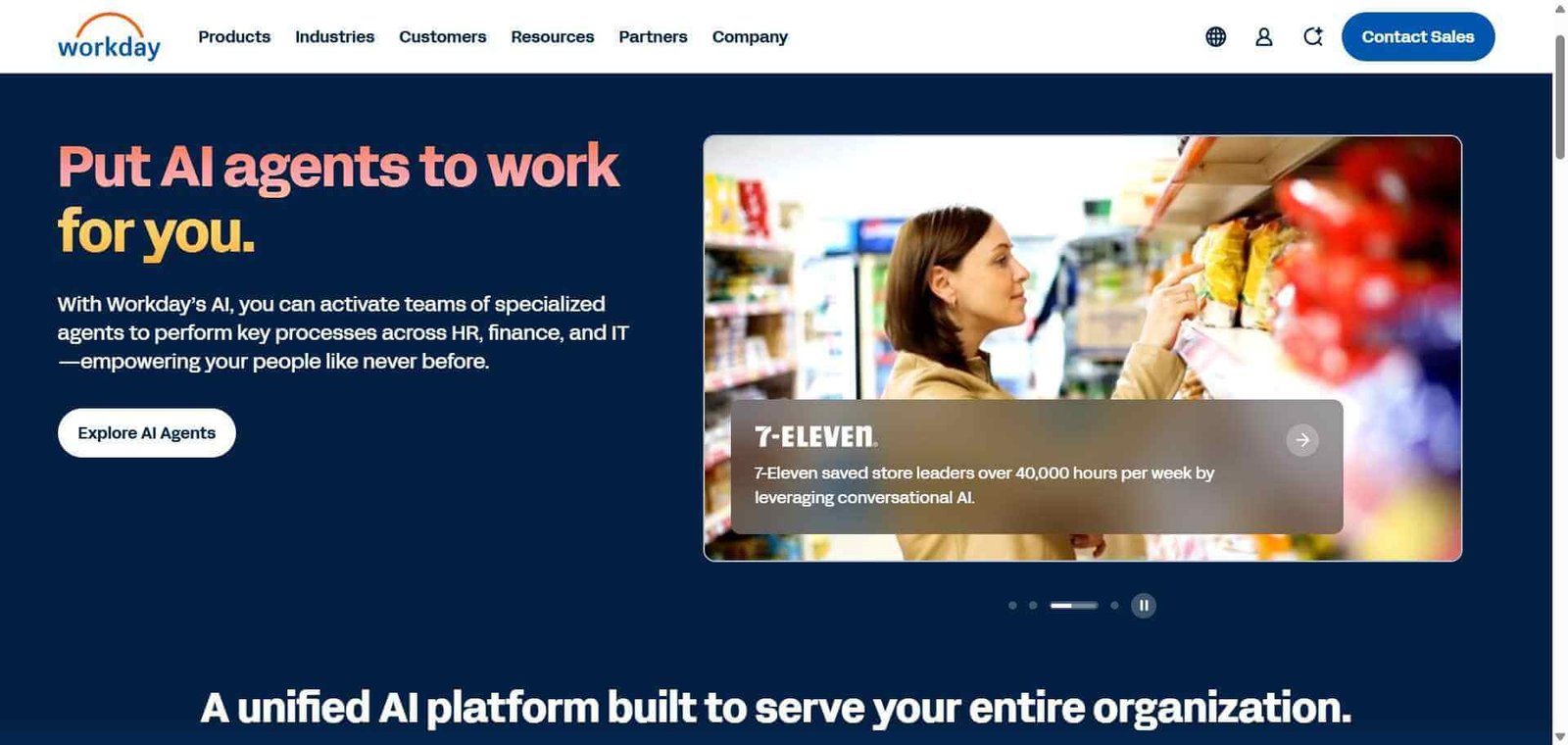
Enterprise HR software has historically been defined by what it centralises: employee records, payroll, benefits, and performance management in one system rather than five. Workday built its reputation on this foundation — a unified data model where every HR function shares the same underlying data rather than synchronising between siloed systems. In 2026, Workday’s positioning has shifted. The company now presents itself as an AI platform for managing people, money, and agents, with Workday Illuminate as the AI layer that powers intelligent assistance, automation, and agentic workflows across the full suite. For large organisations that want AI embedded in the HR platform they already run rather than bolted on from a third party, Workday Illuminate’s integration depth is the most compelling argument in the enterprise HCM category.
Quick Summary
Workday is an enterprise cloud HCM platform providing Core HCM with employee records and organisational management, Global Payroll processing in select countries with partner integrations covering 180 plus countries, Recruiting with AI-assisted sourcing and screening, Skills Cloud for AI-driven skills intelligence, Talent Management covering performance and succession, Workforce Planning with AI-driven demand forecasting, Benefits Administration, Workday Illuminate for native AI across the platform, and Workday Marketplace for third-party integrations. Rated 4.0/5 on G2 from 1,500 plus reviews. Custom enterprise pricing. Reference customers include Coveo, which reduced workforce planning time by 80% after implementation.
Is it worth using? Yes for large enterprises and multinational organisations above 500 employees that want a unified HCM platform with AI embedded natively across HR, payroll, talent, and workforce planning in one consistent data model. Workday is overbuilt and overpriced for small and mid-market organisations.
Who should use it? CHROs, HR Operations leaders, and HR technology teams at large enterprises and multinationals above 500 employees who need an integrated, scalable HCM platform with global reach, regulatory compliance, and AI-powered workforce intelligence.
Who should avoid it? Small and mid-market companies under 500 employees where the implementation cost, complexity, and per-employee pricing are disproportionate to the HR workflow scale. BambooHR, Personio, or Gusto are more appropriate at smaller headcounts.
Verdict Summary
Best for
- Large enterprises and multinationals above 500 employees that want every HR function — payroll, talent, performance, planning, and benefits — in one unified data model with a single system of record that eliminates synchronisation between disparate HR tools
- Organisations that want AI embedded natively in their HCM rather than integrated from a third party. Workday Illuminate powers skills intelligence, workforce demand forecasting, sentiment analysis, and AI-assisted recruiting inside the platform rather than requiring a separate AI HR tool
- Companies with complex global payroll needs across multiple countries who want a platform with payroll capabilities in select countries and partner integrations covering 180 plus countries, with change management and pay equity tracking built in
Not for
- Companies under 500 employees where Workday’s implementation timeline, cost, and complexity are disproportionate. BambooHR and Personio are built for this scale
- Organisations wanting fast self-service deployment. Workday typically requires external implementation consultants and a 6 to 12 month deployment timeline, not a platform that HR teams configure independently
- Buyers who want transparent published pricing before a sales engagement. Workday does not publish pricing and requires a custom quote based on module selection, headcount, and geography
Rating
⭐⭐⭐⭐ 4.0 / 5
(G2: 4.0/5 from 1,500 plus reviews)
What Is Workday?
Workday was founded in 2005 by Dave Duffield and Aneel Bhusri — both former PeopleSoft executives who built the company on a cloud-native architecture at a time when enterprise HR software was predominantly on-premises. The company went public on NASDAQ in 2012 and has grown into one of the two dominant enterprise HCM platforms globally alongside SAP SuccessFactors.
The platform’s architectural differentiator is its unified data model: all HR, payroll, talent, and planning functions operate on a single shared dataset rather than synchronising between separate modules. In 2026, Workday Illuminate is the AI layer built on top of this unified data — powering intelligent HR workflow assistance, agentic task automation, skills intelligence, predictive workforce planning, and AI-assisted recruiting without requiring data to leave the Workday environment for an external AI tool.
How Workday Works
- Manage the employee lifecycle in Core HCM. Workday’s Core HCM covers the full employee record: hire, transfer, promote, and terminate with automated workflow routing, organisational hierarchy management, and self-service access for employees and managers through web and mobile.
- Process payroll globally. Workday processes payroll natively in the US, Canada, the UK, France, and a growing number of countries, with partner integrations through Workday’s payroll partner network covering 180 plus countries for markets where native payroll is not available. Multi-currency processing, local tax calculations, and statutory deduction handling are automated per jurisdiction.
- Source and screen candidates with AI Recruiting. Workday Recruiting uses AI to surface candidate matches from the talent pool, auto-screen applications against role requirements, and score candidates by predicted fit. AI-assisted interview scheduling and offer management reduce administrative overhead at each stage.
- Build a skills-based organisation with Skills Cloud. Workday Skills Cloud maps the skills across the entire workforce from employee profiles, completed learning, job history, and AI inference. Skills-based talent matching, internal mobility recommendations, and succession planning use the Skills Cloud as the foundation.
- Forecast workforce demand with AI Planning. Workday Workforce Planning uses AI-driven demand forecasting to model headcount needs by scenario, flag skill gaps before they become vacancies, and connect workforce planning decisions to financial planning in the same platform.
- Surface insights with Workday Illuminate. The AI layer across the platform surfaces intelligent suggestions, automates repetitive workflows, generates HR policy answers in natural language, and runs agentic tasks across HR processes without requiring human intervention at every step.
Key Features
- Core HCM: employee records, organisational management, self-service, and lifecycle workflow automation
- Workday Illuminate: native AI layer for intelligent assistance, agent-driven automation, and workforce intelligence across all modules
- Global Payroll: native payroll in select countries, partner network covering 180 plus countries
- Recruiting: AI-assisted candidate sourcing, screening, scoring, and interview scheduling
- Skills Cloud: AI-driven skills mapping across the entire workforce for talent matching and internal mobility
- Talent Management: performance management, succession planning, and goal alignment
- Workforce Planning: AI-driven demand forecasting, scenario modelling, and headcount planning connected to financial planning
- Benefits Administration: self-service benefits enrolment, life event management, and retirement planning
- Learning Management: course delivery, completion tracking, and skills-based learning assignment
- AI sentiment analysis for employee engagement monitoring and retention risk identification
- Compensation Management: global pay packages, pay equity tracking, and currency support
- Workday Marketplace: 600 plus partner integrations for specialist functionality
- Mobile app for iOS and Android
- Custom enterprise pricing based on modules, headcount, and geography
- Reference customer Coveo: 80% reduction in workforce planning time and 50% improvement in employee efficiency
Real-World Use Cases
- Workforce planning acceleration (Coveo): Coveo, a cloud-based AI platform company, switched to Workday and reduced workforce planning time by 80% while improving employee efficiency by 50%. The unified HCM, CRM, and financial data within Workday gave the planning team real-time workforce intelligence that the previous fragmented tool stack could not consolidate.
- Skills-based internal mobility: A multinational technology company uses Workday Skills Cloud to identify employees whose current skills match an open role in a different business unit before external recruiting begins. The AI skills matching surfaces 12 internal candidates for a data engineering role, four of whom are hired internally, reducing time-to-fill from 67 days to 28 days and external recruiting costs for the quarter.
- AI-assisted payroll compliance: A global retail organisation runs payroll across 15 countries through Workday’s native payroll and partner integrations. When France updates statutory overtime calculation rules mid-year, Workday’s compliance engine flags the affected payroll configurations and prompts the HR Operations team to review affected employee records before the next payroll cycle processes.
- Illuminate AI manager workflow: A newly promoted people manager at a 3,000-employee organisation asks Workday Illuminate: “What is our parental leave policy and how do I initiate a leave request for a team member?” Illuminate surfaces the policy answer in natural language, generates a pre-filled leave request based on the team member’s employment details, and routes it through the approval workflow without the manager navigating multiple platform screens.
Pros and Cons
| Pros | Cons |
|---|---|
| Unified data model: every HR, payroll, talent, and planning function operates on a single dataset. Eliminates the synchronisation errors and reporting inconsistencies that plague multi-system HR stacks | Implementation requires external consultants and a 6 to 12 month deployment timeline. Workday is not a platform that HR teams configure independently, and implementation costs can approach or exceed first-year licensing fees |
| Workday Illuminate native AI across all modules. Skills intelligence, workforce demand forecasting, sentiment analysis, and agentic workflow automation are embedded in the platform rather than requiring a third-party AI HR tool | No published pricing. All costs require a custom sales engagement based on module selection, headcount, and geography. Buyers cannot self-qualify on budget without a sales conversation |
| Global payroll coverage: native in select countries with partner network covering 180 plus countries. One of the broadest global payroll footprints in the enterprise HCM category | Navigation complexity is a consistent user complaint across G2, Capterra, and Software Advice. Finding specific features often requires multiple clicks, and first-time users face a meaningful learning curve |
| Coveo reference: 80% workforce planning time reduction and 50% employee efficiency improvement. Quantified customer results from a named, credible reference at scale | AI features carry list prices 20 to 40% above their incremental value per independent benchmarking. Buyers who accept AI module additions without negotiation routinely overpay for capabilities that could be bundled in larger deals |
| 600 plus Workday Marketplace partner integrations and payroll partner network for 180 plus countries. The broadest integration ecosystem in the enterprise HCM category for specialist functionality | Workday is built for large enterprises above 500 employees. Small and mid-market companies pay enterprise prices and implementation complexity for a platform significantly overbuilt for their HR workflow scale |
Pricing & Plans
Workday does not publish standard pricing. All pricing is custom-quoted based on:
- Modules selected: Core HCM, Payroll, Recruiting, Talent, Planning, Learning, and others
- Employee headcount: per-employee-per-month (PEPM) model standard for enterprise HCM
- Geography: number of countries and payroll jurisdictions
- Implementation services: typically quoted separately from licensing
Estimated ranges from third-party benchmark data:
- PEPM estimates range from $45 to $270/employee/month depending on module depth
- A 1,000-employee company running Core HCM plus Payroll typically pays $600,000 to $1,200,000/year in licensing
- Implementation costs from implementation partners typically equal 1 to 2 times first-year licensing
- Annual contracts with multi-year terms standard. Renewal price increases of 5 to 10% per year common without negotiated caps
Contact Workday at workday.com for a custom quote. Negotiate AI module inclusions and annual escalation caps before signing.
Best Alternatives & Comparisons
- BambooHR — Better for small and mid-market companies under 500 employees wanting accessible HR software without enterprise implementation complexity or cost
- Personio — Better for European mid-market companies wanting an HR platform built for the European regulatory environment at accessible pricing
- Rippling — Better for US companies wanting HR, IT, and payroll bundled with faster implementation and more transparent pricing
- SAP SuccessFactors — Better for large enterprises already deep in the SAP ecosystem wanting native integration between HCM and ERP
Frequently Asked Questions (FAQ)
Workday is an enterprise cloud HCM platform providing unified HR, global payroll, AI-assisted recruiting, Skills Cloud, talent management, workforce planning, and Workday Illuminate AI across all modules. Used by large enterprises and multinationals. Custom enterprise pricing based on modules and headcount.
Workday Illuminate is Workday’s native AI layer, launched and expanded significantly in 2026. It powers intelligent workflow assistance, agent-driven HR task automation, skills intelligence, workforce demand forecasting, AI sentiment analysis, and natural language HR policy answers across all Workday modules without requiring data to leave the platform.
Workday does not publish pricing. Based on third-party benchmark data, PEPM estimates range from $45 to $270/employee/month depending on module depth. A 1,000-employee company typically pays $600,000 to $1,200,000/year in licensing. Implementation costs from external consultants typically equal 1 to 2 times first-year licensing fees.
No. Workday is designed for enterprises above 500 employees. The implementation timeline of 6 to 12 months, external consultant requirement, and enterprise pricing make it disproportionate for small and mid-market companies. BambooHR, Gusto, or Personio are more appropriate for smaller organisations.
Workday processes payroll natively in select countries including the US, Canada, UK, and France. For markets without native payroll, Workday’s payroll partner network covers 180 plus countries through certified integrations, giving multinationals broad global payroll coverage from one platform.
Both are enterprise HCM platforms serving large organisations with global workforces. Workday has a more modern cloud-native architecture, stronger user experience ratings, and the Illuminate AI layer. SAP SuccessFactors has deeper native integration with SAP ERP, stronger global payroll coverage, and longer enterprise adoption history. Workday for organisations prioritising modern UX and AI-native HCM. SAP SuccessFactors for organisations already running SAP ERP who want native system integration.
Final Recommendation
Workday is the most capable AI-embedded enterprise HCM platform for large organisations that want HR, payroll, talent, and workforce planning in one unified data model with AI running natively across every function rather than integrated from outside. The Illuminate AI layer, Skills Cloud for skills-based workforce intelligence, and Coveo’s documented 80% workforce planning time reduction validate that the platform delivers measurable business outcomes at scale. For any CHRO or HR technology leader at an enterprise above 500 employees who is running fragmented HR tools that do not share a data model, Workday provides the consolidation and AI intelligence layer that transforms HR operations from administrative function to strategic workforce capability.
Next steps