
Pecan AI
Ask a business question, get a deployed predictive model — churn, LTV, demand forecasting, and next best offer without a data science team.
Pecan AI Review: The Predictive Analytics Platform That Removes the Data Science Bottleneck From Business Intelligence
Predictive analytics has a well-documented deployment problem — the business team knows what they want to predict, the data exists, but the data science expertise required to build, validate, and deploy a reliable model sits in a team with a six-month backlog. Pecan AI eliminates this bottleneck by automating every step that previously required data science expertise — data preparation, feature engineering, model building, evaluation, and deployment — and replacing the technical workflow with a conversational AI agent that turns a business question into a deployed prediction in days rather than months. The result is predictive intelligence in the hands of business teams who previously had to wait for it.
Quick Summary
Pecan AI is a predictive analytics platform combining a Predictive AI Agent for conversational model building with SQL-based Predictive Notebooks for data analysts — automating data preparation, feature engineering, model building, validation, and deployment for use cases including customer churn, demand forecasting, lifetime value, next best offer, predictive maintenance, and sales forecasting, with ISO 27001 and SOC 2 Type II certification and integrations with Salesforce, HubSpot, Snowflake, and BI tools.
Is it worth using? Yes for business and data teams at mid-market and enterprise companies who want predictive model capability without the data science team bottleneck — Pecan’s automated pipeline compresses a months-long data science project into days for the most common business prediction use cases.
Who should use it? Data analysts, marketing analysts, RevOps teams, and business intelligence leaders at mid-market and enterprise companies who want to deploy predictive models for churn, LTV, and demand forecasting without data science or data engineering resource allocation.
Who should avoid it? Very small companies whose data volume is insufficient for reliable predictive modelling, or organisations with highly bespoke prediction requirements that fall outside Pecan’s automated model building capabilities.
Verdict Summary
Best for
- Marketing and CRM teams who want to predict customer churn, lifetime value, and next best offer from their existing customer data without submitting a request to a data science team — Pecan’s Predictive AI Agent handles the technical pipeline and delivers predictions in Salesforce or HubSpot
- Data analysts who want to move beyond SQL reporting into predictive modelling using SQL-based Predictive Notebooks without learning Python, R, or machine learning libraries from scratch
- Operations teams who need demand forecasting, capacity planning, and predictive maintenance — common use cases where Pecan’s automated pipeline produces deployable models from operational data without custom ML development
Not for
- Very small companies or startups with insufficient historical data to train reliable predictive models — predictive modelling requires meaningful data volume to produce trustworthy predictions
- Data science teams who need full model customisation, hyperparameter control, and custom architecture options that Pecan’s automated pipeline abstracts away
- Organisations whose prediction requirements are so unusual that no off-the-shelf model building approach can address them without custom ML engineering
Rating
⭐⭐⭐⭐ 4.2 / 5
What Is Pecan AI?
Pecan AI is a predictive analytics platform founded in 2018 that has positioned itself around one specific mission — removing the barriers to AI adoption that stop business teams from getting predictive models into production. Its Predictive GenAI technology combines generative AI for user interaction with automated machine learning for model building — allowing business users to describe a prediction problem in natural language and receive a deployed prediction model rather than a research output.
The platform’s two primary interfaces serve different users within the same organisation — the Predictive AI Agent is designed for business and KPI owners who want conversational model building, while Predictive Notebooks provide SQL-based model building for data analysts who want more control without requiring data engineering or Python expertise.
How Pecan AI Works
- Define the prediction problem. Connect Pecan to the data source — Snowflake, BigQuery, Redshift, or other data warehouses — and describe the business question in natural language: “which customers are likely to churn in the next 90 days?” or “what is the predicted lifetime value of each new customer?”
- Predictive AI Agent builds the model. Pecan’s AI Agent analyses the available data, automatically handles data preparation and feature engineering, selects the appropriate model architecture, builds and trains the model, and validates its accuracy — all without requiring the user to specify any of these technical steps.
- Review predictions and model transparency. The platform provides explainable predictions — showing which features drive each prediction and how confident the model is — alongside the aggregate accuracy metrics that allow teams to assess whether the model is reliable for production use.
- Deploy predictions to business tools. Predictions are delivered to Salesforce, HubSpot, Snowflake, BI dashboards, or directly through the Act Dashboard — making prediction scores available at the account, customer, or transaction level in the tools teams already use.
- Use Predictive Notebooks for analyst control. Data analysts who want more control use Predictive Notebooks — a SQL-based interface that exposes the model building process while automating the machine learning steps that require Python expertise.
- Monitor and retrain automatically. Pecan monitors deployed model performance over time and manages retraining when model accuracy degrades — maintaining prediction quality without requiring data science oversight.
Key Features
- Predictive AI Agent for conversational predictive model building from business questions
- SQL-based Predictive Notebooks for data analyst control without data engineering dependencies
- Automated data preparation, feature engineering, model selection, training, and validation
- Explainable predictions with feature importance and confidence scoring
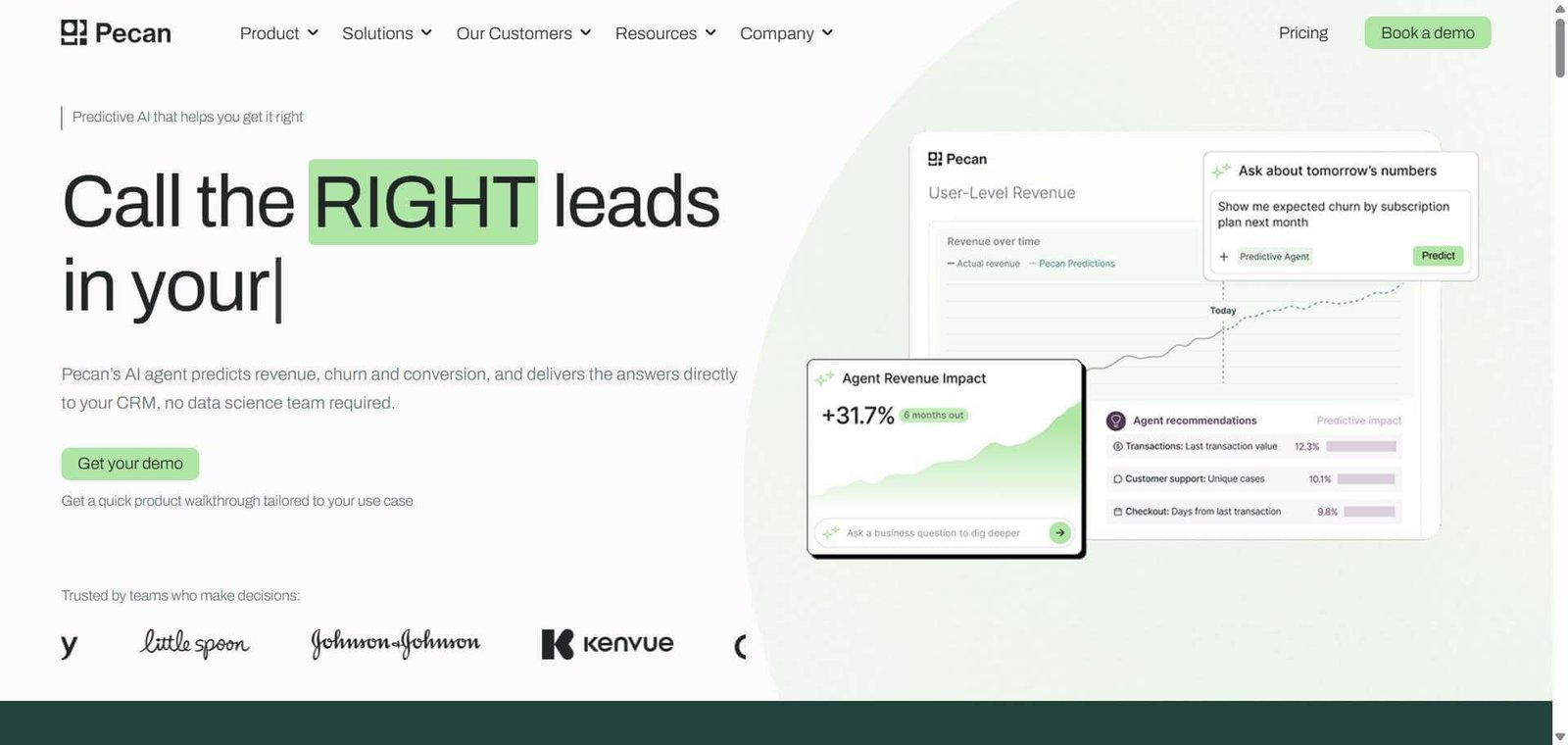
- Act Dashboard showing key metrics, predicted outcomes, and recommended next steps
- Pre-built use case templates for churn, LTV, demand forecasting, next best offer, predictive maintenance, and sales forecasting
- Integrations with Salesforce, HubSpot, Snowflake, BigQuery, Redshift, and BI tools
- Hyper-granular predictions at the individual entity level — per customer, per account, per transaction
- ISO 27001 and SOC 2 Type II certified — enterprise security and compliance
- Granular access controls, SIEM integration, monitoring logs, and penetration testing
Real-World Use Cases
- Churn prediction for subscription business: A SaaS company’s marketing team asks Pecan’s AI Agent “which customers are most likely to churn in the next 60 days?” — the Agent builds a churn model from their subscription and product usage data, delivers a risk score for every account to Salesforce, and the customer success team prioritises intervention on the highest-risk cohort before renewal conversations begin.
- Demand forecasting for retail: A retail operations team uses Pecan to forecast product demand for the next quarter — the automated pipeline builds a demand model from historical sales, seasonal patterns, and promotional data, producing SKU-level forecasts that inform inventory purchasing decisions six weeks in advance.
- LTV prediction for marketing investment: A DTC brand’s growth team uses Pecan to predict customer lifetime value at the point of first purchase — the LTV model allows the performance marketing team to set bid adjustments by predicted LTV cohort, investing more in acquiring customers the model identifies as high-value rather than optimising purely for acquisition cost.
- Analyst-led predictive modelling: A data analyst uses Pecan’s Predictive Notebooks to build a next best offer model for the company’s CRM — writing SQL to define the prediction problem and training data, while Pecan automates the feature engineering and model building steps that previously required data science resource.
Pros and Cons
| Pros | Cons |
|---|---|
| Predictive AI Agent removes the data science bottleneck — business teams deploy predictive models without waiting months for data science resource | Starting at $950/month — meaningful investment that requires clear ROI case before commitment |
| Automated pipeline covers data prep, feature engineering, model building, and deployment — compressing months of data science work into days | Not suitable for very small companies without sufficient historical data volume for reliable predictive modelling |
| Explainable predictions with feature importance build trust in model outputs with non-technical stakeholders | Highly bespoke or novel prediction problems may require more model customisation than the automated pipeline supports |
| ISO 27001 and SOC 2 Type II certification meets enterprise security requirements | Pricing that starts at $950/month positions Pecan above SMB budgets |
| Pre-built use case templates for churn, LTV, demand forecasting, and others reduce setup time for common business prediction problems | Full model customisation and hyperparameter control limited compared to code-first ML platforms for data science teams |
Pricing & Plans
Pecan AI pricing starts at approximately $950/month for entry-level deployments. Custom enterprise pricing is available for larger teams and higher data volumes. Contact pecan.ai for a demo and custom quote based on your prediction use cases and data environment.
Best Alternatives & Comparisons
- Obviously AI — Better for simpler no-code predictive modelling at lower entry pricing for smaller teams
- DataRobot — Better for enterprise automated ML with the deepest model governance and lifecycle management for data science teams
- Julius AI — Better for conversational data analysis through natural language questions on uploaded data
- Polymer — Better for automatic dashboard generation and data exploration without predictive modelling depth
Frequently Asked Questions (FAQ)
Pecan AI is a predictive analytics platform with a Predictive AI Agent that turns business questions into deployed prediction models — covering churn, LTV, demand forecasting, and next best offer — with automated data preparation, feature engineering, and model building without requiring data science expertise.
Pecan AI starts at approximately $950/month for entry-level deployments. Custom enterprise pricing requires contact with the Pecan AI team for a demo and quote based on specific use cases and data environment.
Pecan AI covers the most common business prediction use cases — customer churn, lifetime value, demand forecasting, next best offer, predictive maintenance, sales forecasting, and capacity planning — through pre-built templates alongside the ability to define custom prediction problems.
No — the Predictive AI Agent is designed for business and KPI owners without data science expertise, handling all technical steps automatically. Predictive Notebooks provide SQL-based model building for data analysts who want more control without requiring Python or machine learning knowledge.
Pecan integrates with Snowflake, BigQuery, Redshift, and other data warehouses for data input, and delivers predictions to Salesforce, HubSpot, BI tools, and the Act Dashboard for business consumption.
Pecan AI is designed for mid-market and enterprise data teams needing production-grade predictive models with full pipeline automation, explainability, and enterprise security starting at $950/month. Obviously AI is designed for business analysts wanting simpler no-code prediction at lower pricing. Pecan for enterprise predictive analytics with full pipeline automation. Obviously AI for simpler team prediction use cases at accessible pricing.
Final Recommendation
Pecan AI is the most complete automated predictive analytics platform for business and data teams who want to close the gap between the predictions they need and the data science capacity available to build them. The Predictive AI Agent, automated pipeline, and pre-built use case templates compress months of data science project time into days for the most common business prediction problems — delivering predictions in the business tools teams already use rather than requiring a new workflow to consume them. For any organisation whose data science team backlog is the bottleneck between business intelligence and predictive intelligence, Pecan AI provides the automation that closes that gap.
Next steps