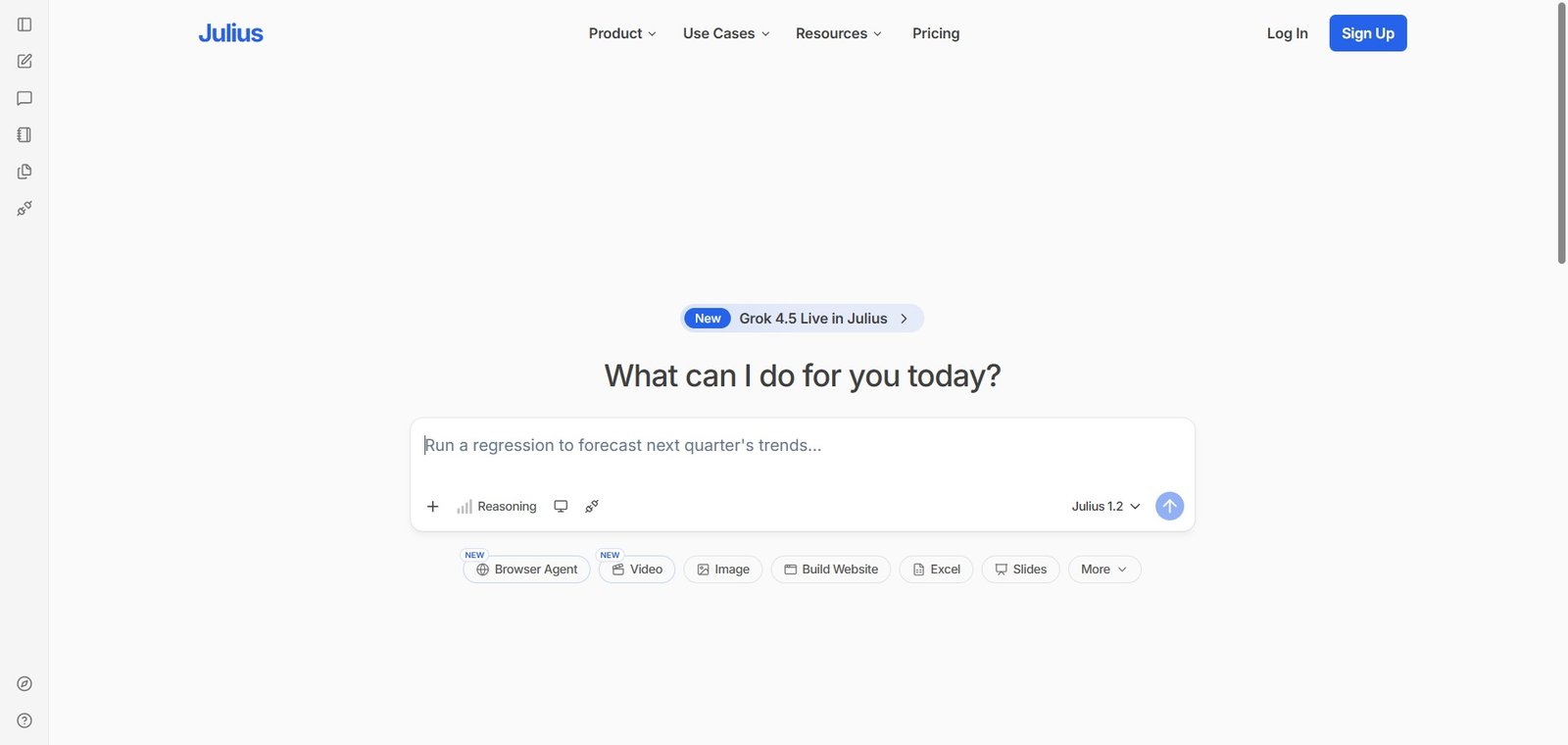
Ask questions about your data in plain English — Julius analyses, visualises, and explains instantly.
Data analysis has a skills barrier — extracting meaningful insights from spreadsheets and databases typically requires SQL knowledge, Python or R proficiency, or expertise in BI tools that take months to learn. Julius AI removes this barrier entirely by letting anyone ask questions about their data in plain English and receiving accurate analysis, charts, and explanations in return. For business teams, marketers, and analysts who want insights from their data without the technical overhead of traditional analysis tools, Julius AI delivers a genuinely accessible alternative.
Julius AI is an AI data analysis platform that connects to spreadsheets, CSV files, and databases to answer analytical questions, generate charts and visualisations, perform statistical analysis, and produce written summaries through natural language conversation — without requiring SQL or coding knowledge.
Is it worth using? Yes for business professionals, marketers, and analysts who want to extract insights from their data through conversation rather than code, and for teams who want to democratise data access without requiring every member to learn BI tools.
Who should use it? Business analysts, marketing managers, operations teams, and any professional who regularly needs to analyse spreadsheet or CSV data and wants AI to handle the technical analysis layer.
Who should avoid it? Data scientists and engineers who need full SQL and Python control for complex analysis pipelines, where traditional data tools provide more power and flexibility.
Best for
Not for
Rating
⭐⭐⭐⭐ 4.3 / 5
Julius AI is a conversational data analysis platform that connects to data sources — CSV files, Excel spreadsheets, Google Sheets, and databases — and allows users to ask analytical questions in plain English. Julius interprets the question, writes and executes the analysis code internally, and returns the result as a clear answer, chart, table, or written summary — without the user ever seeing or writing code.
The platform handles a wide range of analysis tasks — from simple aggregations and filters to statistical analysis, trend identification, correlation analysis, forecasting, and data cleaning — making it useful for both quick exploratory questions and more structured analytical workflows.
| Pros | Cons |
|---|---|
| Natural language interface removes the SQL and coding barrier for non-technical users | Less suitable for complex multi-step analysis pipelines requiring full programmatic control |
| Conversational follow-up maintains context making exploratory analysis genuinely fluid | Data privacy requires careful consideration for sensitive business data |
| Chart generation from questions removes the manual visualisation building step | Analysis accuracy requires verification for high-stakes business decisions |
| Code transparency shows the logic behind each result for trust and learning | Free plan limits analysis volume for regular business use |
| Handles statistical analysis including forecasting that most non-technical users cannot perform | Enterprise data warehouse integration less developed than traditional BI tools |
Julius AI is an AI data analysis platform that connects to spreadsheets and databases to answer analytical questions, generate charts, perform statistical analysis, and produce written summaries through natural language conversation without requiring coding knowledge.
Yes, Julius AI offers a free plan with limited monthly analyses. The Basic plan at $20/month provides more analyses with all data connections and advanced charts.
Julius supports CSV files, Excel spreadsheets, Google Sheets, and database connections — covering the most common data formats that business professionals use for analysis.
Julius AI internally generates and executes code to perform the analysis — but users never see or write the code themselves. The code transparency feature shows what was executed for users who want to understand the analysis logic.
Julius AI performs accurate analysis for standard analytical questions on well-structured data. For high-stakes business decisions, results should be verified, particularly for complex statistical analyses. The code transparency feature helps technical users spot any analysis issues.
Julius AI is a conversational analysis tool where you ask questions about uploaded data. Rows AI is a spreadsheet application with AI capabilities built in. Julius is better for exploratory analysis through conversation; Rows AI for users who want a spreadsheet interface with AI assistance.
Julius AI is the most accessible AI data analysis tool available for business professionals who have data but lack the technical skills to extract full value from it. The conversational interface, automatic chart generation, and statistical analysis capabilities deliver insights that previously required a data analyst or BI tool expertise — making data-informed decision-making genuinely accessible to every team member regardless of technical background. For any professional who regularly opens a spreadsheet wishing they could just ask it a question, Julius AI is exactly that.
Next steps