
Kustomer
CRM-first AI customer service — unified customer timeline, AI that handles 40% of conversations automatically, and omnichannel support in one platform.
Kustomer Review: The CRM-First Customer Service Platform That Gives Agents the Full Customer Story Before They Say Hello
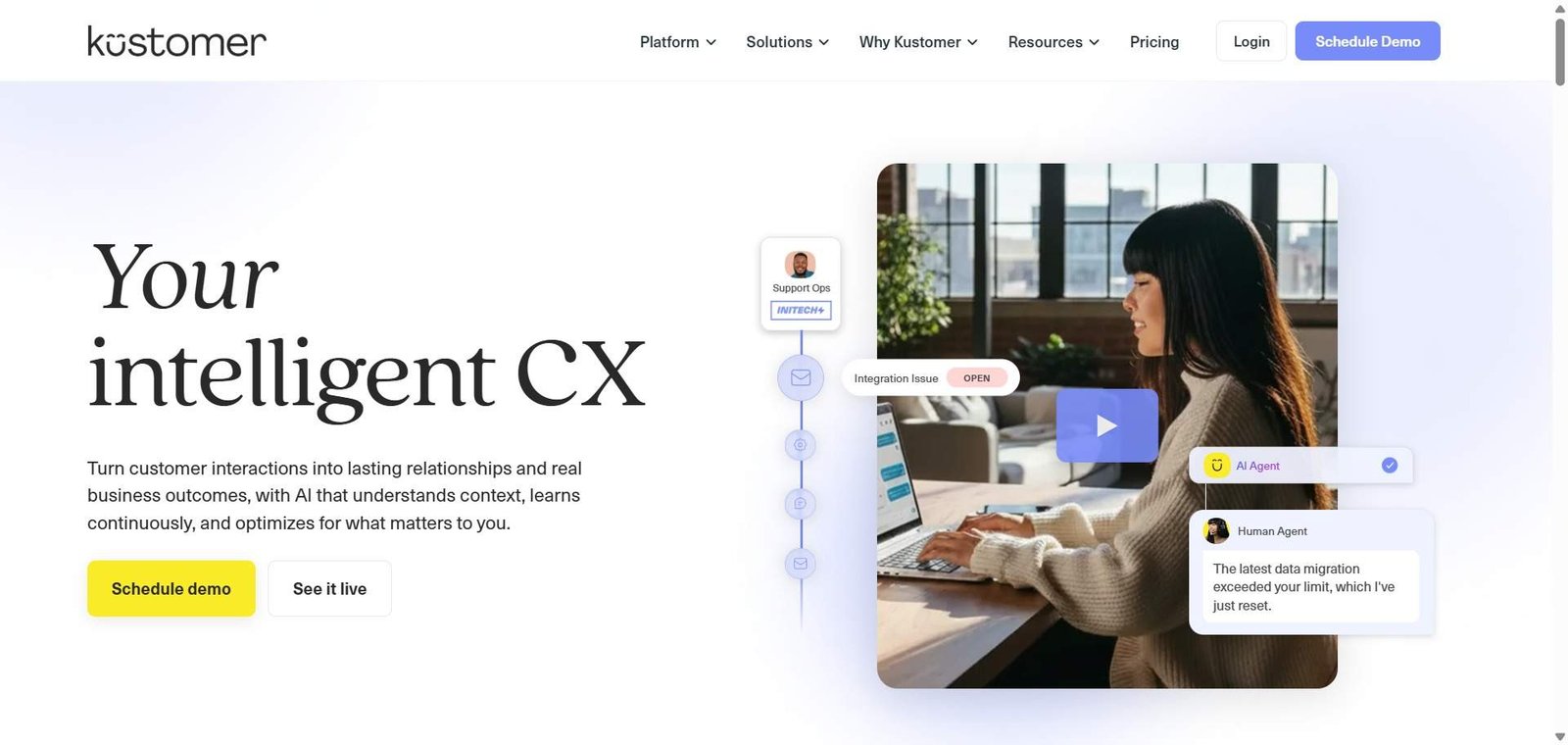
Most customer service platforms are ticket-first — they organise support work around individual tickets that lack context about the customer who created them. Kustomer flips this model — it is CRM-first, organising everything around a unified customer timeline that shows every interaction, every order, every event across every channel in one view. When an agent opens a conversation, they see not just this ticket but the customer’s full history — their previous contacts, their purchase record, their loyalty status, their shipping history — before they say their first word. Combined with AI agents that handle approximately 40% of conversations without human involvement and a Forrester TEI study documenting 422% ROI, Kustomer is the most data-rich customer service platform for mid-market and enterprise B2C support operations.
Quick summary
Kustomer is an AI-native CRM customer service platform — founded in 2015, backed by Battery, Redpoint, and Boldstart Ventures, spun out from Meta in 2023, and used by 600 plus brands including Sweetgreen, Glossier, Turo, and Quizlet — providing a unified customer timeline, omnichannel routing across email, chat, SMS, WhatsApp, voice, and social, AI for Customers handling conversations at $0.60 per engagement, AI for Reps assisting agents with suggestions and summaries, Workflows automation, and a Forrester TEI study showing 422% ROI.
Is it worth using? Yes for mid-market and enterprise B2C and DTC brands with high-volume omnichannel support who want the richest customer context available to agents alongside AI automation that handles the routine majority of conversations.
Who should use it? Customer service leaders, CX directors, and support operations managers at mid-market and enterprise e-commerce, retail, travel, subscription, and marketplace companies running omnichannel support at significant volume.
Who should avoid it? Small teams under 8 agents where the $8,544/year minimum does not make economic sense, or B2B companies whose support model is account-based relationship management rather than high-volume transactional support.
Verdict Summary
Best for
- E-commerce and DTC brands managing high-volume customer support across chat, email, SMS, and social who want agents to see a complete customer picture — purchase history, loyalty tier, previous contacts — before every conversation rather than asking the customer to repeat their history
- Support operations teams who want AI to handle the predictable majority of conversations automatically — order status, returns, FAQs, account changes — while ensuring humans handle the complex and sensitive minority with full customer context
- Companies whose previous support stack was assembled from a separate helpdesk, CRM, and order management integration that produces fragmented agent views and inconsistent customer experience
Not for
- Small support teams under 8 agents where Kustomer’s 8-seat minimum and enterprise orientation are disproportionate to team scale
- B2B SaaS and enterprise software companies whose support model is account-based relationship management — Zendesk and Intercom serve complex B2B support better
- Startups in early customer validation stages where Zendesk or Intercom’s lower entry points and simpler setup better match the operational maturity
Rating
⭐⭐⭐⭐ 4.3 / 5
What Is Kustomer?
Kustomer was founded in 2015 by Brad Birnbaum and Jeremy Suriel — veterans of the customer service software industry who built the platform on the thesis that ticket-based support is the wrong model for the customer relationship era. Its CRM-centric approach, with the unified customer timeline as the core interface, reflects the belief that excellent customer service requires knowing the customer, not just managing their ticket.
The company raised over $170 million, was acquired by Meta for approximately $1 billion in 2020, and then spun back out to independence in May 2023 backed by Battery Ventures, Redpoint Ventures, and Boldstart Ventures. Brad Birnbaum returned as CEO and the company has since focused on AI-native capabilities — building AI for Customers and AI for Reps on top of the CRM and omnichannel infrastructure, with a Forrester TEI study published in 2026 documenting 422% ROI and 30% team capacity increase for customers.
How Kustomer Works
- Build the unified customer timeline. Connect Kustomer to e-commerce platforms, order management, CRM, and other data sources. Every interaction, order, event, and note for each customer appears in one chronological timeline — the agent’s central view before every conversation.
- Route conversations omnichannel. Customer contacts arrive from any channel — email, chat, SMS, WhatsApp, voice, Facebook Messenger, Instagram, and others — and are routed to the appropriate team or agent using skills-based routing, SLA rules, and conversation history.
- AI for Customers handles routine conversations. Deploy AI agents for customer-facing automation — answering FAQs, checking order status, processing returns, and handling account changes autonomously at $0.60 per engaged conversation without agent involvement.
- AI for Reps assists human agents. When conversations escalate to human agents, AI for Reps surfaces suggested responses, generates conversation summaries, recommends next best actions, and auto-fills CRM fields — reducing agent handle time and improving consistency.
- Automate with Workflows. Build Workflows — no-code automation rules triggered by conversation events, customer data, or time — automatically categorising, tagging, routing, and following up on conversations without manual agent action.
- Report and optimise. Real-time dashboards and historical reporting cover conversation volume, resolution time, CSAT, AI containment rate, and agent performance — providing the operational visibility needed to optimise the support operation continuously.
Key Features
- Unified customer timeline — every interaction, order, event, and note in one chronological view
- Omnichannel routing across email, chat, SMS, WhatsApp, voice, Facebook Messenger, Instagram, and others
- AI for Customers — autonomous customer-facing conversation handling at $0.60 per engaged conversation
- AI for Reps — agent assist with suggested responses, conversation summaries, next best actions, and auto-fill CRM
- Workflows no-code automation for conversation routing, categorisation, and follow-up
- KObject flexible data model for custom business objects beyond standard ticket and customer fields
- Skills-based routing ensuring conversations reach the most qualified available agent
- CSAT survey collection integrated into conversation completion workflows
- Integration with Shopify, Magento, Salesforce, and major e-commerce and CRM platforms
- 600 plus brands using the platform including Sweetgreen, Glossier, Turo, and Quizlet
- Forrester TEI study documenting 422% ROI and 30% team capacity increase
- 4.5 rating across 500 plus user reviews
Real-World Use Cases
- DTC e-commerce support: A DTC apparel brand receives 5,000 customer contacts per week across email, chat, and Instagram. AI for Customers handles order status, return initiation, and FAQ responses automatically — containing approximately 40% of contacts without agent involvement. Human agents receive the remaining 60% with the customer’s full order history and previous contact visible in the timeline before the conversation opens.
- Unified agent view: A marketplace’s support agent receives a chat from a customer complaining about a delivery. Rather than asking the customer for their order number and checking a separate OMS, the agent sees the customer’s complete purchase history, the current order status pulled from the integrated OMS, and the customer’s previous contacts on the same order — resolving the issue in one interaction with full context from the start.
- Workflow automation: An online subscription company uses Workflows to automatically tag conversations by topic, route billing complaints to the billing-trained queue, send CSAT surveys three hours after conversation close, and flag repeat contacts on the same issue for escalation — all without manual agent categorisation or manager monitoring.
- AI containment measurement: A support operations leader tracks AI for Customers containment rate weekly — the percentage of conversations AI resolves without human escalation. They identify that return initiation has 85% containment while product complaints have 20%, prioritising improving the product complaint AI flow with better knowledge base content rather than adding agents.
Pros and Cons
| Pros | Cons |
|---|---|
| Unified customer timeline provides the richest agent context of any customer service platform — agents know the customer before the conversation starts | 8-seat minimum and annual-only billing create a $8,544/year minimum commitment — not accessible for very small support teams |
| 422% ROI documented by Forrester TEI study — the strongest third-party financial return validation in the customer service category | AI for Customers and AI for Reps priced separately from the base seat cost — true cost requires modelling AI conversation volume alongside per-seat fees |
| Spun out from Meta independently in 2023 — company direction and product roadmap now controlled by founder and investors rather than a corporate parent | 40% AI containment rate requires well-built knowledge base and AI flow configuration — out-of-the-box AI containment is lower before tuning |
| Flexible KObject data model supports custom business objects without code — extends the platform beyond standard support use cases | Steeper learning curve than simpler helpdesks — implementation requires dedicated effort before full value is realised |
| $0.60 per engaged AI conversation provides clear unit economics for modelling AI ROI before committing to broader deployment | Annual-only contracts create commitment risk for rapidly scaling or seasonal businesses with variable agent headcount |
Pricing & Plans
Enterprise — $89/seat/month (annual billing)
- Unified customer timeline
- Omnichannel routing — email, chat, SMS, WhatsApp, social
- Workflows automation
- Standard integrations
- 8 seat minimum ($8,544/year minimum)
Ultimate — $139/seat/month (annual billing)
- All Enterprise features
- Extra storage and skills routing
- Real-time dashboards
- Advanced reporting
AI Add-ons (priced separately)
- AI for Customers — $0.60 per engaged conversation (any interaction where AI responds)
- AI for Reps — approximately $40/user/month
Enterprise Bundle
- $129/user/month including AI features
- Minimum 8 seats
Pricing based on third-party buyer reports — contact kustomer.com for official quote.
Best Alternatives & Comparisons
- Zendesk AI — Better for B2B SaaS and enterprise software support with the broadest ecosystem of integrations and established enterprise procurement path
- Intercom AI — Better for product-led growth companies wanting AI support alongside in-app messaging and customer communication
- Freshdesk — Better for SMB and mid-market support teams wanting accessible pricing with AI features at lower entry cost
- Forethought AI — Better for adding AI triage, deflection, and resolution on top of an existing helpdesk without migrating to a new platform
Frequently Asked Questions (FAQ)
Kustomer is an AI-native CRM customer service platform — providing a unified customer timeline, omnichannel routing, AI for Customers handling 40% of conversations automatically, and AI for Reps assisting agents — used by 600 plus brands including Sweetgreen, Glossier, and Turo.
Kustomer’s Enterprise plan is $89/seat/month billed annually with an 8-seat minimum ($8,544/year minimum). The Ultimate plan is $139/seat/month. AI for Customers is priced at $0.60 per engaged conversation. AI for Reps is approximately $40/user/month.
Yes — Meta acquired Kustomer for approximately $1 billion in 2020 and closed the deal in early 2022. In May 2023, Kustomer spun back out to independence with Battery Ventures, Redpoint Ventures, and Boldstart Ventures as investors, with founder Brad Birnbaum returning as CEO. Meta retains a minority stake.
The unified customer timeline is Kustomer’s central agent view — a chronological record of every interaction, order, event, and note for each customer across all channels and systems, visible to agents before every conversation begins. It eliminates the need for agents to ask customers for their history or check multiple systems during support interactions.
AI for Customers is Kustomer’s customer-facing AI agent — handling common support requests including order status, returns, FAQs, and account changes autonomously without human agent involvement, priced at $0.60 per engaged conversation where the AI responds.
Kustomer is CRM-first and strongest for B2C and DTC e-commerce brands who want rich customer context and omnichannel coverage. Zendesk has the broader integration ecosystem and is stronger for B2B SaaS and enterprise software support. Kustomer for e-commerce and retail brands who need CRM depth. Zendesk for B2B software companies and organisations wanting the largest support software ecosystem.
Final Recommendation
Kustomer is the most context-rich AI customer service platform for mid-market and enterprise B2C and DTC brands whose support excellence depends on agents knowing the customer — not just the ticket. The unified customer timeline, AI automation at $0.60 per engaged conversation, and 422% ROI Forrester documentation make it the strongest choice for e-commerce, retail, and marketplace companies running omnichannel support at volume. For any support leader whose agents are currently asking customers to repeat their history because the support platform does not surface it automatically, Kustomer provides the CRM-first architecture that makes that problem disappear.
Next steps