
RegieGO
RegieGO is an AI sales prospecting platform that helps businesses discover buyers, enrich contact details, research accounts, and prepare personalized sales outreach.
RegieGO Review: Features, Pricing, Pros, Cons and Alternatives
Finding potential customers is only the first step in outbound sales. Sales representatives also need accurate contact information, relevant reasons to approach prospects, personalized messages, and a way to manage calls and follow-ups. When these activities happen across separate applications, prospecting becomes time-consuming and difficult to manage.
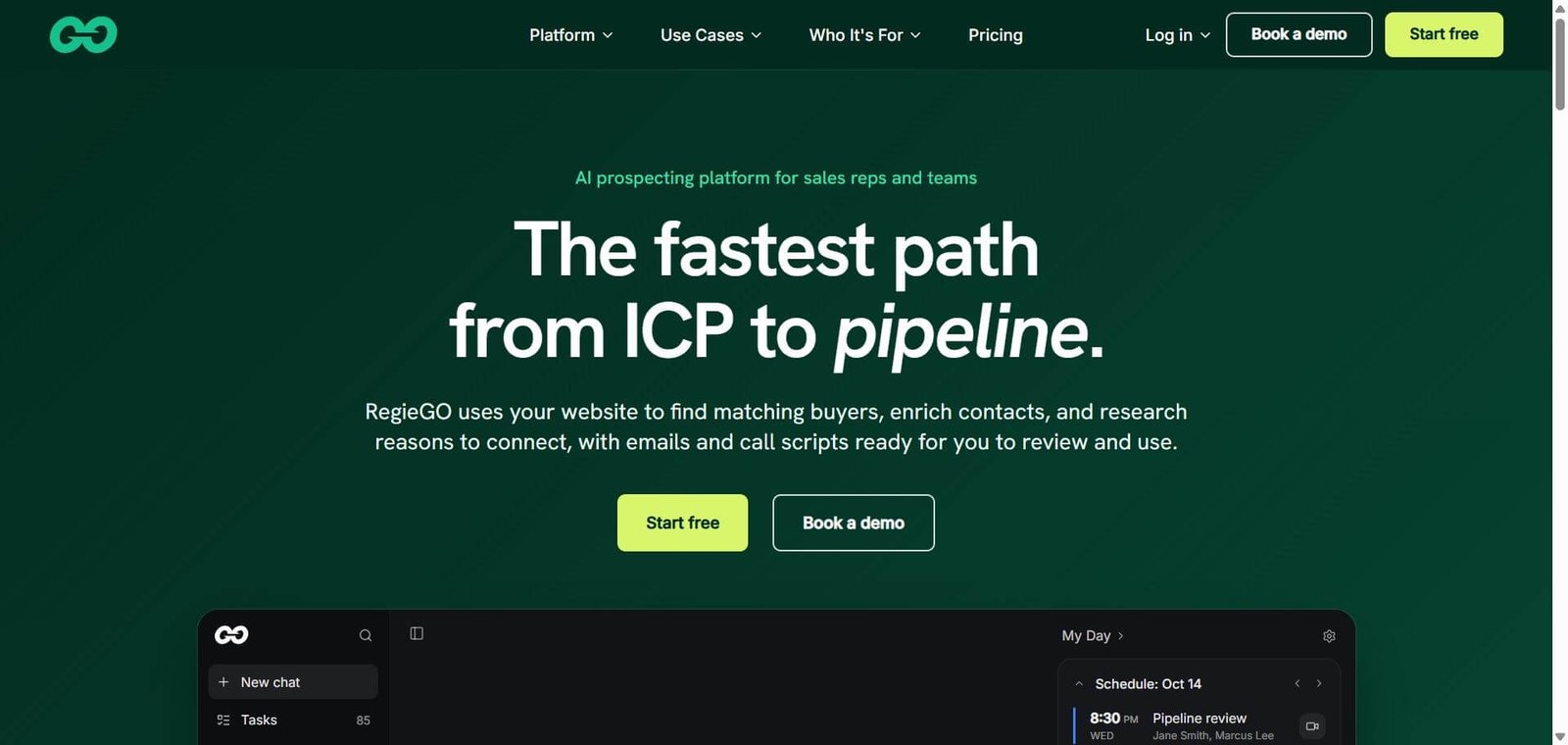
RegieGO is a B2B sales prospecting and engagement platform from Regie.ai that combines ideal customer profile (ICP) discovery, account research, contact enrichment, AI-assisted outreach, and calling. It uses information from your website to identify potential buyers and helps prepare emails and call scripts for sales representatives.
Is RegieGO worth using? It is worth considering for founders, individual sales representatives, and growing B2B sales teams that want to consolidate their outbound prospecting workflow. Its free plan provides an opportunity to explore the platform before upgrading.
However, businesses that need extensive international contact coverage, advanced CRM customization, or highly flexible data enrichment workflows should evaluate its limitations before committing.
This review examines RegieGO’s published features, pricing, credit structure, integrations, alternatives, and suitability for different sales teams. It is an independently researched desk review, not a claim of hands-on product testing.
Quick Verdict
RegieGO combines several activities involved in finding and approaching potential B2B customers. Instead of purchasing separate applications for prospect discovery, contact enrichment, account research, email preparation, and calling, businesses can manage these activities within one platform.
Its main differentiator is the combination of website-led ICP discovery and waterfall contact enrichment with AI-assisted messaging and a built-in dialer.
Best for:
Founders building their first outbound sales pipeline.
SDRs and BDRs responsible for finding and contacting prospects.
Small B2B sales teams that want prospecting and calling in one workspace.
Businesses using Gmail, Outlook, HubSpot, or Salesforce.
Sales representatives who regularly research accounts before approaching decision-makers.
Not ideal for:
Businesses focused primarily on inbound marketing.
Companies that only need an AI email-writing assistant.
Revenue operations teams requiring complex custom enrichment workflows.
Organizations that depend on extensive CRM customization.
Businesses that cannot validate RegieGO’s contact coverage in their target geography.
RegieGO pricing: Free plan available. Pro starts at $49/month, or $41/month equivalent with annual billing. Team starts at $150 per seat monthly, or $125 per seat with annual billing. Annual subscriptions are paid upfront.
Our verdict: RegieGO has an interesting position in the AI sales prospecting market. Its combination of account discovery, enrichment, research, and calling makes it relevant to outbound-focused teams. However, contact accuracy, credit consumption, and regional data availability should be evaluated before upgrading.
What Is RegieGO and Who Is It For?
RegieGO is an AI-powered B2B sales prospecting and engagement platform developed by Regie.ai. It helps businesses identify potential customers, find decision-makers, retrieve contact information, research accounts, and prepare personalized outreach.
Traditional outbound sales often involves several separate tools.
A sales representative might use LinkedIn to identify potential buyers, Apollo.io to find business contact information, an enrichment platform to verify details, ChatGPT to prepare introductory emails, and a CRM to manage conversations.
RegieGO brings these activities into a connected prospecting workspace.
The process starts with a company’s website. RegieGO analyzes the available business information and suggests companies and job roles that may match its ideal customer profile. Users can refine their targeting through chat or upload existing prospect lists.
The platform then helps identify relevant people within those companies and enriches their contact information through multiple data providers.
Its research and messaging capabilities add another layer. Rather than preparing only generic email templates, RegieGO researches accounts and buyers to identify reasons for reaching out. It then uses the company’s pitch and communication style to prepare emails and call scripts.
RegieGO also includes a built-in CRM and supports synchronization with HubSpot and Salesforce. Users can connect Gmail or Outlook to send emails through their own accounts.
This positioning makes RegieGO different from a traditional contact database or standalone AI writing assistant.
A contact database primarily helps users find business information. An enrichment platform improves or supplements existing records. A sales engagement platform manages communication and follow-up activities.
RegieGO attempts to connect these stages within one workflow.
Who should use RegieGO?
The platform is primarily suited to businesses with an active B2B outbound sales process.
Startups: Founders can identify potential customers and begin outbound prospecting without initially building a large sales team.
Individual sales representatives: SDRs can research accounts, find decision-makers, and prepare outreach.
Growing sales teams: Multiple representatives can work from shared prospect lists and credit pools.
B2B service providers: Agencies and consultants can identify businesses that match their target customer profile.
Businesses that rely mainly on inbound enquiries, paid advertising, or organic content marketing may not need the full prospecting workflow.
How RegieGO Works
RegieGO organizes prospecting into a sequence of activities, beginning with customer identification and ending with outreach.
Website analysis: Provide your website so the platform can understand your business and suggest potential customer profiles.
ICP refinement: Review the suggested companies and job roles. Refine your targeting criteria through the chat interface.
Account discovery: Find businesses that match your target profile or upload an existing list of accounts.
Decision-maker identification: Locate relevant contacts within each company.
Contact enrichment: Search multiple data providers for business email addresses and phone numbers.
Account research: Gather relevant information about companies and individual buyers to identify possible reasons for reaching out.
Message preparation: Generate emails and call scripts using your company’s pitch and communication style.
Human approval: Review the generated messages, edit them, or request changes before sending.
Email and calling: Send messages through connected Gmail or Outlook accounts and use the built-in dialer for calls.
CRM management: Track prospect information and activity through the built-in CRM or supported CRM integrations.
The important distinction is that RegieGO connects prospecting activities rather than simply generating sales emails. The quality of the outcome, however, depends on the relevance of the accounts, the quality of the available contact data, and the sales representative’s review.
RegieGO Features: What Does It Actually Offer?
RegieGO’s feature set covers seven main areas. Here is what each capability means for a sales team and what buyers should evaluate.
1. AI-powered ICP discovery
An ideal customer profile describes the type of company most likely to purchase a business’s product or service.
Building one manually requires understanding industry, company size, business model, geography, job roles, and other targeting characteristics.
RegieGO uses information from a company’s website to suggest businesses and roles that may fit its ICP. Users can refine the suggested targeting through chat.
This is useful for startups that have not yet developed a detailed prospecting strategy.
However, website analysis should be treated as a starting point rather than a substitute for customer research. A company’s website may not communicate its ideal buyer, purchasing authority, budget, or actual sales qualification criteria.
Before relying on the generated account list, review whether the suggested businesses resemble existing customers.
2. Account and contact prospecting
Once the ICP is established, RegieGO helps identify matching businesses and the people who work within them.
Users can also upload existing target accounts or prospect lists and use the platform to identify relevant decision-makers.
This is useful for sales representatives who already have a list of target companies but need to identify the right people to approach.
The quality of account matching and contact coverage is an important evaluation point. Buyers should check whether the platform identifies the correct departments, seniority levels, and decision-making roles for their industry.
3. Waterfall contact enrichment
Waterfall enrichment is a process in which a platform checks multiple data providers sequentially when an earlier source cannot supply the required contact information.
RegieGO describes its enrichment process as checking up to seven providers for each contact.
The objective is to improve the likelihood of finding usable business email addresses and phone numbers without depending entirely on one database.
According to RegieGO’s product information:
It checks multiple providers for contact information.
Users pay for successful enrichment rather than unsuccessful lookups.
Email addresses are verified before sending.
Records show the source of the retrieved information.
These are vendor-described capabilities, not independently measured accuracy results.
Checking more providers does not automatically guarantee that an email address is current or that a phone number belongs to the intended decision-maker.
For buyers, the important metrics are the percentage of contacts successfully enriched, the percentage of accurate records, and the number of usable contacts generated per credit spent.
4. Account research and reasons to connect
A generic cold email rarely gives a prospect a compelling reason to respond.
RegieGO researches individual accounts and buyers to identify relevant reasons for outreach. It uses this research to prepare messages and call scripts.
For example, a software company targeting financial services businesses may want to understand the prospect’s business, role, and potential operational requirements before making contact.
The usefulness of this feature depends on the quality and freshness of the underlying information.
Regie’s product descriptions refer to dated reasons for reaching out, but buyers should check the underlying sources and publication dates before using those claims in sales communications.
5. AI email and call script generation
RegieGO prepares outreach messages using a company’s pitch and communication style.
Sales representatives can:
Approve generated messages.
Edit emails manually.
Request changes through chat.
Generate call scripts based on prospect research.
This can reduce the amount of repetitive writing involved in outbound prospecting.
However, personalized wording does not necessarily mean personalized selling. A message should still address a genuine business problem, be relevant to the recipient’s role, and avoid unsupported claims.
Human review remains important before sending.
6. Power and parallel dialer
RegieGO includes calling functionality with single-line, power, and parallel dialing.
Its published product information describes parallel dialing across up to five lines and the provision of local phone numbers.
Calling is included in the Pro and Team plans rather than the Free plan.
For sales representatives who make a high volume of calls, having prospect research, contact details, and call scripts available in the same workspace can be useful.
However, the availability of calling numbers, dialing capabilities, and permitted call configurations should be confirmed for the relevant country and subscription before purchasing.
7. Built-in CRM and third-party integrations
RegieGO includes its own CRM, so businesses can begin prospecting without purchasing another CRM immediately.
Its published integrations include:
Gmail
Outlook
HubSpot
Salesforce
Gong and other listed integrations, subject to current availability and supported functionality.
The platform supports synchronization with HubSpot and Salesforce. It also describes write-back functionality for sending RegieGO activity into connected CRM records.
The built-in CRM may be sufficient for basic prospect and activity management. However, businesses with complex sales pipelines, advanced reporting, custom objects, extensive automation, and detailed permission requirements should compare its capabilities against a dedicated CRM.
A built-in CRM should not automatically be considered a full replacement for an established Salesforce or HubSpot implementation.
RegieGO Real-World Use Cases
RegieGO is designed around outbound sales rather than general marketing automation.
Here are some of the situations where its features are most relevant.
For founders and first sales hires
A startup founder can provide the company website, define an initial customer profile, discover matching businesses, and prepare introductory outreach.
This is particularly relevant when a company needs to establish an outbound process before hiring a dedicated sales development team.
For SDRs and BDRs
Sales development representatives can use account discovery, contact enrichment, research, and AI-generated scripts to prepare their daily prospecting lists.
The value depends on whether the resulting contacts match their territory and qualification requirements.
For growing sales teams
Teams can use shared prospect lists, common CRM records, and shared credit pools to coordinate outbound activities.
This can help standardize prospecting, although managers should evaluate reporting and workflow controls before replacing existing systems.
For B2B agencies and consultants
Service providers can identify companies that match their target market and prepare relevant introductory messages.
For example, a digital marketing agency can target businesses in a specific industry and identify marketing or business development decision-makers.
For speed-to-lead workflows
When a business receives an enquiry, RegieGO describes a workflow that can enrich the contact, prepare a follow-up, and queue a call.
This can support faster follow-up, provided the relevant integrations and workflow configuration are available.
Pros and Cons
| Pros | Cons |
|---|---|
| Combines prospecting, enrichment, research, and outreach | Contact accuracy has not been independently benchmarked |
| Website-based ICP discovery | Suggested targeting still needs human validation |
| Waterfall enrichment across multiple providers | Geographic data coverage needs testing |
| Built-in CRM | May not replace advanced CRM systems |
| AI-assisted email and call scripts | Generated content requires human review |
| Free plan with 250 one-time credits per person | Limited allocation for ongoing prospecting |
| Built-in parallel dialer on paid plans | Calling availability and restrictions need confirmation |
The strongest aspect of RegieGO is its integrated approach to outbound prospecting. Its biggest uncertainty is not the number of features but how consistently those features deliver usable prospects in a particular market.
Pricing & Plans
RegieGO offers four plans: Free, Pro, Team, and Enterprise.
The following pricing is based on the published pricing information used for this review.
| Plan | Monthly billing | Annual billing equivalent |
|---|---|---|
| Free | $0 | $0 |
| Pro | $49/month | $41/month |
| Team | $150/seat/month | $125/seat/month |
| Enterprise | Custom | Custom |
Annual subscriptions are paid upfront.
Free plan
The Free plan includes:
250 one-time credits per person.
Up to 10 people sharing a credit pool.
Prospect research and enrichment.
AI drafting and agents.
Built-in CRM.
Gmail and Outlook sending.
No credit card requirement.
It is suitable for exploring the platform and understanding its prospecting workflow.
Pro plan
The Pro plan costs $49 per month or $41 per month equivalent with annual billing.
It includes:
Everything in Free.
5,000 monthly credits.
Parallel dialer.
Local calling numbers.
Enrichment charges only when information is successfully found, according to the published pricing description.
This plan is designed for individual sales representatives and founders who manage their own outbound pipeline.
Team plan
The Team plan costs $150 per seat monthly or $125 per seat with annual billing.
It includes:
Everything in Pro.
15,000 monthly credits per seat.
Shared team credit pool.
Shared CRM and prospect lists.
Integrations.
Minimum two seats.
The shared credit allocation is useful for teams whose prospecting requirements vary between representatives.
Enterprise plan
Enterprise pricing is customized.
Published inclusions cover volume-based credits, custom CRM synchronization, advanced analytics, a dedicated account manager, and enterprise security arrangements.
Organizations should request a detailed quotation and confirm the features, data limits, and support commitments included in their agreement.
Understanding RegieGO Credits: What Does Prospecting Actually Cost?
The subscription price is only one part of RegieGO’s total cost.
The platform uses credits for activities such as research, enrichment, drafting, and other prospecting workflows. This means the number of contacts a team can process depends on both its subscription allocation and its actual credit consumption.
The published pricing information provides the main credit allocations:
| Plan | Credit allocation | Credit type |
|---|---|---|
| Free | 250 per person | One-time |
| Pro | 5,000 per month | Monthly |
| Team | 15,000 per seat per month | Monthly |
For annual subscriptions, the published allocations are 60,000 credits upfront for Pro and 180,000 per seat for Team.
The following distinction matters when calculating prospecting costs:
| Activity | What to verify |
|---|---|
| Account research | Credits consumed per account |
| Contact discovery | Whether discovery consumes credits |
| Email enrichment | Cost per successful result |
| Phone enrichment | Cost per successful result |
| AI email drafting | Credits per generated message |
| Call activity | Whether dialing consumes credits |
| Failed enrichment | Published pricing says unsuccessful enrichment is not charged |
Important: The available pricing information does not provide a complete activity-level credit schedule. Therefore, it would be misleading to estimate how many prospects 5,000 credits can process or calculate an exact cost per lead without additional evidence.
Before upgrading, check the credit calculator and current in-product credit costs.
A useful evaluation is to track:
Total accounts researched.
Number of relevant companies identified.
Number of contacts discovered.
Number of successfully enriched emails.
Number of accurate phone numbers.
Number of messages generated.
Number of qualified conversations created.
Then calculate:
Cost per usable prospect = Total prospecting cost ÷ Number of usable prospects
This is a more meaningful purchasing metric than simply comparing monthly subscription prices.
RegieGO Limitations: What Should Buyers Consider?
RegieGO covers several stages of outbound prospecting, but there are limitations that buyers should understand.
Dependence on external data providers
Waterfall enrichment increases the number of sources checked, but the quality of the final information still depends on those providers.
A phone number can be outdated, an employee can change companies, or an email address can belong to someone other than the intended decision-maker.
Businesses should validate a sample of enriched records before using the platform for large campaigns.
Contact accuracy is not independently established
The product describes email verification before sending, but the available information does not provide an independently measured accuracy rate.
Email verification should also not be confused with confirmation that a person is still employed at a particular company or is interested in a product.
International prospecting needs validation
The available product information does not establish contact coverage or enrichment accuracy across individual countries.
This is particularly important for businesses prospecting outside the United States.
Before committing, test:
Business email coverage in your target country.
Availability of direct phone numbers.
Accuracy of job titles and company information.
Local dialing number availability.
Applicable privacy and data protection requirements.
For Indian businesses, for example, US-focused contact coverage should not be assumed to translate into equally strong coverage of Indian companies.
Credit consumption can affect total cost
The Free plan is useful for exploration, but ongoing prospecting requires a larger allocation.
Without verified activity-level credit costs, it is difficult to estimate the number of qualified contacts a subscription can produce.
The built-in CRM may not replace an established system
RegieGO includes CRM functionality and supports HubSpot and Salesforce synchronization.
However, companies with complex sales operations should check reporting, automation, pipeline management, permissions, and customization before changing their existing CRM setup.
AI-generated messaging still needs human oversight
AI-generated outreach can save writing time, but messages should be checked for factual accuracy, relevance, and tone.
A poorly researched message sent to the wrong decision-maker can damage a sales relationship rather than improve it.
RegieGO vs Apollo.io
Apollo.io is one of the most relevant alternatives because both platforms address B2B prospecting and outbound sales.
However, their positioning differs.
| Comparison factor | RegieGO | Apollo.io |
|---|---|---|
| Primary focus | Integrated prospecting and engagement | B2B sales intelligence and engagement |
| ICP discovery | Website-led suggestions | Database and search-led targeting |
| Contact enrichment | Waterfall enrichment | Database and enrichment capabilities |
| Outreach assistance | AI-assisted emails and scripts | Sales engagement capabilities |
| Calling | Built-in dialer | Calling capabilities vary by offering |
| Best suited for | Consolidated prospecting workflow | Database-led outbound sales |
This is a qualitative positioning comparison, not an independently tested feature benchmark.
Choose RegieGO if: You want website-based ICP discovery, prospect research, enrichment, and calling in one workspace.
Choose Apollo.io if: Access to an established B2B prospect database and database-led sales prospecting are your main priorities.
The better choice depends on the geographic coverage, contact accuracy, and workflow requirements of your business.
RegieGO vs Clay
Clay is another relevant alternative, particularly for revenue operations and growth teams.
| Comparison factor | RegieGO | Clay |
|---|---|---|
| Primary focus | Integrated prospecting | Data enrichment and workflow automation |
| ICP discovery | Website-led | Custom targeting workflows |
| Enrichment | Waterfall approach | Multiple data sources and integrations |
| Outreach | AI-assisted messaging and calling | Workflow-dependent |
| Calling | Built-in dialer | Not its primary focus |
| Best suited for | Sales representatives and outbound teams | RevOps and growth teams |
RegieGO is positioned around a ready-to-use prospecting workflow.
Clay is more suitable for teams that want to construct customized enrichment and automation processes.
Choose RegieGO for an integrated sales prospecting experience. Consider Clay when flexibility and data orchestration are more important than a built-in calling workflow.
RegieGO vs ZoomInfo
ZoomInfo is generally positioned toward enterprise B2B sales intelligence, company information, and buyer intelligence.
RegieGO focuses more on connecting prospect discovery, enrichment, research, and outreach.
Choose ZoomInfo when extensive enterprise intelligence and data requirements are central to your sales process.
Consider RegieGO when a smaller team wants a more consolidated outbound workflow without starting with a traditional enterprise intelligence platform.
Actual data coverage, pricing, and contract terms should be compared before making a decision.
RegieGO vs Outreach and Salesloft
Outreach and Salesloft are established sales engagement platforms designed for structured sales operations.
Their strengths are particularly relevant to businesses managing multiple representatives, communication sequences, sales activities, and revenue workflows.
RegieGO differs by placing greater emphasis on finding prospects, enriching their details, and preparing initial outreach.
Choose Outreach or Salesloft if your organization already has a mature prospecting process and needs a dedicated sales engagement platform.
Consider RegieGO if discovering and preparing new prospects is a larger challenge than managing an established engagement operation.
Best RegieGO Alternatives
Here is a quick guide to the main alternatives covered in this review.
| Alternative | Consider it when |
|---|---|
| Apollo.io | You prioritize B2B contact discovery and database-led prospecting |
| Clay | You need flexible enrichment and customized data workflows |
| ZoomInfo | You require enterprise sales intelligence |
| Outreach | You need structured sales engagement workflows |
| Salesloft | You need multichannel sales engagement and revenue orchestration |
These products are not interchangeable in every situation. Compare their current plans, integrations, data coverage, and usage limits before selecting a replacement.
Frequently Asked Questions (FAQ)
RegieGO is an AI-powered B2B sales prospecting platform that helps businesses find potential customers, identify decision-makers, enrich contact information, research accounts, and prepare personalized emails and call scripts. It is best suited for founders, SDRs, and sales teams managing outbound prospecting.
RegieGO offers a free plan with 250 one-time credits per person. Its Pro plan costs $49/month ($41/month with annual billing), including 5,000 monthly credits, while Team costs $150 per seat/month ($125 annually billed), with 15,000 credits per seat. Credits are used for activities such as research, enrichment, and AI drafting. Check activity-level credit costs before upgrading.
Yes. RegieGO uses waterfall enrichment to check multiple data providers for business email addresses and phone numbers. It states that emails are verified before sending and that contact records show their data sources. However, verification does not guarantee contact accuracy or confirm that the person is the correct decision-maker.
RegieGO can replace some prospecting and outreach workflows offered by Apollo.io, but the platforms have different strengths. RegieGO combines website-based ICP discovery, enrichment, account research, and calling, while Apollo.io is particularly relevant for database-led prospecting. RegieGO also includes a built-in CRM and supports HubSpot and Salesforce synchronization, although businesses with complex CRM requirements should evaluate its capabilities before switching.
RegieGO can suit startups building their first outbound sales process, particularly because its free plan allows them to explore prospecting and enrichment without a credit card. However, businesses targeting international markets should first verify contact coverage, email accuracy, phone number availability, local dialing support, and applicable data protection requirements in their target countries.
Final Recommendation
RegieGO is best suited to founders, SDRs, and growing B2B sales teams that want to connect prospect discovery, contact enrichment, account research, and outbound communication in one workspace.
Its website-based ICP discovery, waterfall enrichment, AI-assisted outreach, and built-in parallel dialer give it a distinct position among sales prospecting tools.
However, it is not automatically a replacement for every sales application. Businesses that depend on extensive contact databases may prefer Apollo.io, while teams building customized enrichment workflows should consider Clay. Established enterprise sales organizations may find dedicated CRM and engagement platforms more appropriate.
The most sensible approach is to start with RegieGO’s free plan. Test it using companies and job roles that closely match your actual customer profile. Check contact accuracy, regional coverage, credit consumption, and the quality of the generated messages.
If it consistently produces relevant, usable prospects at a reasonable cost, moving to Pro or Team may make sense.
Explore RegieGO: https://regie.ai/
You can also compare it with other AI-powered sales and lead generation tools before choosing a prospecting platform on itirupati.com.