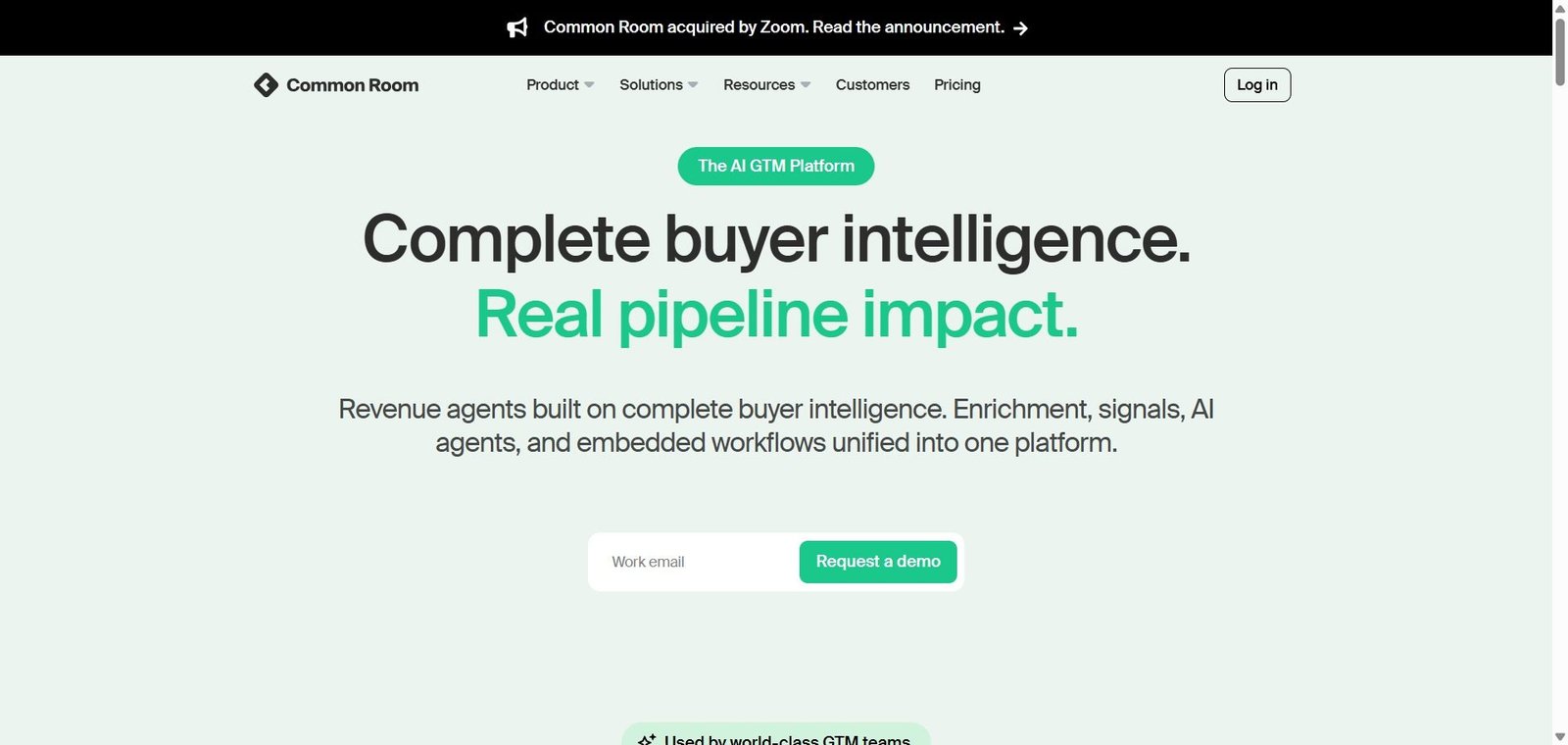

Common Room
Unify every buyer signal into one intelligence layer — AI that prioritises the right accounts and puts your GTM team in motion.
Common Room Review: The AI GTM Platform That Connects Product Usage, Community Signals, and CRM Data Into One Buyer Intelligence Layer
Most GTM teams operate on incomplete information — sales reps toggle between LinkedIn, Salesforce, product analytics, and Slack to piece together a picture of whether an account is ready to buy. Common Room replaces this manual signal aggregation with a continuously updated system of buyer intelligence that combines first-party customer data with real-world signals — product usage, community activity, website behaviour, job changes, hiring trends, and intent data — all unified through Context360 AI identity resolution that connects anonymous signals to known contacts and companies automatically.
Quick Summary
Common Room is an AI GTM platform combining Context360 AI identity resolution, 400 million plus contact directory with waterfall enrichment, RoomieAI research agent for account and contact intelligence, Prospector for contact identification and outreach, workflow automation, and MCP server integration — helping B2B sales, marketing, and RevOps teams at mid-market and enterprise companies move from fragmented buyer data to precise, AI-driven GTM execution at scale. Essential plan at $2,500/month billed annually.
Is it worth using? Yes for B2B revenue teams at product-led or community-led companies whose pipeline generation depends on identifying high-intent accounts from product usage, community engagement, and digital signals before competitors notice the same buying intent.
Who should use it? Sales development representatives, account executives, demand generation managers, and RevOps leaders at product-led and community-led B2B SaaS companies who want to convert digital engagement signals into pipeline without manual signal aggregation.
Who should avoid it? Traditional sales-led companies with limited digital signals from product usage or community engagement — the platform’s signal intelligence advantage diminishes significantly for companies without meaningful first-party digital behaviour data.
Verdict Summary
Best for
- Product-led growth companies whose ideal customers are active users, trial converters, or community participants — Common Room connects product usage signals to the sales workflow, identifying when a trial user’s behaviour indicates expansion or conversion readiness before they request a meeting
- Developer-focused and open-source companies who want to identify which GitHub contributors, Stack Overflow participants, or community members work at target accounts and are actively engaging with the product ecosystem
- RevOps teams who want a unified signal layer that connects across the full GTM tech stack — CRM, product analytics, community platforms, and intent data — without building custom integrations or writing SQL queries to aggregate signals
Not for
- Traditional sales-led companies with primarily offline or phone-based sales motions whose accounts leave no meaningful digital signals in product usage or online community activity
- Very small GTM teams where the $30,000 annual minimum exceeds budget — Common Room’s value scales with the volume and richness of signals, which requires a mature digital GTM infrastructure to generate
- Teams seeking transparent self-serve pricing — all plans above Essential require a sales conversation for custom quotes
Rating
⭐⭐⭐⭐ 4.1 / 5
What Is Common Room?
Common Room was founded in 2020 by Linda Lian and Tom Kleinpeter — starting as a community analytics platform for developer relations and open-source communities, then evolving into a broader GTM intelligence platform as the founders recognised that community signals were only one of many buying signals that GTM teams needed to aggregate and act on.
In 2026, Common Room has repositioned as an AI GTM platform — Context360 AI identity resolution, the RoomieAI research agent, and MCP server integration represent the current product direction, connecting buyer intelligence to the AI tools and workflows GTM teams already use. The MCP server ships across all plans, allowing GTM teams to query Common Room’s buyer intelligence through AI assistants including Claude, GPT, and others — a forward-looking integration that positions Common Room as the buyer intelligence layer for AI-powered GTM workflows.
How Common Room Works
- Connect signal sources. Integrate Common Room with product analytics platforms, community tools including Slack, Discord, and GitHub, CRM systems, website analytics, and third-party intent data. Context360 resolves signals from across these sources to named contacts and companies automatically.
- Context360 resolves identities. Common Room’s AI identity resolution matches anonymous product usage, community engagement, and website behaviour to known contacts — connecting digital activity to CRM records and enriching profiles with data from the 400 million plus contact directory.
- AI surfaces high-intent accounts. Alerts and workflows surface accounts and contacts showing elevated buying signals — trial users who have invited team members, community members who have started evaluating competitors, companies that have hired for roles suggesting budget availability.
- RoomieAI researches accounts. Ask RoomieAI research questions about target accounts and contacts — the AI aggregates publicly available information, company signals, and Common Room’s enriched data to produce account briefs and contact profiles without manual research.
- Prospector identifies contacts. Use Prospector to find new contacts at target accounts — drawing from the 400 million plus contact directory with waterfall enrichment to fill gaps where CRM records are incomplete.
- Activate through workflow automation. Build workflows that trigger outreach through Slack alerts to SDRs, CRM task creation, email sequences via sales engagement platforms, or direct actions through Common Room’s MCP server integration — converting intelligence into execution automatically.
Key Features
- Context360 AI identity resolution connecting anonymous signals to known contacts and companies across all integrated sources
- 400 million plus contact directory with waterfall enrichment filling gaps in CRM contact data
- RoomieAI research agent generating account briefs and contact intelligence on demand
- Prospector for identifying and enriching new contacts at target accounts
- Unlimited alerts, workflows, and segments across all plans
- Signal aggregation from product usage, community platforms, website activity, CRM data, job changes, and Bombora intent
- MCP server shipping across all plans — AI assistants can query Common Room buyer intelligence directly
- Integration with Salesforce, HubSpot, Slack, GitHub, Discord, and major GTM tools
- Essential plan at $2,500/month billed annually — Advanced and Enterprise at custom pricing
Real-World Use Cases
- PLG conversion signals: A product-led SaaS company uses Common Room to identify trial accounts whose usage has expanded beyond a single user — the signal that a trial account has invited three or more colleagues is correlated strongly with conversion. Common Room surfaces these accounts automatically and creates Salesforce tasks for the assigned SDR to reach out with a targeted expansion conversation.
- Community-to-pipeline: An open-source developer tools company uses Common Room to identify which GitHub contributors and Discord community members work at target accounts. When a contributor from a Fortune 500 account starts using advanced features of the open-source tool, Common Room surfaces the account for outbound with relevant context — the SDR reaches out knowing which specific features the prospect has engaged with.
- Job change targeting: Common Room’s job change tracking identifies when a champion at an existing customer moves to a new company — triggering an automatic alert to the account executive with context about the champion’s new role and the new company’s profile, enabling warm outreach to a buyer who already knows the product.
- RevOps signal consolidation: A RevOps leader uses Common Room as the unified signal layer — replacing the manual process of querying product analytics, checking community activity, and reviewing intent data separately — with a single view of account signals that feeds into Salesforce scoring and territory prioritisation automatically.
Pros and Cons
| Pros | Cons |
|---|---|
| Context360 identity resolution connects anonymous digital signals to known contacts automatically — the technical foundation that makes PLG signal intelligence practical at scale | $2,500/month Essential plan with a $30,000 annual minimum is a significant commitment — value requires meaningful digital signal volume to justify |
| MCP server shipping across all plans is genuinely forward-looking — positions Common Room as the buyer intelligence source for AI-native GTM workflows | Contact-based pricing compounds as enrichment grows contact database — model 12 to 24 months of volume growth before signing |
| RoomieAI research agent eliminates manual account research — account briefs available on demand without SDR time spent aggregating information | Signal intelligence advantage diminishes for traditional sales-led companies with limited digital product or community signals |
| Unlimited alerts, workflows, and segments across all plans — no gating on the automation features that deliver most of the day-to-day GTM value | Pricing restructured in 2025/2026 — older plan information online is outdated and misleading, contact Common Room directly for current terms |
| Job change tracking and hiring signal monitoring extend signal coverage beyond product usage into the account’s broader business context | Learning curve for complex signal configurations — maximum value requires RevOps involvement to configure the right signals, alerts, and workflows |
Pricing & Plans
Essential — $2,500/month (billed annually — $30,000/year)
- 5 seats included
- Up to 100,000 contacts
- 5,000 RoomieAI research credits
- 2,500 Prospector credits
- Unlimited alerts, workflows, and segments
- Select integrations
- Shared CSM
- MCP server included
Advanced — Custom pricing
- 15 seats included
- Up to 250,000 contacts
- 7,500 RoomieAI research credits
- Additional integrations and enrichment sources
- Dedicated CSM
Enterprise — Custom pricing
- Custom seat and contact volume
- Full integration library
- Premium support
Contact Common Room at commonroom.io for a demo and pricing quote.
Best Alternatives & Comparisons
- 6sense — Better for enterprise dark funnel intent intelligence and account-based marketing orchestration at companies where third-party intent data is the primary signal
- Backstory — Better for automatically capturing and organising sales activity data from existing CRM and communication systems
- Clay — Better for building custom lead lists and enrichment workflows from multiple data sources at more accessible pricing
- Warmly — Better for smaller teams wanting website visitor identification and intent-based outreach at lower entry pricing
Frequently Asked Questions (FAQ)
Common Room is an AI GTM platform that unifies first-party customer data with real-world buyer signals using Context360 AI identity resolution and a 400 million plus contact directory — helping B2B revenue teams prioritise accounts, research contacts, and personalise outreach at scale.
Common Room’s Essential plan is $2,500/month billed annually ($30,000/year) with 5 seats, 100,000 contacts, and unlimited alerts and workflows. Advanced and Enterprise plans are custom-priced. Contact commonroom.io for current pricing.
Context360 is Common Room’s AI identity resolution technology — automatically connecting anonymous signals from product usage, community engagement, website behaviour, and other sources to known contacts and companies in the CRM, enriching profiles from the 400 million plus contact directory.
RoomieAI is Common Room’s research agent — generating account briefs and contact intelligence on demand from publicly available information, company signals, and Common Room’s enriched data, eliminating manual account research for SDRs and account executives.
Yes — Common Room includes its MCP server across all plans, allowing AI assistants including Claude, GPT, and others to query Common Room’s buyer intelligence directly — positioning Common Room as the buyer intelligence source for AI-native GTM workflows.
Common Room provides a continuous signal intelligence system — monitoring existing contacts and accounts for buying signals over time through persistent integrations. Clay is a workflow-based lead list building and enrichment tool — assembling lists from multiple sources on demand. Common Room for ongoing signal monitoring and PLG intelligence. Clay for building custom enriched lead lists for targeted outbound campaigns.
Final Recommendation
Common Room is the most technically sophisticated buyer intelligence platform for product-led and community-led B2B companies whose pipeline generation depends on identifying high-intent accounts from digital signals before they raise their hand. The Context360 identity resolution, RoomieAI research agent, and MCP server integration create an AI-native GTM intelligence layer that connects to the workflows and AI tools revenue teams already use. For any PLG or developer-focused company whose ideal customers are already engaging with the product or community before they are identified as prospects, Common Room provides the signal intelligence infrastructure that turns that engagement into pipeline systematically.
Next steps