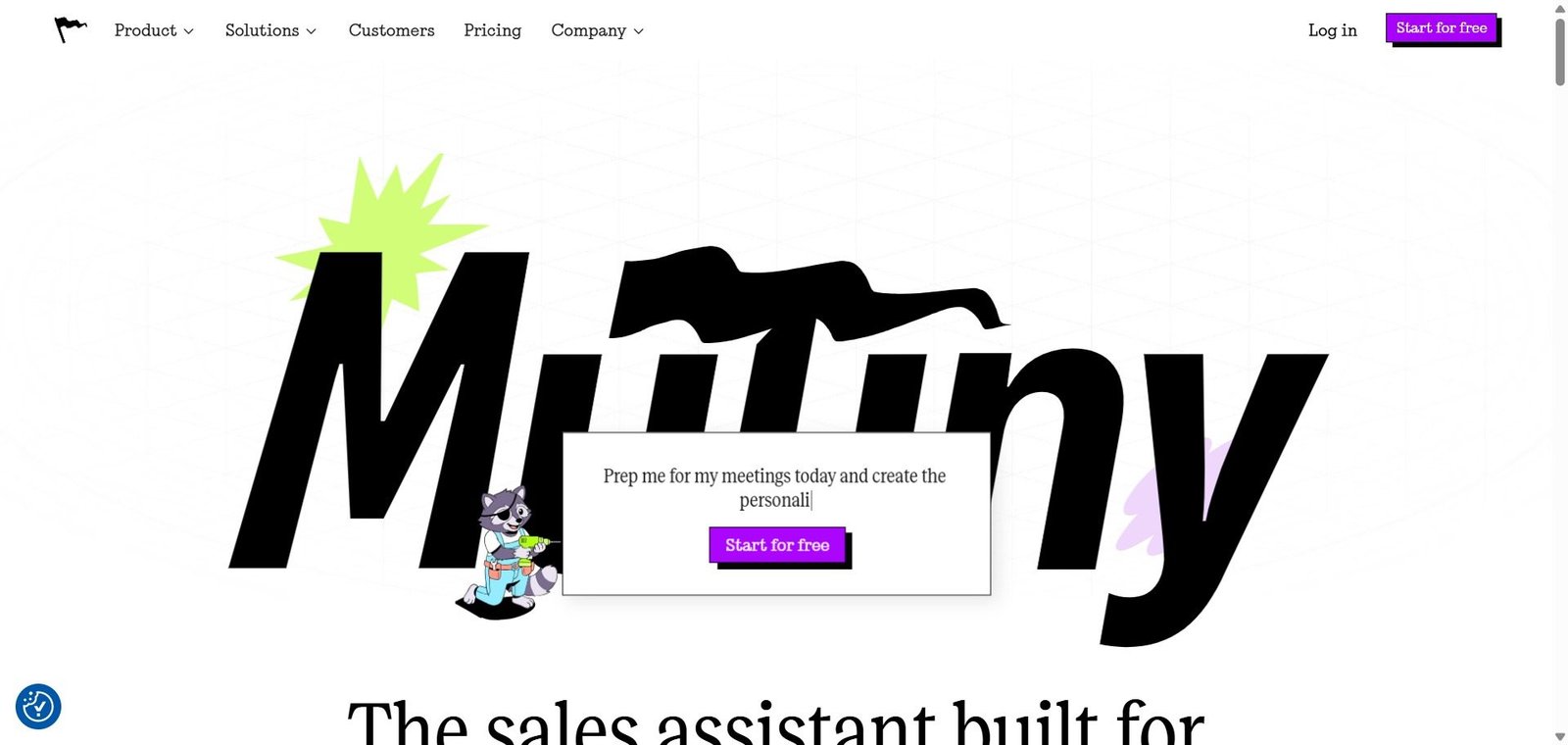

Mutiny
AI that generates personalised decks, deal rooms, and ABM pages from your account context — in minutes, on brand, without design dependencies.
Mutiny Review: The AI GTM Assistant That Replaced the Design-Dependent ABM Content Bottleneck
Account-based marketing has a production problem — creating personalised content for every target account requires design resources, copywriting resources, and time that most revenue teams do not have in the volume ABM demands. A personalised microsite for the CISO at a Fortune 500 target account should have their logo, their industry’s language, their specific pain points, and their peers’ success stories — but creating that for 50 target accounts manually requires weeks of production work. Mutiny eliminates this bottleneck with an AI GTM assistant that generates personalised decks, microsites, deal rooms, 1:1 ABM pages, competitor comparisons, and business cases from account context — on brand, in minutes, without any design dependency — and then tracks exactly who viewed them and for how long.
Quick Summary
Mutiny is an AI GTM assistant for B2B sales and marketing teams — generating personalised customer-facing assets including decks, 1:1 ABM microsites, deal rooms, competitor comparisons, business cases, and follow-up emails from account context, with full visitor-level analytics showing exactly who engaged with each asset, integrations with HubSpot, Salesforce, Gong, Gmail, and Slack, and plans from Free to Enterprise — used by Rippling, Snowflake, Vanta, and SingleStore.
Is it worth using? Yes for B2B sales and marketing teams who run account-based marketing programmes and want AI to generate personalised assets at the volume ABM requires without design dependencies or weeks of production time.
Who should use it? Account executives, demand generation teams, and ABM managers at B2B technology companies who want to create personalised sales assets — decks, deal rooms, microsites — faster and measure their engagement with prospect-level analytics.
Who should avoid it? Small teams with low deal volumes where ABM personalisation does not justify the investment, or teams whose primary need is website personalisation technology rather than AI-generated customer-facing assets.
Verdict Summary
Best for
- Account executives at B2B companies who lose competitive deals because they cannot create personalised materials fast enough — Mutiny generates a personalised deck, competitive comparison, and deal room from the account’s context in minutes rather than waiting days for design support
- Demand generation and ABM teams running targeted campaigns at named accounts who want every prospect to receive a 1:1 personalised microsite rather than a generic landing page — and want to see exactly who from each account engaged with it
- Revenue teams who want to arm champions with materials they are proud to share internally — personalised business cases, competitive comparisons, and ROI models that champions can use to build internal consensus without the selling team in the room
Not for
- Teams whose primary need is AI-driven website personalisation technology that shows different content to different segments on an existing website — this was Mutiny’s original positioning but the 2026 product is now primarily an asset generation platform
- Very small startups without named account ABM programmes where personalisation at this level adds friction rather than revenue
- Teams looking for a content management system or sales collateral library — Mutiny generates assets, it does not serve as the repository for all sales content
Rating
⭐⭐⭐⭐ 4.1 / 5
What Is Mutiny?
Mutiny began as an AI-powered website personalisation platform for B2B marketing — showing different homepage content to different visiting companies based on their firmographic profile. In 2026, the company has repositioned around a broader and more powerful product thesis: an AI GTM assistant that generates the full range of customer-facing assets that sales and marketing teams need for account-based motions.
The 2026 product pulls account context from CRM, call recordings, emails, and analytics — and uses it to generate personalised assets on brand and tailored to the specific account’s language, pain points, industry, and competitive situation. The resulting assets are tracked at the visitor level, showing exactly which contacts from the account opened the deck, how long they spent on each slide, and whether they shared it internally — intelligence that sales teams previously had no visibility into.
How Mutiny Works
- Connect your GTM data sources. Integrate Mutiny with HubSpot or Salesforce for CRM data, Gong for call recordings, Gmail and Google Calendar for email and meeting context, and Notion for knowledge base content. Mutiny scrapes brand guidelines from the company website automatically.
- Describe the account or asset. Tell Mutiny what you need — “create a personalised deck for the CISO at Acme Corp, they are concerned about cloud security compliance and evaluating us against CrowdStrike” — and the AI pulls the relevant context from connected sources.
- AI generates the asset on brand. Mutiny generates the requested asset — deck, microsite, deal room, competitor comparison, or business case — using the account’s context, the company’s brand, relevant customer stories, and personalised messaging, without requiring design involvement.
- Share and track engagement. Send the personalised asset to the prospect — via email, Slack, or a direct link. Mutiny tracks visitor-level engagement — which contacts opened it, which slides they spent time on, whether they returned, and whether they shared it with other stakeholders.
- Follow up with intelligence. Use the engagement data to inform follow-up — a prospect who spent 10 minutes on the ROI slide and shared the deck internally is a very different follow-up conversation than one who opened it once for 20 seconds.
Key Features
- AI-generated personalised decks from account context — company, industry, pain points, competitive situation
- 1:1 ABM microsites tailored to named accounts without engineering involvement
- Deal rooms that update with the deal — living documents that evolve as the opportunity progresses
- Competitor comparison pages generated from competitive intelligence context
- Business cases and ROI models personalised to account-specific data
- Meeting recaps and personalised follow-up emails from call recording context
- Visitor-level analytics showing individual contact engagement with each asset
- Brand scraping — Mutiny extracts brand colours, fonts, and tone from the company website automatically
- Integrations with HubSpot, Salesforce, Gong, Gmail, Google Calendar, Google Drive, Notion, and Slack
- Works inside Slack — AI accessible where the revenue team already works
- Free plan with 5 monthly credits; Business at $50/month; Enterprise from $40,000/year
Real-World Use Cases
- Competitive deal acceleration: An account executive at a software company is in a competitive evaluation against two larger vendors. They use Mutiny to generate a personalised competitive comparison in 15 minutes — pulling the prospect’s stated requirements from Gong call recordings, framing each evaluation criterion in the prospect’s language, and showing how the vendor’s positioning maps to the prospect’s specific use case. The asset is shared with the champion who uses it to build internal consensus.
- ABM programme scale: A demand generation team runs ABM campaigns for 60 named accounts. Instead of creating one generic landing page for all 60, they use Mutiny to generate 60 personalised 1:1 microsites — each with the target account’s logo, their industry’s specific language, and relevant customer stories from companies similar to theirs. The personalised pages produce 3x the engagement rate of the generic alternatives.
- Deal room intelligence: A sales team shares a deal room with a buying committee at a large enterprise account. Mutiny’s visitor analytics show that the CFO spent 12 minutes on the ROI slide and returned twice — intelligence that prompts the account executive to prioritise the financial ROI conversation in the next meeting rather than the technical feature discussion originally planned.
- Champion enablement: A sales rep arms their internal champion with a personalised business case built around the champion’s company’s specific metrics. The champion shares it in an internal Slack channel with the economic buyer — Mutiny’s tracking shows the economic buyer opened it 4 days before the planned deal review, allowing the sales team to prepare for a faster-than-expected decision.
Pros and Cons
| Pros | Cons |
|---|---|
| Generates personalised sales assets in minutes without design dependencies — eliminates the production bottleneck that limits ABM personalisation at scale | Enterprise plan at $40,000/year is significant — ROI requires meaningful deal volume and account-based motion to justify |
| Visitor-level asset analytics provide sales intelligence previously invisible — knowing which contacts engaged and how changes follow-up strategy | Product repositioning from website personalisation to GTM asset generation may confuse buyers evaluating Mutiny based on its original positioning |
| Works inside Slack — sales team can request personalised assets in the tools they already use without switching applications | Free plan limited to 5 credits/month — insufficient for active selling without upgrading |
| Brand scraping automatically applies company branding without manual setup | Not a content management system — Mutiny generates assets but does not replace a sales collateral library or content hub |
| Integrations with Gong pull call recording context for the most accurate personalisation possible | Early-stage AI GTM category — buyer education required to explain the value proposition to stakeholders unfamiliar with AI-generated sales content |
Pricing & Plans
Free — $0/month
- 5 credits per month
- Up to 5 team members
- 5 templates, 5 Routines, 5 Projects per user
- Unlimited integrations for first 30 days
Business — $50/month
- 50 credits per month
- Unlimited team members
- Unlimited templates, skills, and integrations
- 20 Routines and 20 Projects per user
- Custom subdomain
- Password protection for assets
- Visitor Intelligence analytics
Enterprise — From $40,000/year
- Volume credit discounts
- Custom per-user credit limits
- Unlimited templates, routines, projects, and integrations
- SSO
- Custom MSA and DPA terms
- Dedicated Growth Strategist
- Onboarding support
- Salesforce integration
Best Alternatives & Comparisons
- Qualified — Better for inbound website pipeline generation with Piper AI SDR rather than personalised asset creation for outbound deals
- 6sense — Better for account-level intent intelligence to identify which accounts to prioritise before creating personalised assets
- Highspot — Better for full sales enablement platform including content management, training, and coaching alongside personalised content delivery
- Seismic — Better for enterprise sales content management with personalisation at scale in an established platform
Frequently Asked Questions (FAQ)
Mutiny is an AI GTM assistant that generates personalised customer-facing assets — decks, ABM microsites, deal rooms, competitor comparisons, and business cases — from account context, with visitor-level engagement analytics, used by Rippling, Snowflake, and Vanta for account-based selling and marketing.
Yes — Mutiny offers a free plan with 5 credits per month for evaluation. The Business plan at $50/month provides 50 credits with full features. Enterprise plans from $40,000/year cover high-volume teams with custom credit allocations.
Mutiny originally focused on B2B website personalisation — showing different content to different visiting companies. In 2026, the company has repositioned around its AI GTM assistant capabilities — generating personalised assets for account-based selling and marketing. Website personalisation remains part of the Business and Enterprise offerings through Visitor Intelligence analytics.
Mutiny generates personalised decks, 1:1 ABM microsites, deal rooms, competitor comparisons, business cases and ROI models, meeting recaps, and follow-up emails — all from account context pulled from CRM, call recordings, email, and knowledge base sources.
Mutiny tracks visitor-level engagement on every shared asset — showing which individual contacts opened the asset, how long they spent on each slide or section, whether they returned, and whether they shared it with other stakeholders — giving sales teams real-time intelligence about buyer engagement that traditional email-based sharing cannot provide.
Seismic is a full enterprise sales enablement platform — content management, training, coaching, and personalised content delivery at large scale with deep governance. Mutiny is an AI generation tool that creates personalised assets from account context without requiring a content library to exist first. Seismic for enterprises managing large sales content libraries. Mutiny for teams who want AI to generate personalised assets on demand from deal context.
Final Recommendation
Mutiny is the most practical AI tool for the specific and expensive problem of personalised content creation in account-based selling and marketing — the gap between what great ABM requires (personalised, relevant, account-specific content at scale) and what most revenue teams can actually produce (generic materials sent to everyone with a name mail-merge). The AI asset generation from account context, visitor-level engagement analytics, and Slack-native workflow make personalised selling accessible to any account executive without design support or marketing queue delays. For any B2B revenue team running account-based motions at meaningful scale and losing deals because personalisation takes too long, Mutiny provides the AI production infrastructure that makes doing it consistently achievable.
Next steps