
Devin
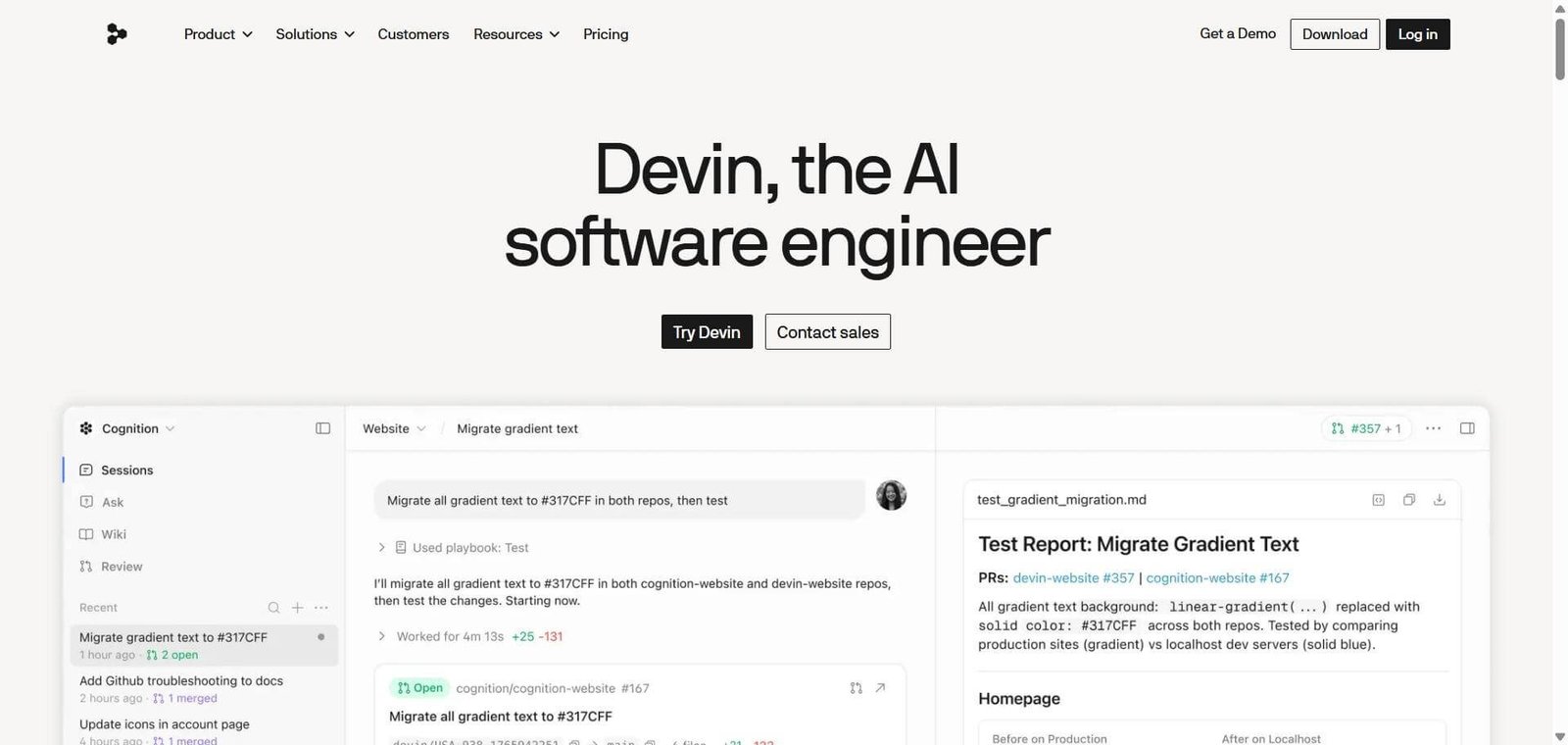
The autonomous AI software engineer that works like a remote contractor: give it a ticket, it plans the solution, writes the code, runs tests, and opens a pull request independently.
Devin Review: The First Autonomous AI Software Engineer That Completes Engineering Tasks Without a Human at Every Step
Every AI coding tool that preceded Devin is fundamentally an augmentation tool. GitHub Copilot, Cursor, Tabnine, and Amazon Q Developer make individual developers more productive by completing lines, suggesting functions, and answering questions in a chat interface. They require a developer to guide every step. Devin is a different category entirely: an autonomous AI agent that plans, codes, tests, and ships independently. You assign a ticket in plain language, Devin formulates a plan, executes it inside a sandboxed virtual machine with a browser, terminal, and code editor, handles failures, and returns with a pull request. The developer reviews the PR rather than supervising every keystroke. For engineering teams running well-scoped, repetitive tasks at scale, large migrations, framework upgrades, CI failure triage, and legacy code documentation, Devin represents the clearest available example of what agentic AI looks like in production software engineering.
Quick Summary
Devin is an autonomous AI software engineering agent from Cognition AI, a San Francisco applied AI research company founded in late 2023. Built on the SWE-1.7 model scoring 77.8% on SWE-bench Multilingual and 81.5% on Terminal-Bench 2.1 as of July 2026. Devin plans, executes, debugs, and opens pull requests for multi-step engineering tasks in a sandboxed VM with browser, terminal, and code editor. Integrates with GitHub, GitLab, Linear, Slack, and Jira. Cognition’s ARR grew from $1M to $73M in the 9 months following the April 2025 Devin 2.0 price cut to $20/month. Free tier available, Pro at $20/month, Max at $200/month, Teams at $80/month plus $40/seat.
Is it worth using? Yes for engineering teams running well-scoped, repetitive tasks at volume: migrations, upgrades, CI triage, documentation, and boilerplate generation. Devin multiplies engineering output on the categories of work where the specification is clear but the execution is time-consuming.
Who should use it? Software engineering teams, engineering managers, and platform engineers at tech companies who want to delegate well-defined coding tickets to an autonomous agent rather than interrupting senior engineers with repetitive implementation work.
Who should avoid it? Teams expecting Devin to handle open-ended, ambiguous, or highly creative engineering problems without clear specifications. Devin performs best on well-scoped tasks: the more specific the ticket, the more reliable the output. Poorly specified tasks produce unreliable results regardless of model capability.
Verdict Summary
Best for
- Engineering teams running large-scale migrations where the pattern is clear but the volume is prohibitive. Nubank used Devin for a Talend-to-modern-stack migration covering 6 million lines of code and approximately 100,000 data class implementations, a project originally projected at 18 months
- Platform and DevOps teams who want to automate CI failure triage, dependency upgrades, and framework version bumps that take senior engineer time without requiring senior engineer judgment
- Engineering managers who want to increase team throughput without proportionally scaling headcount, delegating the well-defined implementation layer of the backlog to Devin while senior engineers focus on architecture, design, and review
Not for
- Teams expecting Devin to architect novel systems, make high-stakes design decisions, or handle ambiguous requirements without clear specifications. Success rate on highly complex, open-ended tasks remains below senior engineer performance
- Individual developers who want instant inline code suggestions and fast autocomplete. Devin works at agent speed: tasks take minutes to hours, not milliseconds. Cursor or Claude Code are faster for interactive development
- Teams needing extensive documentation for edge-case failures. As of mid-2026, Devin is relatively new in production and battle-tested failure documentation is less comprehensive than for established tools
Rating
⭐⭐⭐⭐ 4.2 / 5
What Is Devin?
Devin is built by Cognition AI, a San Francisco applied AI research company founded in late 2023. The company was publicly unveiled in March 2024 with a demo showing Devin autonomously writing code, debugging errors, and completing real Upwork freelance engineering tasks. Devin became generally available in late 2024 after a long invite-only beta.
The April 2025 release of Devin 2.0 reduced the entry price from $500/month to $20/month, driving a dramatic ARR expansion from $1M to $73M in the following 9 months. The price reduction reflected a genuine product maturation: Devin 2.0 completed 83% more junior-level development tasks per Agent Compute Unit compared to Devin 1.x, making the lower price point commercially sustainable.
In July 2026, Cognition integrated the Windsurf IDE into the Devin plan, following its acquisition of the Windsurf business from Codeium in 2025 after Google’s partial acqui-hire of Codeium engineering. This gives Devin plan subscribers both the autonomous agent and an interactive IDE under one subscription.
How Devin Works
- Assign a task in plain language. Describe the engineering task in natural language: “Upgrade all dependencies in the auth service from Node 18 to Node 22 and fix any breaking tests” or “Document all public API endpoints in the payments module with JSDoc comments.” Devin accepts tasks through its interface, Slack, Linear, Jira, and GitHub issue integrations.
- Devin plans a sequence of steps. The agent formulates a structured plan before executing: identifying the files to modify, the tests to run, the dependencies to check, and the verification steps to confirm success. Users can review and adjust the plan before execution begins through the Interactive Planning feature.
- Devin executes in a sandboxed VM. Devin works in an isolated virtual machine with a browser, terminal, and code editor. It reads the codebase, makes changes, runs the test suite, reviews failures, and iterates without any human involvement during execution.
- Devin handles failures autonomously. When a test fails or a build breaks, Devin diagnoses the error, hypothesises a fix, implements it, and runs verification again. This debugging loop continues until the task succeeds or Devin surfaces the issue for human review.
- Devin opens a pull request. When the task is complete and tests pass, Devin opens a pull request with a description of the changes made, the tests run, and any decisions or trade-offs encountered during execution. The developer reviews the PR rather than supervising the implementation.
Key Features
- Autonomous end-to-end task execution: planning, coding, testing, debugging, and PR creation without continuous human oversight
- SWE-1.7 model: 77.8% on SWE-bench Multilingual and 81.5% on Terminal-Bench 2.1 as of July 2026 (vendor-reported)
- Sandboxed VM environment: isolated execution with browser, terminal, and code editor
- Interactive Planning: review and adjust Devin’s task plan before execution begins
- Parallel agent execution: run multiple Devin instances on separate tasks simultaneously on paid plans
- Integrations: GitHub, GitLab, Linear, Slack, Jira, and developer tool ecosystem
- Windsurf IDE included on Devin plan (as of July 21, 2026): interactive development environment alongside autonomous agent
- Agent Compute Units (ACU): usage metering unit roughly equal to 15 minutes of autonomous agent work
- Free tier for initial evaluation
- Pro at $20/month, Max at $200/month, Teams at $80/month plus $40/seat, Enterprise custom-priced
- Cognition ARR grew from $1M to $73M in 9 months following April 2025 price restructure
- Reference customer: Nubank, 6 million lines of code Talend-to-modern-stack migration
Real-World Use Cases
- Large-scale code migration (Nubank): Nubank used Devin for a Talend-to-modern-stack migration covering 6 million lines of code and approximately 100,000 data class implementations across more than 1,000 engineers, a project originally projected at 18 months. Devin handled the repetitive pattern-based transformation work autonomously while the engineering team focused on architecture decisions and review.
- Dependency upgrade automation: A platform engineering team needs to upgrade all microservices from Python 3.9 to Python 3.12 across a 40-service codebase. Devin receives the task per service, handles the dependency updates, fixes deprecation warnings, updates test assertions for changed behaviour, and opens a separate PR per service. The platform engineer reviews 40 PRs rather than executing 40 upgrades.
- CI failure triage: A team’s CI pipeline is generating 15 to 20 flaky test failures per week that require manual investigation. Devin is assigned each failure ticket automatically via Jira integration. For each ticket, Devin diagnoses the root cause, determines whether it is a flaky test or a real regression, proposes a fix where appropriate, and adds the finding to a weekly triage summary.
- Legacy code documentation: A fintech company has 200,000 lines of legacy payment processing code with minimal inline documentation. Devin systematically generates JSDoc comments for every public function, module-level documentation for every file, and a README for every package, working through the codebase autonomously while the team ships new features.
Pros and Cons
| Pros | Cons |
|---|---|
| Genuinely autonomous execution: Devin plans, codes, tests, and opens PRs without continuous human supervision. The PR review model multiplies engineering output on repetitive, well-scoped tasks | Agent speed means tasks take minutes to hours. Teams expecting instant responses like autocomplete tools will find the execution model frustrating for interactive development workflows |
| SWE-1.7 model with 77.8% on SWE-bench Multilingual. The most capable autonomous coding model available in production as of mid-2026 on public benchmarks, noting these are vendor-reported numbers | Performance on ambiguous, open-ended, or architecturally novel tasks remains below senior engineer level. Well-specified tickets are essential for reliable output |
| Pro tier at $20/month is accessible for individual engineers to evaluate autonomous agent capability on real tasks. A 96% price reduction from the original $500 made meaningful evaluation possible | Windsurf IDE integration as of July 2026 adds interactive development, but the unified platform is newer and the IDE integration depth is still maturing relative to standalone Cursor |
| Nubank reference customer validating production use at 6 million lines of code migration scale. Real-world enterprise validation at a scale that few AI engineering tools have achieved | Cognition AI is relatively new as a commercial company. Battle-tested documentation for edge-case failures and extensive community resources are less available than for established tools |
| Parallel agent execution on paid plans: run multiple Devin instances simultaneously on separate tasks. True task parallelism multiplies throughput beyond what a single agent running sequentially provides | Integration ecosystem is narrower than established platforms. Connecting to proprietary internal systems requires custom configuration that may need engineering support to set up |
Pricing & Plans
Free
- Limited Agent Compute Units
- Core autonomous task execution
- GitHub integration
- Evaluate on real tasks before committing
Pro — $20/month
- Expanded ACU quota for individual developers
- All core features: autonomous execution, PR creation, Interactive Planning
- GitHub and GitLab integration
- Windsurf IDE included (as of July 2026)
Max — $200/month
- Higher ACU quota for power users
- Parallel agent execution
- Priority processing
- All Pro features
Teams — $80/month base + $40/seat
- Team-level ACU quota
- Slack and Linear integrations
- Shared task history and reporting
- Admin controls
Enterprise — Custom pricing
- Volume ACU pricing
- SSO and audit logs
- SOC 2 compliance commitments
- Jira and proprietary system integrations
- Dedicated support
ACU (Agent Compute Unit) is roughly equal to 15 minutes of autonomous Devin work. Current pricing uses flat monthly tiers with daily and weekly quotas. Verify current plan limits at devin.ai.
Best Alternatives & Comparisons
- Claude Code — Better for interactive terminal-based agentic coding with direct repository access, faster response times, and Anthropic’s model quality for collaborative development
- Cursor — Better for interactive AI-assisted development inside a full IDE with instant code completion, inline chat, and the fastest feedback loop for active development sessions
- GitHub Copilot — Better for individual developer inline code completion and chat within the existing IDE without switching to an autonomous agent workflow
- SWE-agent — Better for research teams and open-source contributors wanting a free, open-source autonomous coding agent without a commercial subscription
Frequently Asked Questions (FAQ)
Devin is an autonomous AI software engineering agent from Cognition AI that plans, codes, tests, debugs, and opens pull requests for multi-step engineering tasks without continuous human oversight. Built on the SWE-1.7 model with 77.8% SWE-bench Multilingual score. Free tier available, Pro at $20/month.
Cursor and GitHub Copilot are augmentation tools: they make developers more productive by completing lines and suggesting code in real time inside an editor, requiring the developer to guide every step. Devin is an autonomous agent: you assign a ticket, Devin plans and executes the full solution independently, and returns with a pull request for the developer to review. Different workflow, different use case.
Devin offers a free tier for evaluation, Pro at $20/month for individuals, Max at $200/month for power users, Teams at $80/month base plus $40/seat for engineering teams, and Enterprise at custom pricing with SSO, audit logs, and SOC 2 compliance.
Devin performs best on well-scoped, repetitive engineering tasks: dependency upgrades, framework migrations, CI failure triage, legacy code documentation, boilerplate generation, and pattern-based code transformation at scale. Performance on ambiguous, open-ended, or architecturally novel problems is less reliable.
An ACU is roughly equal to 15 minutes of autonomous Devin work. Devin’s pricing uses flat monthly tiers with included ACU quotas and metered overflow. The more complex the task, the more ACUs it consumes. Verify current ACU rates and quotas at cognition.ai before budgeting for high-volume use.
Yes. The Pro plan at $20/month makes Devin accessible for individual developers who want to delegate well-scoped implementation tasks. The original $500/month price made individual evaluation impractical. The current pricing allows genuine single-developer evaluation before committing to Team or Enterprise tiers.
Final Recommendation
Devin represents the clearest available production example of what agentic AI looks like in software engineering: a system that works like a remote contractor rather than an autocomplete tool, handling the full engineering workflow from specification to pull request without a human supervising every step. The SWE-1.7 model benchmarks, Nubank’s 6 million line migration reference, and Cognition’s $1M to $73M ARR growth following the $20/month price democratisation validate that Devin is not a demo product but a production tool with real enterprise adoption. For any engineering team spending senior engineer time on dependency upgrades, framework migrations, and CI triage that a well-specified autonomous agent could handle, Devin converts that overhead into reviewed pull requests.
Next steps