
Baseten
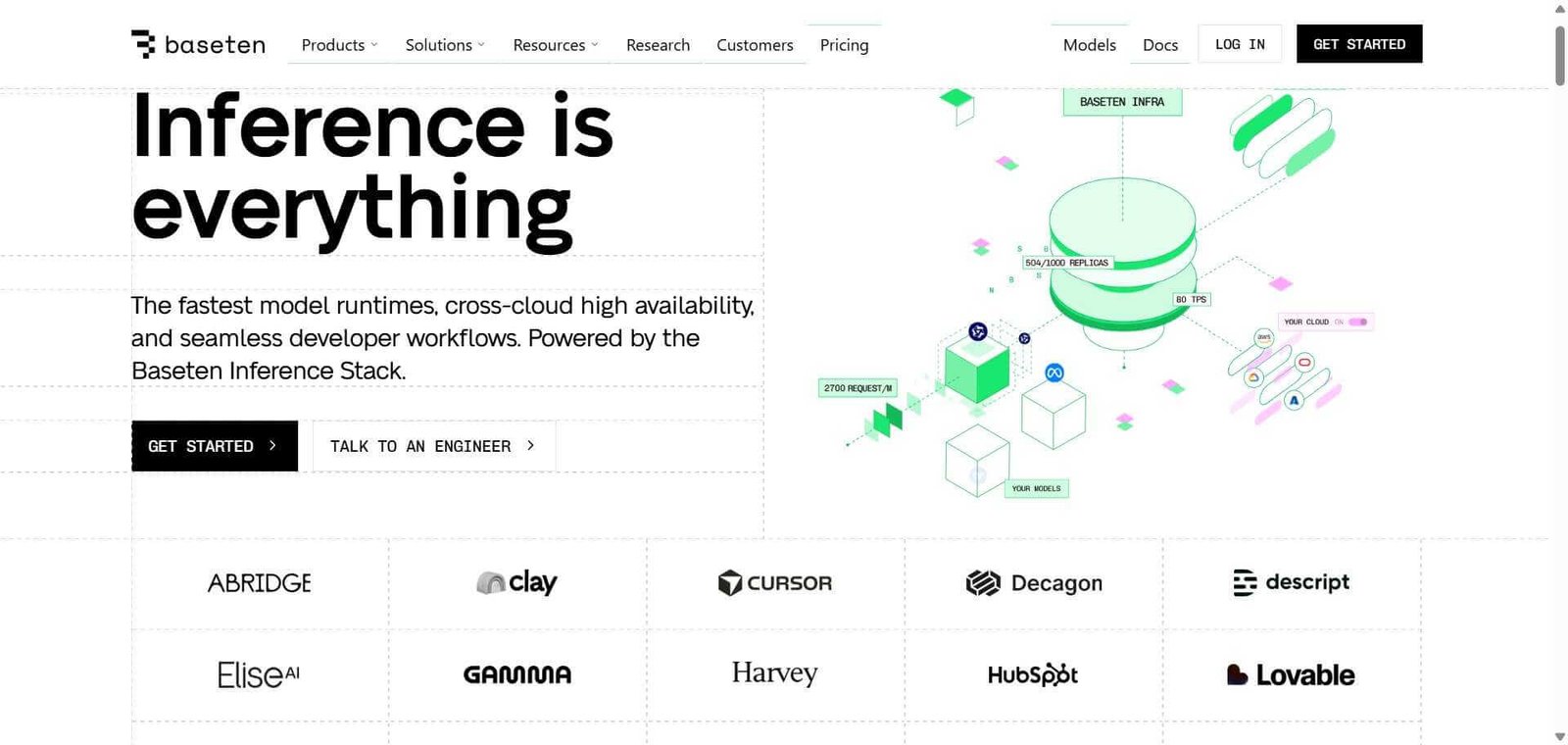
Enterprise AI model serving for production workloads. H100s at $6.50/hr, scale-to-zero with no idle billing, and Truss packaging trusted by Writer, Descript, and Patreon.
Baseten Review: The Production AI Inference Platform That Sits Between Replicate and the Hyperscalers
There is a gap in the AI inference infrastructure market. Replicate is fast to start but expensive at scale and limited in control. AWS SageMaker gives full control but demands significant Kubernetes and infrastructure management overhead. Baseten fills this gap: bring your trained or fine-tuned model, package it with Truss, deploy to dedicated GPU infrastructure with scale-to-zero billing and autoscaling, and ship it to production without managing a single container registry or Kubernetes cluster. Raised at a reported $2 billion valuation in late 2025 following a $75 million Series C led by IVP, used in production by Writer, Descript, Patreon, and Robust Intelligence, Baseten has become the default inference platform for AI-native companies that have outgrown the model marketplace and want more control than hyperscalers allow without the infrastructure overhead.
Quick Summary
Baseten is an enterprise AI model inference and serving platform providing dedicated GPU deployments at H100 $6.50/hr, A100 $4.00/hr, and B200 $9.98/hr with scale-to-zero billing, Truss open-source model packaging, Model APIs for token-based LLM access, BYOC self-hosted deployment for regulated industries, async inference, streaming, sub-second latency optimisation, and custom request handlers. Serving Writer, Descript, Patreon, Robust Intelligence, and Picnic Health. Free Basic tier with starter credits, Pro and Enterprise custom-priced.
Is it worth using? Yes for AI-native startups and enterprise ML engineering teams who need production inference infrastructure with dedicated GPU capacity, scale-to-zero cost efficiency, and enterprise-grade SLAs without managing cloud infrastructure themselves.
Who should use it? ML engineers, AI platform teams, and infrastructure engineers at AI-native startups and enterprises who serve custom or fine-tuned models in production and need low-latency autoscaling inference without Kubernetes expertise.
Who should avoid it? Teams whose primary need is access to pre-built community models through a simple API without custom model deployment. Replicate’s 50,000 plus model catalogue serves this use case at lower complexity.
Verdict Summary
Best for
- AI-native startups serving custom fine-tuned models in production who need reliable sub-second inference latency without managing GPU infrastructure. Baseten’s Truss packaging and scale-to-zero autoscaling handle the entire serving layer
- Enterprise teams with HIPAA, SOC 2, or data residency requirements who need BYOC deployment. Model inference runs inside the customer’s own cloud account without data leaving their security perimeter
- Teams that have hit Replicate’s cost ceiling at sustained production volume. Baseten’s H100 at $6.50/hr with no idle billing provides better unit economics for workloads that scale to zero overnight
Not for
- Teams whose primary need is community open-source model access through one API without custom model deployment. Replicate’s 50,000 plus model catalogue is simpler and faster for this use case
- Early-stage projects running occasional inference jobs where Replicate’s per-prediction billing with $5 free signup credit provides enough capacity without platform commitment
- Teams whose primary workloads are training rather than inference. Modal’s Python-native serverless architecture is more flexible for training and batch processing
Rating
⭐⭐⭐⭐ 4.2 / 5
What Is Baseten?
Baseten was founded in 2019 in San Francisco. The company started as a no-code ML application builder before pivoting to model serving infrastructure as the market signal clarified. The $75 million Series C in February 2024 was led by IVP at a reported $825 million post-money valuation, followed by a Series D round at a reported $2 billion valuation in late 2025. Customers include Writer, Descript, Patreon, Robust Intelligence, and Picnic Health, spanning enterprise compliance-sensitive workloads and high-growth AI-native startups.
Truss, Baseten’s open-source model packaging framework, predates the company’s hosted platform by three years. It standardises how ML models are containerised and shipped to production APIs, eliminating the bespoke per-model container engineering that slows deployment without the right abstraction layer.
How Baseten Works
- Package the model with Truss. Use Baseten’s open-source Truss framework to package any model, including PyTorch, JAX, and ONNX formats, into a standardised serving container with a defined request and response schema, custom pre and post processing handlers, and configurable GPU hardware requirements.
- Deploy to dedicated GPU infrastructure. Push the Truss-packaged model to Baseten. The platform provisions the required GPU tier (H100, A100, B200, A10G, or T4) and deploys the container without any container registry or Kubernetes configuration.
- Scale-to-zero eliminates idle costs. When traffic drops to zero, Baseten scales replicas to zero. Billing stops entirely during the zero-replica state. When new requests arrive, autoscaling restores replicas automatically. A 15-minute inactivity window precedes scale-down.
- Autoscaling handles traffic spikes. The Baseten autoscaler adds replicas when request queue depth exceeds configured thresholds, handling burst traffic without manual capacity planning or reserved instance commitments.
- Use Model APIs for managed LLM inference. Teams that want managed token-based LLM access without custom model deployment use Baseten’s Model APIs, providing access to Llama 4, Mistral, and other popular open-source models at per-token rates.
- BYOC for regulated industries. Enterprise teams with HIPAA or strict data residency requirements deploy Baseten’s infrastructure inside their own AWS account. All inference runs within the customer’s security perimeter.
Key Features
- Dedicated GPU deployments: H100 80GB at $6.50/hr, A100 80GB at $4.00/hr, B200 at $9.98/hr, A10G and T4 at lower tiers
- Scale-to-zero with no idle billing. Replicas at zero are not billed. Minutes spent deploying or scaling are billed
- Truss open-source model packaging: standardised serving containers with custom request handlers
- Model APIs: token-based managed LLM inference for Llama 4, Mistral, and other popular open-source models
- Async inference for batch processing workloads
- Streaming support for real-time output generation
- BYOC self-hosted deployment for HIPAA and data residency compliance
- No model markup: GPU rates are identical regardless of model size or parameter count
- Custom request handlers for pre and post processing logic embedded in the serving layer
- SOC 2 Type II and HIPAA compliance for regulated industry deployments
- $75 million Series C led by IVP, reported $2 billion Series D valuation
- Customers: Writer, Descript, Patreon, Robust Intelligence, Picnic Health
Real-World Use Cases
- Custom fine-tuned model production serving: An AI startup has fine-tuned Llama 4 on its domain-specific dataset and needs to serve it in production with sub-250ms p95 latency. The team packages the model with Truss, configures an H100 deployment with a warm pool of two replicas during business hours, and scales to zero overnight. The serving infrastructure is live in production in one day without Kubernetes configuration.
- HIPAA-compliant healthcare AI inference: A healthcare AI company’s compliance requirements prohibit patient data from being processed on third-party managed infrastructure. Baseten’s BYOC deployment runs the serving infrastructure inside the company’s own AWS account. All inference requests and responses stay within the security perimeter, satisfying the compliance requirement.
- Burst inference for batch processing: A media technology company runs nightly batch inference jobs on a large video transcription model, processing 10,000 videos overnight. Baseten’s async inference endpoint handles the batch with autoscaling across multiple A100 replicas during the processing window, then scales to zero for the remaining hours. Batch cost is dramatically lower than a persistent always-on deployment.
- Writer production LLM serving: Writer, the enterprise AI company, uses Baseten to serve its custom enterprise LLMs in production with the latency and reliability that enterprise SLAs require. The Baseten infrastructure handles the serving layer while Writer’s team focuses on model development and enterprise product features.
Pros and Cons
| Pros | Cons |
|---|---|
| No model markup: H100 at $6.50/hr regardless of model size. More cost-effective than Replicate for sustained production workloads at equivalent GPU tier | Scale-to-zero with a 15-minute scale-down delay means cold start latency variability. Teams with strict sub-second SLAs for all requests need warm pools that add to cost |
| Truss open-source packaging standardises model serving. The reusable abstraction eliminates per-model bespoke container engineering for every new deployment | More technical setup than Replicate’s zero-configuration model calls. Requires ML infrastructure experience to configure deployments, autoscaling, and request handlers correctly |
| BYOC deployment for regulated industries. HIPAA and SOC 2 compliance with data residency within the customer’s own cloud account | Biased toward inference rather than training. Modal or direct cloud providers are more appropriate for training workloads requiring flexible Python execution environments |
| Reported $2 billion valuation with Writer, Descript, and Patreon as production customers. Strong financial position and validated enterprise adoption | Model APIs for popular LLMs have a smaller catalogue than Replicate’s 50,000 plus community models. Platform is strongest for custom model deployment rather than community model access |
| Scale-to-zero with no idle billing. The most cost-effective billing model for workloads with variable traffic including overnight zero-traffic windows | Platform complexity increases with BYOC deployment. Self-hosted enterprise infrastructure requires dedicated engineering effort beyond what the managed SaaS tier demands |
Pricing & Plans
Basic — Free
- Starter GPU credits on signup
- Access to all GPU tiers (H100, A100, B200, A10G, T4)
- Core inference features
- Community support
Pay-As-You-Go GPU Rates
| GPU | Rate |
|---|---|
| H100 80GB | approximately $6.50/hr |
| A100 80GB | approximately $4.00/hr |
| B200 | approximately $9.98/hr |
| A10G | approximately $0.80/hr |
- Scale-to-zero: $0 when replicas are at zero
- No idle billing on zero-replica deployments
- Minutes spent deploying or scaling are billed
Pro — Custom quote
- Committed compute discounts
- Reserved capacity
- Priority support
- Faster cold starts with warm pool management
Enterprise — Custom pricing
- BYOC deployment inside customer AWS account
- Dedicated infrastructure
- Custom SLAs
- HIPAA and SOC 2 compliance support
- Dedicated solutions engineer
- AWS Marketplace billing available
Model API rates: median approximately $0.60 per million input tokens and $2.20 per million output tokens across tracked models. Verify current GPU rates at baseten.co/pricing as rates are updated regularly.
Best Alternatives & Comparisons
- Modal — Better for Python-native serverless AI workloads including training, batch processing, and custom ML code with sub-second cold starts
- Replicate — Better for teams wanting access to 50,000 plus pre-built community models through one API without custom model deployment
- Together AI — Better for managed LLM inference with per-token pricing and the widest range of hosted open-source models without custom deployment
- AWS SageMaker — Better for large enterprises deeply embedded in the AWS ecosystem wanting hyperscaler managed ML with full AWS integration
Frequently Asked Questions (FAQ)
Baseten is an enterprise AI model serving platform providing dedicated GPU deployments, scale-to-zero billing, Truss open-source model packaging, and BYOC deployment for regulated industries. Used in production by Writer, Descript, and Patreon. Reported $2 billion valuation. Free to start with pay-as-you-go GPU billing.
Truss is Baseten’s open-source model packaging framework that standardises how ML models are containerised for production serving. It provides a consistent request and response schema, custom pre and post processing handlers, and configurable hardware requirements, eliminating the bespoke container engineering required for each new model deployment.
When a Baseten deployment has no active traffic for approximately 15 minutes, it scales to zero replicas and billing stops. When new requests arrive, replicas are restored automatically. Minutes spent in the deployment or scaling phase are billed even if no predictions are processed.
Bring Your Own Cloud (BYOC) is Baseten’s enterprise deployment option that runs the serving infrastructure inside the customer’s own AWS account. All model inference happens within the customer’s security perimeter without data being processed on Baseten-managed infrastructure, meeting HIPAA and strict data residency requirements.
Replicate provides access to 50,000 plus pre-built community models through one consistent API. Baseten is for custom model deployment in production: teams bring their own trained or fine-tuned models, package with Truss, and deploy to dedicated GPU infrastructure with enterprise SLAs. Replicate for community model access. Baseten for custom model production serving with compliance and latency requirements.
Yes. The free Basic tier with starter credits and pay-as-you-go GPU billing makes Baseten accessible for validating production inference requirements. Pro and Enterprise tiers with committed compute discounts become more appropriate as production traffic grows and reserved capacity justifies the contract commitment.
Final Recommendation
Baseten is the production AI inference platform for engineering teams who need more control and better unit economics than Replicate provides and less infrastructure overhead than hyperscalers require. Truss model packaging, scale-to-zero GPU billing, BYOC compliance deployment, and production validation from Writer, Descript, and Patreon create an inference infrastructure choice that is directly appropriate for AI-native companies scaling toward enterprise. For any AI team spending increasing engineering hours managing GPU infrastructure rather than shipping product, Baseten converts that overhead into working production endpoints with the compliance and latency guarantees that enterprise customers require.
Next steps