
Modal Review: The Python-Native Serverless GPU Platform That Reached Unicorn Status in 23 Months
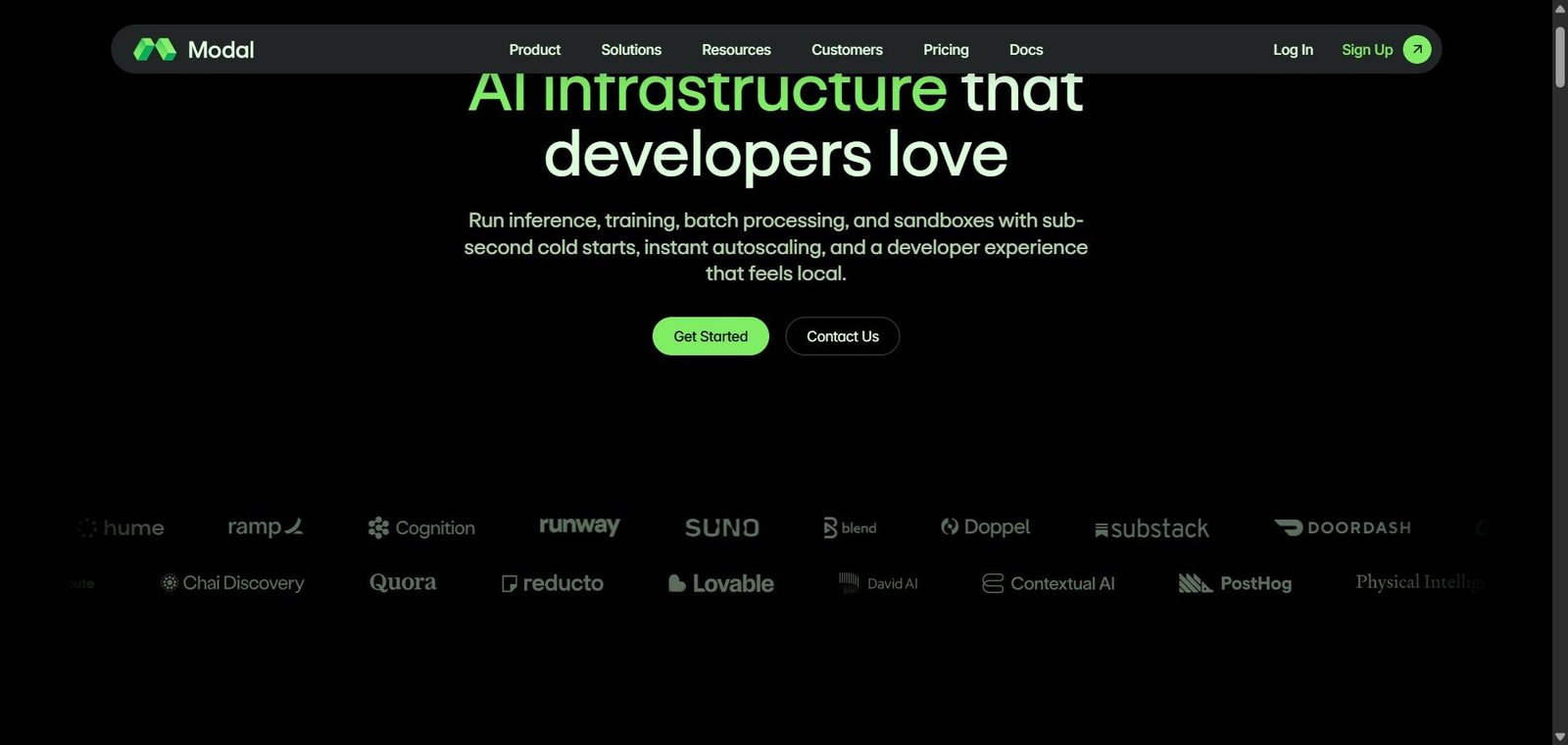
AI infrastructure has a paradox — the teams who most need fast access to GPU compute for training, inference, and batch jobs are the same teams least able to spend their time managing Kubernetes clusters, container registries, and autoscaling policies. Modal was built to resolve this paradox: a Python-native serverless cloud where developers decorate functions with @app.function(), specify the GPU type, memory, and concurrency requirements in code, and Modal handles every infrastructure concern — container build, image registry, scheduling, autoscaling, and per-second billing — without exposing a single infrastructure abstraction the developer needs to manage.
Founded in 2021 by Erik Bernhardsson (creator of Luigi and Annoy, former Spotify ML lead) and Akshat Bubna, Modal reached unicorn status at a $1.1 billion valuation in September 2025 — just 23 months after its Series A. Customers include Suno, Substack, Ramp, Notion, and Anthropic for select internal workloads.
Quick Summary
Modal is a serverless AI infrastructure platform backed by Lux Capital, Redpoint Ventures, and Amplify Partners — providing Python-native GPU compute access across H100s, B200s, B300s, A100s, and A10Gs with sub-second cold starts, elastic autoscaling, per-second billing, Depot CI integration, agent sandboxes, multi-node training, Infiniband networking, web endpoints, Jupyter notebooks, and a Shared API — from a free Starter tier with $30 monthly credits to a Team plan at $250/month and custom Enterprise.
Is it worth using? Yes for ML engineers, AI developers, and data scientists who want the fastest path from Python code to GPU-accelerated production workloads without managing cloud infrastructure — Modal removes the DevOps overhead that delays AI teams from shipping.
Who should use it? Machine learning engineers, AI developers, data scientists, and AI-native startup engineering teams who work in Python and need elastic GPU compute for inference, training, batch processing, and AI agent sandboxes without cloud infrastructure expertise.
Who should avoid it? Teams that need deep infrastructure customisation, persistent always-on GPU clusters, or multi-cloud control plane features that Modal’s serverless model abstracts away — AWS and GCP direct cloud deployments provide more flexibility at the cost of infrastructure management.
Verdict Summary
Best for
- AI-native startups and ML engineering teams who want to ship inference APIs, fine-tuning jobs, and batch processing pipelines in days rather than weeks — Modal’s sub-second cold starts and Python-first interface reduce the infrastructure gap between writing code and running it at scale
- Generative AI teams who need burst GPU access for model inference and training without committing to reserved cloud instances — Modal’s per-second billing and elastic scaling mean teams pay for compute they use rather than capacity they reserve
- AI agent developers who need secure sandboxes for executing agent-generated code at scale — Modal Sandboxes provide isolated execution environments that start in under a second
Not for
- Teams needing always-on persistent GPU clusters with no cold start latency — Modal’s serverless model optimises for elastic scaling rather than persistent dedicated infrastructure
- Organisations with strict multi-cloud or on-premises compute requirements that Modal’s AWS-based cloud infrastructure cannot accommodate
- Teams without Python fluency — Modal’s developer experience is built around Python and requires comfort with the language and decorators to access its value
Rating
⭐⭐⭐⭐ 4.3 / 5
What Is Modal?
Modal is a New York-based serverless compute platform founded in September 2021 by Erik Bernhardsson — who created Luigi (Spotify’s data pipeline framework) and Annoy (Spotify’s approximate nearest neighbour library) before joining Spotify as ML lead — and Akshat Bubna. The platform’s thesis is that the infrastructure complexity of AI development should be invisible: developers should write Python functions, declare their compute requirements, and Modal handles everything else.
In 2026, Modal serves approximately 1,000 paying customers spanning AI-native startups, academic research labs, and mid-market product engineering teams. The platform supports multi-node training with high-speed Infiniband networking, AI agent sandboxes for isolated code execution, web endpoints for serving models, Jupyter notebooks for interactive development, and a Shared API for token-metered LLM inference launched in July 2026.
How Modal Works
- Decorate Python functions with compute requirements. Add
@app.function(gpu="H100", memory=32768)to any Python function to specify compute requirements. Modal reads the decorator and provisions the appropriate infrastructure automatically. - Modal builds and caches the container. The platform builds a container from the specified image, installs dependencies, and caches the result — subsequent runs reuse the cached container, keeping cold starts under one second.
- Functions scale elastically. Modal scales the function from zero to hundreds of concurrent executions based on demand — no manual autoscaling configuration, no minimum idle compute costs.
- Pay per second of active compute. Modal bills per second of active execution with no idle charges — compute costs accrue only when the function is running, making it cost-effective for workloads with variable demand.
- Deploy web endpoints and batch jobs. Modal Functions serve as synchronous web endpoints for model inference APIs, batch jobs for training and data processing, and scheduled tasks for periodic compute workflows — all from the same Python decorator interface.
- Use Sandboxes for agent code execution. Modal Sandboxes provide isolated ephemeral environments for executing untrusted agent-generated code — starting in under a second and running at scale for AI agent applications that need secure code execution.
Key Features
- Python-native serverless compute — infrastructure defined in code with
@app.function()decorators - GPU access: H100 SXM ($4.29/hr effective), A100 ($3.72/hr effective), B200 ($6.25/hr effective), A10G ($1.10/hr effective), T4 ($0.59/hr effective)
- Sub-second container cold starts — cached containers reuse previous builds
- Per-second billing with no idle charges — pay only for active compute time
- Elastic autoscaling from zero to hundreds of concurrent executions
- Multi-node training support with high-speed Infiniband networking
- Modal Sandboxes — isolated ephemeral environments for secure agent code execution
- Web endpoints for serving model inference APIs
- Jupyter Notebooks for interactive development on Modal compute
- Persistent volumes, cloud bucket integration, task queues, key-value storage
- Shared API for token-metered LLM inference (launched July 2026)
- Depot CI integration for AI-accelerated CI/CD workflows
- Available in US (us-east-1), EU (eu-central-1), UK, and Asia-Pacific regions
- Customers: Suno, Substack, Ramp, Notion, Anthropic (select workloads)
- $1.1 billion valuation — backed by Lux Capital, Redpoint Ventures, Amplify Partners
Real-World Use Cases
- AI startup inference deployment: An AI startup serving a music generation model needs to handle variable request volume — hundreds of simultaneous requests during peak hours and near-zero during off-peak times. Modal’s elastic scaling handles peak load automatically and costs nothing during idle periods, compared to a reserved GPU instance that charges whether the model is serving requests or not.
- Fine-tuning pipeline: An ML engineering team runs weekly fine-tuning jobs on a 7B parameter model using Modal’s H100 access. The job runs in Modal, completes in hours, and the team pays only for the H100 time consumed — without managing a dedicated training cluster that would cost more per month than the actual training compute used.
- AI agent code execution: A developer building an AI coding agent uses Modal Sandboxes to execute agent-generated code safely — each sandbox is isolated, starts in under a second, and the agent can trigger hundreds of sandboxes concurrently without any infrastructure configuration.
- Batch image generation: A generative AI company runs nightly batch jobs generating thousands of images for client campaigns. Modal processes the batch in parallel across multiple GPU workers, completing in minutes rather than hours, with per-second billing ensuring the team pays only for the actual compute time rather than reserving a GPU cluster overnight.
Pros and Cons
| Pros | Cons |
|---|---|
| Sub-second cold starts and per-second billing — the fastest path from Python code to GPU-accelerated production for teams without cloud infrastructure expertise | Regional multipliers of 1.25x and non-preemption multipliers of up to 3x mean real production costs are significantly higher than base GPU rates — model costs carefully |
| Python-native interface requires no separate infrastructure tooling — developers declare compute requirements in the same codebase as application logic | Serverless model means no persistent always-on GPU clusters — workloads requiring zero cold start latency need a different architecture |
| Unicorn status at $1.1B valuation 23 months after Series A — strong financial foundation and product-market validation | No perpetual free tier — the Starter plan includes $30 monthly credits that deplete, requiring paid upgrade for production workloads |
| Customers include Suno, Ramp, Notion, and Anthropic — validated at AI-native companies with demanding production workloads | Team plan at $250/month plus usage charges — full production costs require careful modelling including multipliers before committing |
| Agent Sandboxes enable secure isolated code execution for AI agent applications — a forward-looking capability as agentic AI workloads grow | Relatively small team of approximately 58 employees — support depth may be limited for very complex enterprise deployments |
Pricing & Plans
Starter — Free
- $30 monthly compute credits included
- 3 workspace seats
- 100 concurrent containers
- 10 concurrent GPUs
- Community Discord support
Team — $250/month
- $100 monthly compute credits included
- Unlimited workspace seats
- 1,000 concurrent containers
- 50 concurrent GPUs
- Email support
- Optional SSO add-on available
Enterprise — Custom pricing
- Dedicated infrastructure
- Custom GPU quotas
- Advanced compliance controls
- SSO/SAML/SCIM
- Audit logging
- Slack Connect support
- AWS Marketplace billing
GPU compute rates (effective per hour — includes regional multiplier for US):
- A10G: approximately $1.10/hr
- A100 40GB: approximately $3.72/hr
- H100 SXM: approximately $4.29/hr
- B200: approximately $6.25/hr
Compute is billed per second. Regional multipliers and non-preemption multipliers apply — verify total cost including multipliers at modal.com/pricing before committing.
Best Alternatives & Comparisons
- RunPod — Better for lower per-GPU-hour pricing with persistent pod deployments for teams comfortable managing their own containers
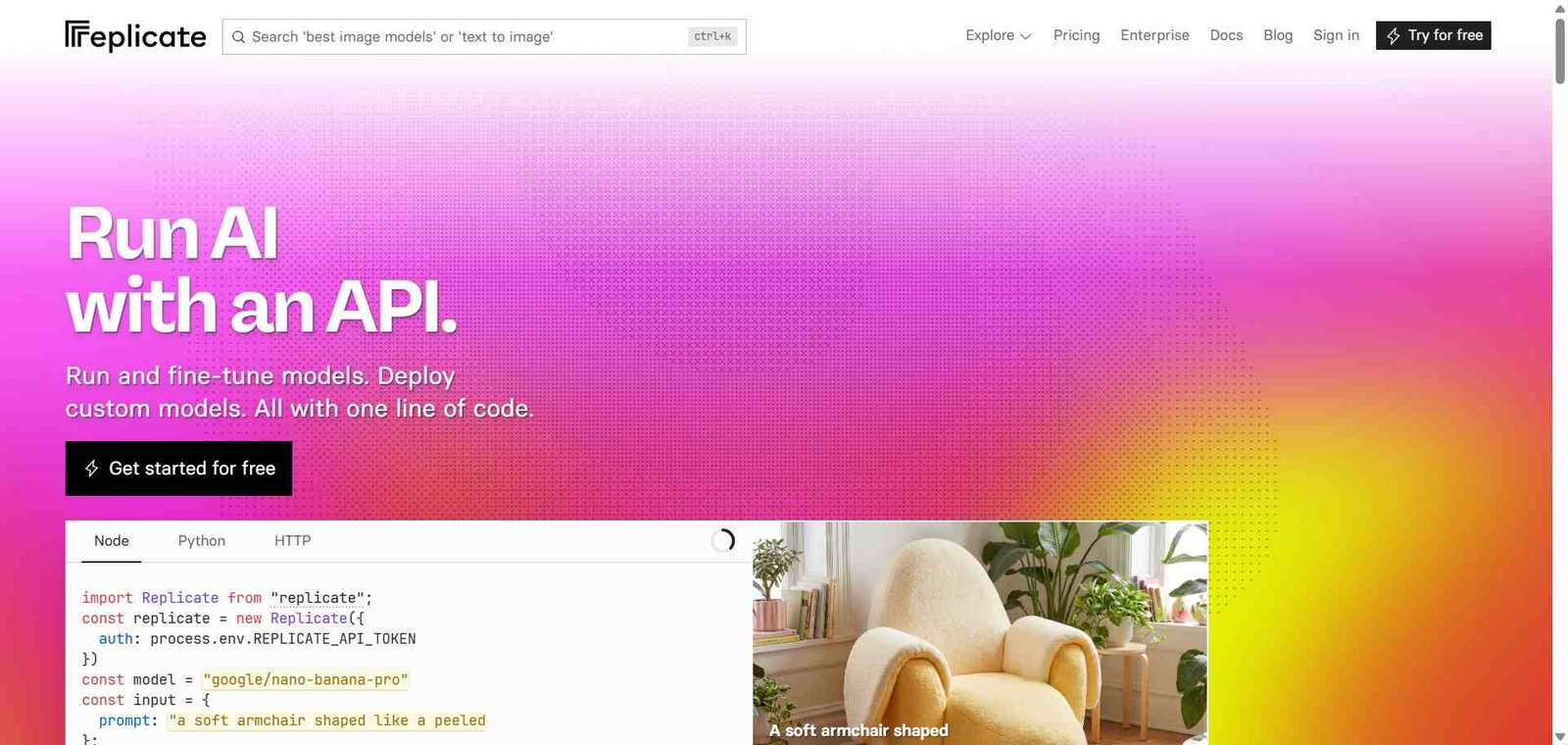
- Replicate — Better for running pre-built open-source models via API without writing infrastructure code
- AWS SageMaker — Better for enterprise ML workflows deeply integrated with the full AWS ecosystem
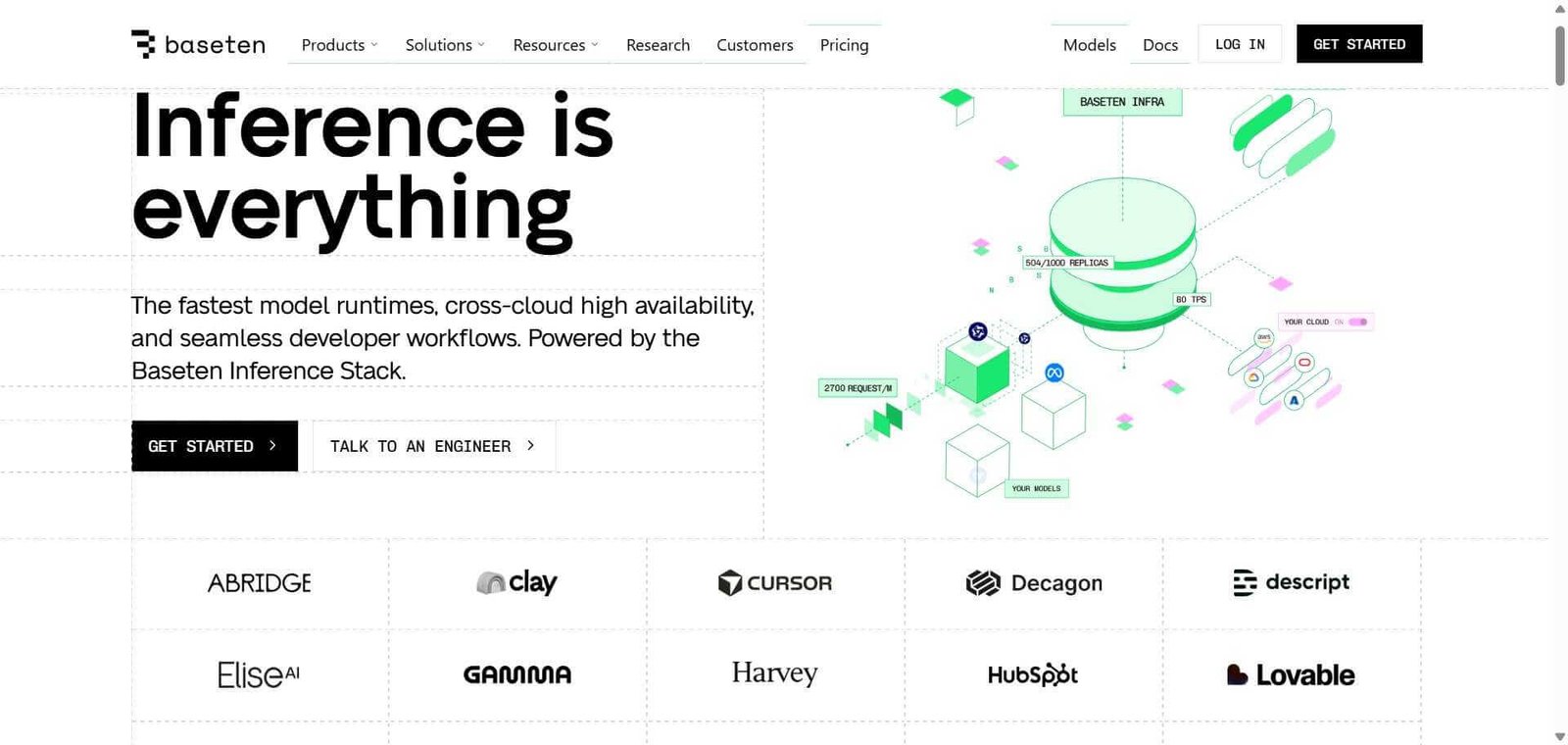
- Baseten — Better for production model serving with guaranteed SLAs and enterprise support requirements
Frequently Asked Questions (FAQ)
Modal is a Python-native serverless AI infrastructure platform providing GPU compute for ML inference, training, batch jobs, and agent sandboxes — with sub-second cold starts, per-second billing, and elastic autoscaling. Used by Suno, Ramp, Notion, and Anthropic. Unicorn valued at $1.1 billion.
Yes — the Starter plan includes $30 monthly compute credits at no charge for evaluation. Production workloads typically require the Team plan at $250/month plus metered compute usage.
Modal provides access to H100 SXM, A100 40GB and 80GB, B200, B300, A10G, and T4 GPUs across US, EU, UK, and Asia-Pacific regions, with elastic scaling from zero to hundreds of concurrent GPU workers.
Modal bills per second of active compute execution — there are no idle charges when functions are not running. Regional multipliers (1.25x for US/EU/UK) and non-preemption multipliers (up to 3x) apply on top of base rates — real production costs should be modelled including these multipliers before committing.
Modal Sandboxes are isolated ephemeral execution environments for running untrusted code — starting in under a second. They are designed for AI agent applications that need to execute agent-generated code safely at scale without dedicated sandbox infrastructure.
Modal is Python-native with sub-second cold starts, per-second billing, and zero infrastructure management — developers write Python and Modal handles everything. RunPod offers lower base GPU rates with persistent pod deployments but requires more infrastructure management. Modal for teams who want zero DevOps overhead. RunPod for teams comfortable with container management who prioritise the lowest per-GPU-hour cost.
Final Recommendation
Modal is the fastest path from Python AI code to GPU-accelerated production for ML engineering teams who want to ship rather than manage infrastructure. The sub-second cold starts, Python-native decorator interface, per-second billing, and elastic scaling from zero make it the default recommendation for AI-native startups and ML teams who need GPU compute without the DevOps overhead. The $1.1 billion valuation, Lux Capital and Redpoint backing, and customer list including Suno and Anthropic validate that Modal has found genuine product-market fit in the most demanding AI infrastructure segment. For any ML engineer who has spent a week setting up cloud infrastructure before writing a single line of model code, Modal compresses that infrastructure setup to a single Python decorator.
Next steps