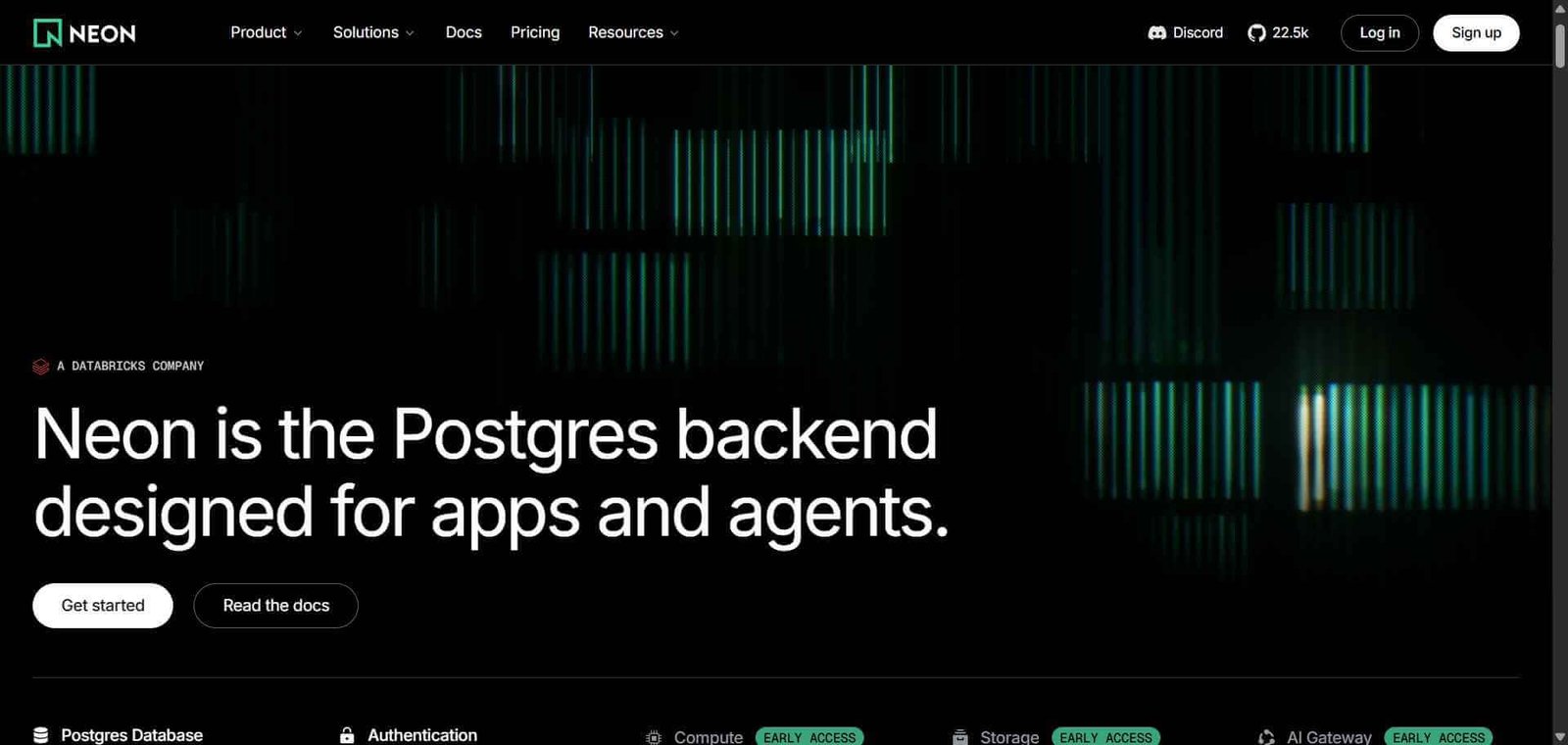
Serverless Postgres that scales to zero, branches like Git, and provisions in seconds.
Traditional databases are always on — they run continuously whether or not anyone is using them, consuming compute and costing money around the clock. Neon introduces serverless architecture to Postgres, meaning databases scale to zero when inactive, scale up instantly when needed, and cost nothing when not in use. Combined with database branching — the ability to create an isolated copy of your database for a new feature branch the same way you branch code in Git — Neon fundamentally changes how developers work with databases in the same way that Vercel changed how they deploy frontend code.
Neon is a serverless Postgres database platform with autoscaling, scale-to-zero, database branching, and instant provisioning, designed for modern web applications, AI workloads, and development workflows that benefit from isolated database environments per branch.
Is it worth using? Yes for developers building on Next.js, Vercel, and other serverless platforms who want a Postgres database that matches the serverless architecture of their deployment environment.
Who should use it? Full-stack developers, indie hackers, and engineering teams building modern web applications who want Postgres with serverless economics, database branching for development workflows, and deep integration with Vercel and other modern deployment platforms.
Who should avoid it? Teams running traditional always-on applications that require persistent database connections and predictable flat-rate pricing rather than usage-based serverless pricing.
Best for
Not for
Rating
⭐⭐⭐⭐½ 4.6 / 5
Neon is a serverless Postgres database company that separates storage and compute to enable the scale-to-zero capability that traditional Postgres cannot offer. When no queries are running, Neon databases pause their compute and cost nothing. When a query arrives, compute spins up in milliseconds — fast enough that users do not notice the delay. This architecture makes Neon economics match perfectly with serverless application deployments where traffic is bursty or variable rather than constant.
The database branching feature is Neon’s most developer-experience-defining capability. Each branch creates an isolated copy-on-write snapshot of the database state, sharing storage with the parent branch for unchanged data but creating independent data as changes are made. This means every pull request can have its own isolated database environment without duplicating storage costs, enabling development workflows that were previously impractical with traditional databases.
| Pros | Cons |
|---|---|
| Scale-to-zero makes hobby and low-traffic projects genuinely free to run | Cold start latency (milliseconds) affects first query after idle period |
| Database branching transforms development and preview workflows | Usage-based pricing can be unpredictable for variable traffic patterns |
| Vercel integration for preview branch databases is seamless | Persistent connection architectures incompatible without connection pooler |
| pgvector support eliminates need for separate vector database | Less suitable for traditional always-on application architectures |
| Instant provisioning removes database setup overhead | Enterprise features and dedicated compute on higher plan tiers |
Neon is a serverless Postgres database platform with scale-to-zero, autoscaling, database branching, and instant provisioning for modern web applications and AI workloads.
Yes, Neon offers a free plan with 0.5 GB storage, 1 project, and 10 branches. The free tier genuinely supports small applications and hobby projects indefinitely when traffic is low.
Database branching creates an isolated copy-on-write snapshot of your database that diverges independently as changes are made, similar to branching in Git. It enables isolated development environments, preview deployment databases, and safe experimentation without affecting production data.
When no queries are running against a Neon database for a defined idle period, the compute component pauses and costs nothing. When a new query arrives, compute resumes in milliseconds. This eliminates the cost of running idle databases, making Neon economically efficient for variable traffic applications.
Yes, Neon supports the pgvector extension for storing vector embeddings and running similarity searches, enabling AI applications to use the same Postgres database for both standard data and AI embedding workloads.
Neon has a native Vercel integration that automatically creates a Neon database branch for each Vercel preview deployment, giving every preview its own isolated database environment without manual branch creation or cleanup.
Neon is the most developer-friendly Postgres database available for modern serverless web application development. The scale-to-zero economics make it genuinely free for small projects, the database branching workflow eliminates one of the most frustrating aspects of collaborative database development, and the pgvector support future-proofs the choice for AI application development. For any developer building on Next.js, Vercel, or other modern serverless platforms, Neon is the natural database companion.
Next steps