Design and publish interactive 3D scenes and web experiences directly in your browser — no code needed.
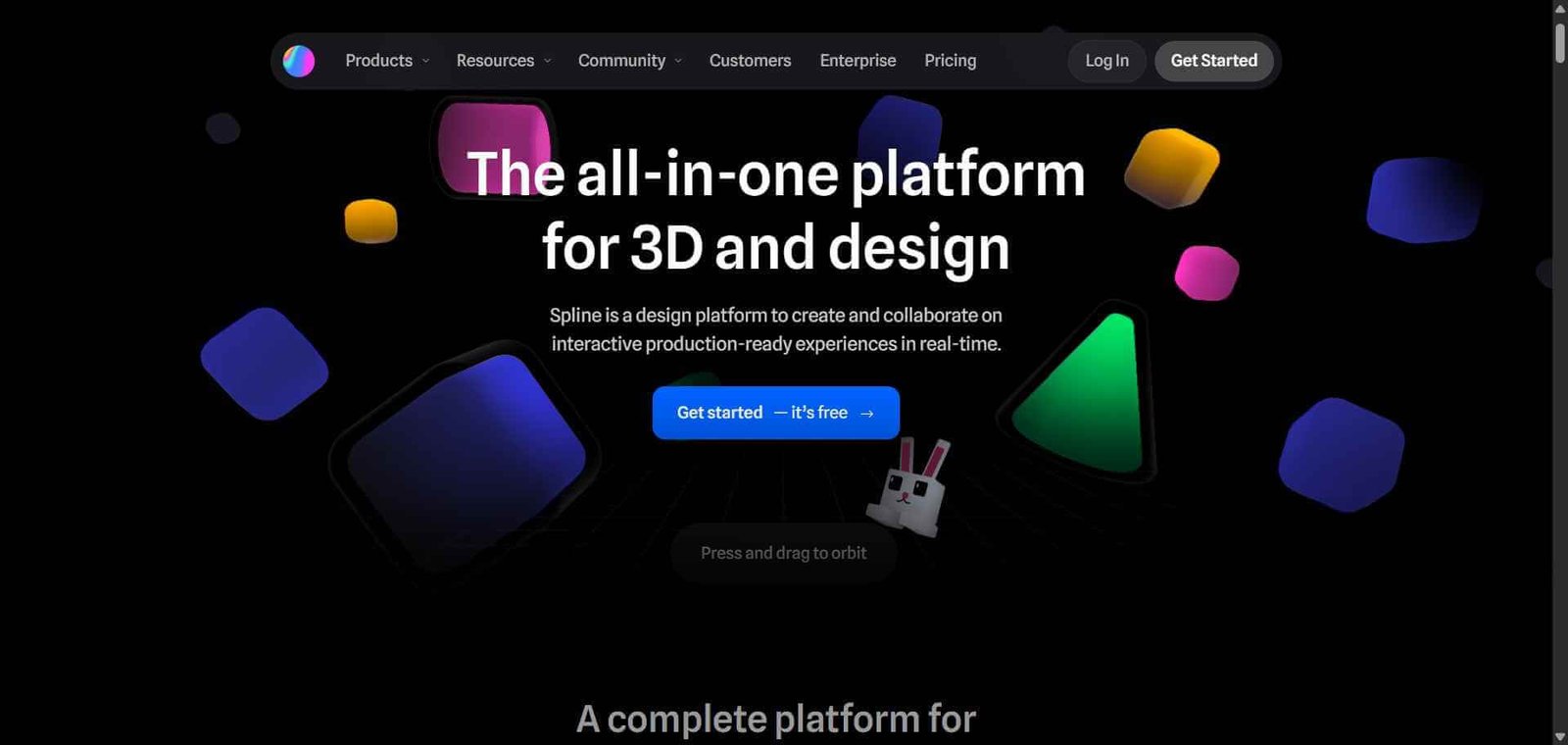
Until recently, interactive 3D on the web required Three.js expertise, complex WebGL shaders, and significant development time. Spline changes that fundamentally — it is a browser-based 3D design tool where designers and developers create interactive 3D scenes, animations, and product visualisations and export them directly to the web with a single embed code, no Three.js required. For product teams, marketers, and designers who want the visual impact of 3D on their websites and applications without the development investment, Spline has opened a previously inaccessible creative space.
Spline is a browser-based 3D design and prototyping tool that enables designers to create interactive 3D scenes, animations, and product visualisations and publish them to the web with a single code snippet — no WebGL or Three.js development required.
Is it worth using? Yes for designers and product teams who want to add interactive 3D elements to websites, landing pages, and applications without development resources.
Who should use it? Product designers, web designers, marketers, and creative teams who want to incorporate interactive 3D into their digital work without learning 3D development frameworks.
Who should avoid it? Game developers needing game-engine-level 3D capability, or studios producing photorealistic 3D rendering for film and advertising where Blender or Cinema 4D are the appropriate tools.
Best for
Not for
Rating
⭐⭐⭐⭐ 4.4 / 5
Spline is a 3D design tool built for the web era — created by Colombian designer Alejandro León, it runs entirely in the browser and produces 3D output that embeds directly into websites via an iframe or React component. The design workflow is familiar to anyone who has used Figma — objects, layers, transforms — extended into the third dimension with cameras, lights, materials, and physics.
What makes Spline particularly powerful is its interactivity layer. 3D objects in Spline can respond to mouse movement, scroll position, clicks, and hover states, enabling experiences where a product model rotates as the user scrolls down the page, or a 3D character reacts to cursor movement — interactions that previously required significant WebGL development to produce.
| Pros | Cons |
|---|---|
| Browser-based with no installation removes setup barrier | Not suitable for game development or film-quality 3D production |
| Web export makes 3D interactive experiences genuinely accessible | Performance of complex scenes on lower-end devices requires optimisation |
| Interactivity without code opens 3D to non-developers | Learning 3D concepts has a curve even in a friendly tool |
| AI scene generation from text accelerates exploration | Export formats limited compared to professional 3D tools |
| Real-time collaboration enables team-based 3D design | Free plan limits scene exports and sharing |
Spline is a browser-based 3D design tool that enables designers to create interactive 3D scenes, animations, and product visualisations and publish them directly to the web without WebGL development knowledge.
Yes, Spline offers a free plan with unlimited scenes and basic publishing. The Pro plan at $9/month per editor adds custom domain publishing, full React component export, and advanced physics.
No, Spline is designed for designers without coding knowledge. Interactive events and animations are configured visually through the Spline editor. Embedding the output into a website requires pasting an embed code, which is similar difficulty to embedding a YouTube video.
Yes, Spline generates an iframe embed code that works in any website. It also exports React components for direct integration into React-based web applications.
Spline is designed for web-focused interactive 3D experiences with browser publishing as the primary output. Blender is a full professional 3D suite for modelling, rigging, animation, simulation, and rendering with far greater capability but a much steeper learning curve and no built-in web publishing. Spline is for designers who want to add 3D to websites; Blender for professional 3D production.
Yes, Spline includes AI scene generation that creates 3D scenes from text descriptions, accelerating the exploration phase of 3D design work.
Spline is one of the most exciting creative tools available in 2026 for web designers and product teams who want the visual differentiation that interactive 3D provides without the technical investment that 3D has historically required. The browser-based workflow, web-native export, and interactivity without code remove every barrier that previously kept 3D out of most web projects. The Pro plan at $9/month is one of the most accessible entry points into professional 3D web design available.
Next steps