Backstory
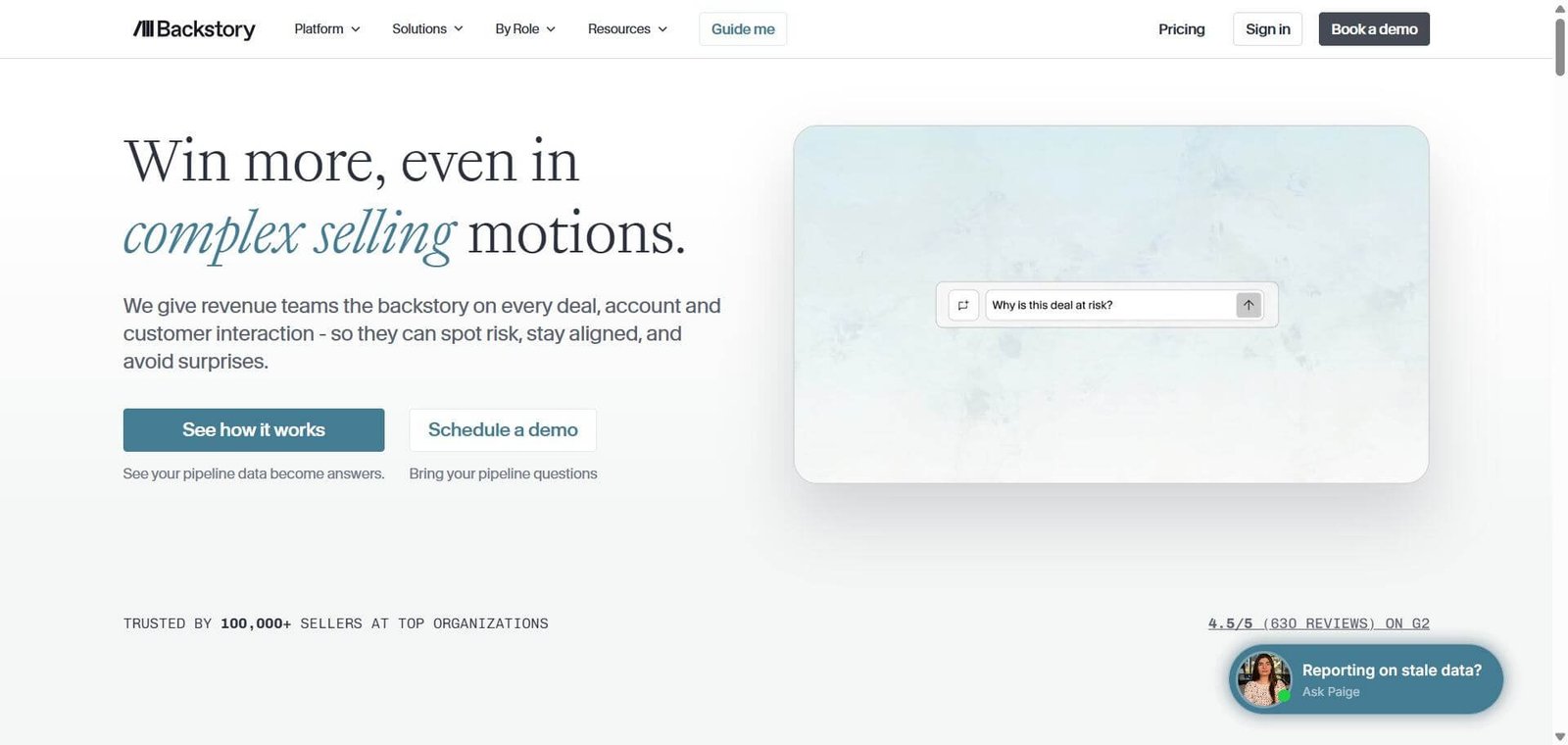
Ask what’s really happening with your deals — AI that captures every signal and gives you direct answers, not dashboards.
Backstory Review: The AI Revenue Answers Platform That Replaced People.ai — and Went Further
People.ai became one of the most recognised names in revenue intelligence by solving the CRM data problem — automating the activity capture that reps were not doing manually. Backstory, its April 2026 rebrand, reflects a deeper ambition: not just cleaning and organising the data, but answering the questions revenue leaders actually ask. “What’s the backstory on this deal?” “Which deals in the forecast are real?” “What should the rep do next?” Backstory connects signals across email, calls, meetings, CRM records, Slack, news, and websites — and delivers direct answers grounded in that data rather than requiring leaders to synthesise dashboards and decide for themselves.
Quick Summary
Backstory is an AI revenue answers platform — formerly People.ai, rebranded April 15, 2026 — that automatically captures go-to-market activity across email, meetings, calls, and CRM, applies over a decade of training on billions of real sales interactions, and delivers direct answers to deal and pipeline questions inside Salesforce, Slack, Microsoft Copilot, ChatGPT, and Claude via open APIs and MCP integration. Serving enterprise clients including OpenAI, Red Hat, HPE, Zscaler, and Rubrik.
Is it worth using? Yes for enterprise revenue leaders — CROs, VPs of Sales, and RevOps teams — whose pipeline visibility is limited by the gap between what the CRM shows and what is actually happening in deals, and who want AI to answer deal questions directly rather than building more dashboards.
Who should use it? CROs, VPs of Sales, RevOps leaders, and sales managers at enterprise B2B technology and SaaS companies running on Salesforce who want AI-powered deal answers and automated activity capture for 50 plus seller organisations.
Who should avoid it? SMB and mid-market teams without dedicated RevOps support, organisations not on Salesforce as their primary CRM, and teams who need outbound prospecting and contact sourcing rather than deal intelligence on existing pipeline.
Verdict Summary
Best for
- Revenue leaders who spend hours each week piecing together the real status of their most important deals from disconnected sources — Backstory delivers the answer to “what’s actually happening in this deal?” directly rather than requiring manual synthesis
- CROs and VPs of Sales running pipeline reviews and forecast calls who want AI-grounded deal status rather than rep-reported stage updates — Backstory’s signals-to-answers approach reflects actual buyer engagement rather than optimistic CRM entries
- RevOps teams who want automated activity capture to keep Salesforce current and an AI answers layer on top that makes that data usable for revenue leadership without custom reporting
Not for
- SMB and mid-market teams that need lighter-weight self-serve RevOps tooling — Gong Copilot, Clari, or HubSpot Sales Hub are more appropriate at this scale
- Teams who need outbound contact sourcing and prospecting data — Backstory does not source contact data or send outbound email
- Organisations primarily on HubSpot, Pipedrive, or non-Salesforce CRMs where Backstory’s patented matching and case study corpus are predominantly Salesforce-oriented
Rating
⭐⭐⭐⭐ 4.2 / 5
What Is Backstory?
Backstory is the April 2026 rebrand of People.ai — founded in 2016 by Oleg Rogynskyy and backed by ICONIQ Capital, Andreessen Horowitz, and Lightspeed Venture Partners. The name change signals a deliberate product repositioning: from data and analytics infrastructure to a Revenue Answers Platform that delivers direct answers to the questions revenue leaders ask in every pipeline review, forecast call, and deal desk across the industry.
The underlying technology is the same — patented activity capture and record-matching from a decade of building on more than 1 trillion sales interactions and 69 approved AI patents — but the user experience has shifted toward answering questions rather than surfacing data. Revenue leaders type a question in natural language — inside Salesforce, Slack, Copilot, ChatGPT, or Claude — and Backstory delivers a cited answer grounded in the full signal set from that deal.
How Backstory Works
- Auto-capture activity across all channels. Backstory connects to email, calendar, Zoom calls, Gong recordings, Slack, and other communication tools — automatically capturing every interaction and matching it to the correct Salesforce account, opportunity, and contact without rep involvement.
- Connect signals across systems. Beyond internal communications, Backstory pulls signals from CRM records, news, company websites, and other external sources — building a comprehensive deal context that extends beyond what the sales team has directly experienced.
- Ask deal questions in plain language. Revenue leaders ask questions — “what’s the backstory on the Zscaler renewal?”, “which deals in the Q3 forecast haven’t had buyer engagement in two weeks?”, “what should the rep do next on the HPE deal?” — directly inside Salesforce, Slack, Copilot, ChatGPT, or Claude via MCP integration.
- Backstory delivers cited answers. The AI generates direct answers grounded in the captured signal data — citing the specific emails, calls, and CRM records that support each answer rather than presenting undifferentiated summaries.
- Pipeline and forecast intelligence. Revenue leadership gets AI-grounded pipeline visibility — which deals are tracking to close, which are at risk, and what actions should be prioritised — without requiring managers to manually review each deal’s activity before forecast calls.
- Surface answers where teams work. MCP integration and open APIs mean answers surface inside Salesforce, Slack, Microsoft Copilot, ChatGPT, and Claude — not requiring users to log into a separate Backstory dashboard for deal intelligence.
Key Features
- Automatic activity capture from email, calendar, Zoom, Gong, Slack, and communication tools into Salesforce
- Patented AI activity-to-record matching — correctly mapping every interaction to the right account and opportunity
- Revenue Answers Platform — direct answers to deal and pipeline questions in plain language
- Signal aggregation across email, meetings, CRM records, news, and external sources for comprehensive deal context
- MCP integration surfacing answers inside Salesforce, Slack, Microsoft Copilot, ChatGPT, and Claude
- AI deal health and pipeline risk intelligence grounded in actual buyer engagement signals
- Proprietary dataset of 1 trillion plus sales interactions and 69 approved AI patents
- Free PeopleGlass tier for individual Salesforce users (legacy free product)
- SOC 2 Type II, ISO 27001, GDPR, CCPA, ISO 27701, ISO 27017, and CSA STAR certified
- Enterprise clients including OpenAI, Red Hat, HPE, Zscaler, Rubrik, Five9, and Palo Alto Networks
Real-World Use Cases
- Pipeline review preparation: A CRO uses Backstory before their weekly pipeline review — asking “which deals committed for this quarter haven’t had buyer engagement in the last 10 days?” Backstory returns the list with cited evidence from email and meeting data, allowing the CRO to focus the pipeline conversation on the specific deals that need attention rather than asking reps to update their status.
- Deal desk answers: A sales leader needs to understand the full backstory on a complex enterprise deal before a deal desk meeting — Backstory synthesises 6 months of emails, calls, Slack messages, and CRM records into a direct answer about where the deal stands, what the buyer has said, and what the recommended next step is.
- Forecast accuracy: A VP of Sales uses Backstory’s AI-grounded pipeline signals to supplement CRM-based forecasting — identifying three deals the team has committed where actual buyer engagement suggests risk, enabling early intervention before the quarter ends.
- MCP-powered answers in Claude: A revenue operations leader asks Claude a question about a key account — Backstory’s MCP integration means Claude can pull the deal’s backstory from Backstory’s captured signal data and include it in the answer, without the user leaving the Claude interface or manually finding the context.
Pros and Cons
| Pros | Cons |
|---|---|
| MCP integration is genuinely current — answers surface inside Claude, ChatGPT, Copilot, and Slack rather than requiring a separate tool login | Salesforce-centric despite listed multi-CRM support — patented matching, case studies, and review corpus are overwhelmingly Salesforce |
| Decade of training on 1 trillion plus sales interactions and 69 patents represents a proprietary data advantage | Enterprise-only — SMB and mid-market teams without RevOps support find lighter alternatives more appropriate |
| April 2026 rebrand from People.ai reflects a genuine product shift — answers rather than dashboards is a more useful framing for revenue leaders | Does not source contact data or run outbound email — teams needing prospecting must use Apollo, ZoomInfo, or Clay separately |
| SOC 2 Type II, ISO 27001, GDPR, CCPA, and CSA STAR — broadest published security certification stack among revenue intelligence platforms | Non-refundable fees and automatic renewals with up to 5% annual increases — commercial terms require careful review |
| MCP support is unusually forward-looking for a 2016-founded enterprise vendor — the genuine product story behind the rebrand | People.ai-to-Backstory rebrand means older resources, case studies, and community content still reference the old name — can cause research confusion |
Pricing & Plans
PeopleGlass — Free
- Individual Salesforce spreadsheet interface
- Basic account and opportunity views
- Available to any Salesforce user
Revenue Answers Platform — Custom pricing
- Full activity capture and Salesforce integration
- AI deal answers and pipeline intelligence
- MCP integration for Salesforce, Slack, Copilot, ChatGPT, Claude
- Entry-level approximately $50/user/month
- Median annual contract approximately $23,000
- Enterprise contracts scale with team size and modules
Contact backstory.ai for a custom quote.
Best Alternatives & Comparisons
- Gong — Better for conversation intelligence and call recording analysis alongside deal signals
- Clari — Better for revenue operations workflow management and collaborative forecasting
- 6sense — Better for identifying in-market accounts through dark funnel intent before they engage
- Salesforce Einstein — Better for native Salesforce AI without third-party vendor dependency
Frequently Asked Questions (FAQ)
Backstory — formerly People.ai, rebranded April 2026 — is an AI revenue answers platform that automatically captures sales activity across email, meetings, and calls, connects signals across CRM and communication tools, and delivers direct answers to deal and pipeline questions inside Salesforce, Slack, Copilot, ChatGPT, and Claude.
Yes — People.ai officially rebranded as Backstory on April 15, 2026. Same team, same patented technology, same enterprise platform. The rebrand reflects a product shift from data and analytics toward a Revenue Answers Platform that delivers direct answers to deal questions.
Backstory’s official website is backstory.ai — people.ai redirects there. The platform is accessible and all new content is published at backstory.ai.
Backstory lists support for multiple CRMs but its patented matching, case study corpus, and review history are overwhelmingly Salesforce-oriented. Buyers on HubSpot, Pipedrive, or other non-Salesforce CRMs should verify integration depth before committing.
Backstory’s Model Context Protocol integration allows answers to surface inside Claude, ChatGPT, Microsoft Copilot, Salesforce, and Slack — meaning revenue leaders can ask deal questions in the AI tools and communication platforms they already use and receive Backstory-grounded answers without logging into a separate interface.
Backstory is a Revenue Answers Platform — delivering direct deal answers from aggregated signals across email, CRM, calls, and external sources. Gong specialises in conversation intelligence — analysing call recordings for coaching and deal risk signals. Backstory for deal-level pipeline answers across all signal sources. Gong for conversation-based coaching and call intelligence.
Final Recommendation
Backstory is the most forward-looking enterprise revenue intelligence platform in 2026 — and its MCP integration surfacing deal answers inside Claude, ChatGPT, Copilot, and Slack reflects a genuinely current understanding of how AI-native revenue teams will work rather than how legacy enterprise software companies assume they will. The decade of training on billions of sales interactions, 69 approved patents, and enterprise client list including OpenAI, Red Hat, and Zscaler validate the platform’s scale and sophistication. For any CRO or VP of Sales whose pipeline reviews are still built on rep-reported status rather than AI-grounded signal analysis, Backstory provides the answers that make the difference.
Next steps