
Weights & Biases
The ML experiment tracking standard — 21M plus monthly PyPI downloads, used by OpenAI, Nvidia, and Samsung to track every training run, version every model, and evaluate every LLM.
Weights & Biases Review: The ML Experiment Tracking Platform That Became the Default Standard for AI Development Teams
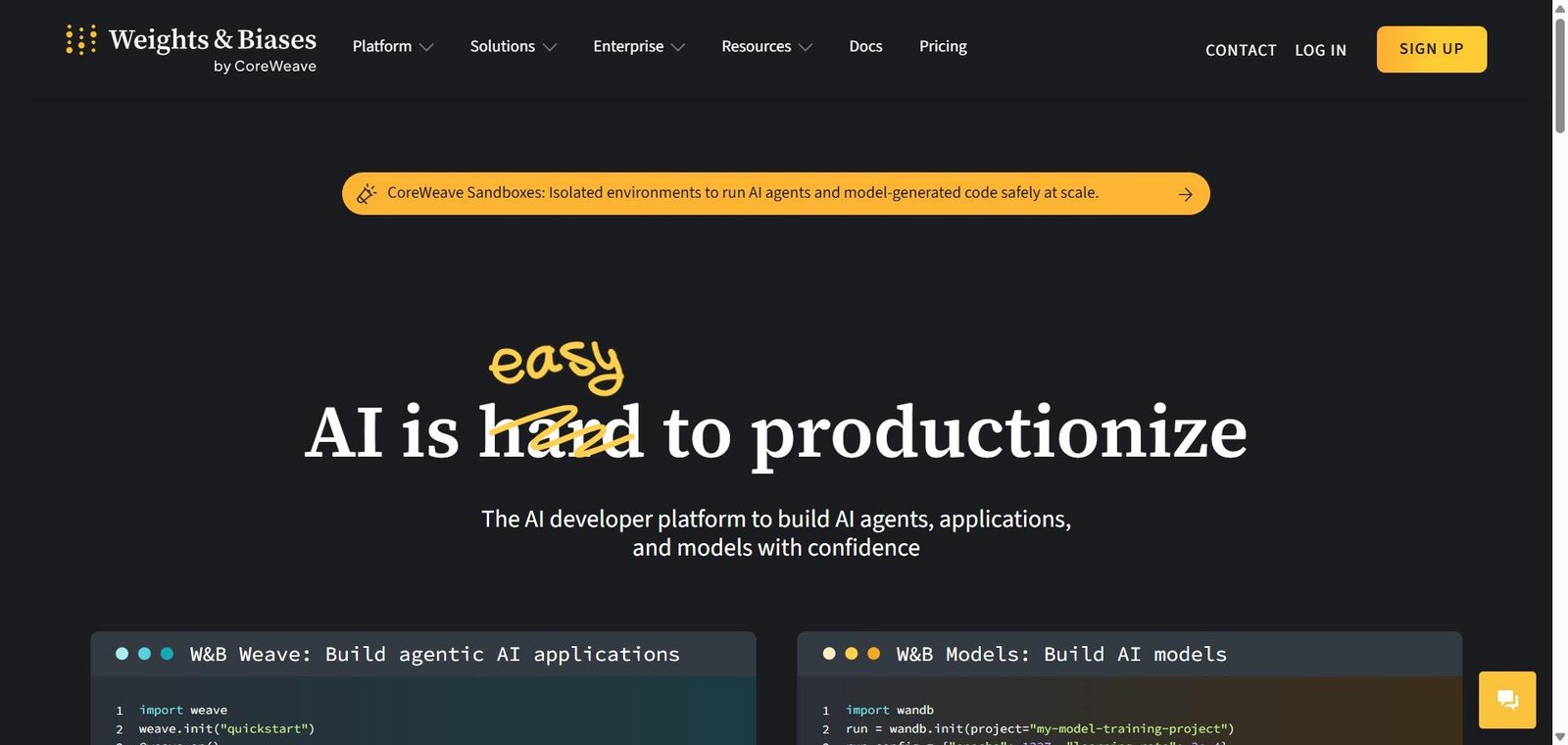
Training a machine learning model without experiment tracking is making irreproducible decisions — you cannot reliably know which hyperparameter change improved performance, which dataset version produced the best results, or why the model deployed three months ago outperformed the one you trained last week. Weights & Biases became the default answer to this problem for AI research and engineering teams — a platform that logs every experiment automatically with a single SDK call, visualises results in interactive dashboards, manages model artifacts across their lifecycle, and in 2026 provides specialised tooling for LLM evaluation and fine-tuning through its Weave product. With 21.6 million monthly PyPI downloads and adoption by OpenAI, Nvidia, Samsung, Toyota Research, and leading AI labs globally, W&B has become as fundamental to professional ML development as version control is to software engineering.
Quick Summary
Weights & Biases is an AI developer platform combining experiment tracking, hyperparameter sweeps, artifact versioning, model registry, and Weave for LLM evaluation and fine-tuning monitoring — with a Python SDK integrating in one line across PyTorch, TensorFlow, Keras, JAX, Hugging Face, XGBoost, and 30 plus ML frameworks, 21.6 million monthly PyPI downloads, 10,900 plus GitHub stars, and a free individual tier with Pro at approximately $50/user/month and Enterprise from $200,000/year.
Is it worth using? Yes for ML engineers, data scientists, AI researchers, and ML platform teams who run iterative model development and need reproducible experiments, visual comparison of training runs, and a model registry that bridges research and production.
Who should use it? ML engineers, data scientists, AI researchers, and ML ops teams at AI-native startups, research labs, and enterprise AI teams who conduct iterative model training and need structured experiment tracking, artifact management, and LLM evaluation.
Who should avoid it? Very small teams running infrequent, one-off model training who do not need structured experiment comparison — the free tier covers occasional use, but teams without iterative ML development get limited value from the platform’s core workflow.
Verdict Summary
Best for
- ML engineering teams doing iterative model development who need to compare hundreds of training runs across hyperparameters, architectures, and datasets — W&B’s parallel coordinates plots and parameter importance analysis make experiment comparison more visual and actionable than any competing platform
- LLM fine-tuning and evaluation teams who need Weave’s specialised tooling for tracking LLM training runs, evaluating prompt variants, and monitoring production LLM application performance alongside traditional model tracking
- Enterprise AI teams who need a model registry with alias-based promotion from training to staging to production with full auditability — W&B’s artifact versioning and webhook triggers for CI/CD pipelines provide the lifecycle management that research-to-production deployment requires
Not for
- Teams with strict data residency requirements that the SaaS version cannot meet — W&B Server exists for self-hosting but requires significant infrastructure overhead and a separate enterprise contract
- Small teams where $50/user/month accumulates to a significant annual spend before enterprise features are needed — MLflow offers comparable open-source experiment tracking at near-zero cost for teams comfortable with infrastructure management
- Teams without Python as the primary ML language — W&B is Python-centric and the integrations are built around the Python ecosystem
Rating
⭐⭐⭐⭐ 4.4 / 5
What Is Weights & Biases?
Weights & Biases was founded in 2017 by Lukas Biewald, Chris Van Pelt, and Shawn Lewis — building on the observation that ML teams were losing enormous amounts of productive effort to unreproducible experiments and manual result tracking in spreadsheets. The platform’s core thesis was that experiment tracking should be as automatic as logging — a single wandb.init() call should capture everything relevant to reproducing and understanding the experiment.
In 2026, W&B has expanded from its experiment tracking origins into a full AI developer platform — Weave provides specialised tooling for LLM application development and evaluation, the model registry enables production lifecycle management, and the hyperparameter sweep engine automates the most time-consuming part of model optimisation. The platform serves teams from solo researchers on the free tier to multi-hundred-engineer AI organisations on enterprise contracts.
How Weights & Biases Works
- Instrument with one SDK call. Add
wandb.init()to any Python training script — W&B automatically captures hyperparameters, system metrics, git state, environment details, and the training command. No additional boilerplate required. - Log metrics and media throughout training. Use
wandb.log()to stream metrics, images, audio, video, and custom charts to W&B in real time during training — the dashboard updates live so teams can monitor experiments without waiting for completion. - Compare runs with interactive dashboards. The W&B dashboard shows all runs in a project with parallel coordinates plots for hyperparameter analysis, scatter plots for metric comparison, and parameter importance analysis that identifies which hyperparameters had the most impact on performance.
- Run automated hyperparameter sweeps. Define the search space and optimisation strategy — W&B’s Sweep engine automatically launches training runs across hyperparameter combinations using Bayesian optimisation, random search, or grid search, and identifies the best configuration from the results.
- Version artifacts and datasets. Use W&B Artifacts to version datasets, model weights, and other experiment inputs — every artifact has a full lineage graph showing which runs produced it, which datasets it was trained on, and which downstream artifacts it generated.
- Manage models through the registry. Promote model versions through aliases — latest, staging, production — with webhook triggers that automate CI/CD pipeline actions when a model is promoted, creating a full lifecycle from training to deployment with auditability.
- Evaluate LLMs with Weave. For LLM applications, Weave provides specialised tracing, evaluation, and monitoring — tracking prompt chains, evaluating outputs against test datasets, and monitoring production LLM application performance alongside traditional model experiments.
Key Features
- Experiment tracking with automatic capture of hyperparameters, metrics, system resources, git state, and environment
- Real-time interactive dashboards — parallel coordinates, scatter plots, parameter importance analysis, custom panels
- Hyperparameter sweeps — Bayesian optimisation, random search, and grid search across distributed training runs
- Artifact versioning — datasets, model weights, and custom artifacts with full lineage graphs
- Model registry with alias-based promotion (latest → staging → production) and CI/CD webhook triggers
- Weave — specialised LLM evaluation, fine-tuning monitoring, and production LLM application tracing
- Framework integrations in 1 to 2 lines — PyTorch, TensorFlow, Keras, JAX, Hugging Face, XGBoost, LightGBM, scikit-learn, and 30 plus others
- Reports — shareable collaborative experiment analyses with embedded charts and commentary
- Team collaboration — shared projects, role-based access, and comment threads on runs
- 21.6 million monthly PyPI downloads — the most widely adopted experiment tracking SDK
- Used by OpenAI, Nvidia, Samsung, Toyota Research, and leading AI labs globally
- Free individual tier — unlimited experiments, 100GB storage; Pro at approximately $50/user/month; Enterprise from $200,000/year
Real-World Use Cases
- Hyperparameter optimisation: An ML engineering team is training a transformer model for text classification. Rather than manually testing 50 hyperparameter combinations over 3 weeks, they define a search space in W&B Sweeps — Bayesian optimisation identifies the best configuration after 20 runs in 4 days, with the parallel coordinates plot visually revealing which learning rate and batch size combinations drove the largest performance improvement.
- LLM fine-tuning tracking: An AI team fine-tuning Llama 4 on a proprietary dataset uses W&B to track each fine-tuning run — logging training loss, validation perplexity, and output quality scores for each checkpoint. Weave traces the evaluation pipeline, comparing the fine-tuned model against the base model on a held-out test set, and the model registry captures the best checkpoint for promotion to the production inference pipeline.
- Research reproducibility: An academic research team publishes a paper on a new vision model architecture. They include W&B run links in the paper — any reader can view the exact hyperparameters, training curves, dataset versions, and environment that produced the paper’s results, making the research reproducible without requiring direct correspondence with the authors.
- Experiment collaboration: A distributed ML team across three time zones uses W&B Reports to share experiment analyses — a researcher in London adds commentary to a training run showing unexpected performance degradation, linking to the specific epoch where the curve diverges. The team in San Francisco picks up the investigation the same day without a synchronous meeting.
Pros and Cons
| Pros | Cons |
|---|---|
| 21.6 million monthly PyPI downloads — the most widely adopted experiment tracking platform, meaning integrations, community resources, and documentation are the most comprehensive available | Enterprise pricing starting around $200,000/year and team pricing at $50/user/month scales expensively for large engineering teams — MLflow at near-zero cost serves teams comfortable with self-managed infrastructure |
| Single-line integration captures all relevant experiment metadata automatically — minimal instrumentation overhead before tracking begins | Primarily SaaS — W&B Server for self-hosting adds significant infrastructure overhead and requires a separate enterprise contract for regulated industries with strict data residency requirements |
| Weave specialised LLM evaluation tooling is the most complete addition to the platform for 2026’s LLM-heavy development landscape | Python-centric — teams using R, Julia, or other languages have limited native integration support |
| Parallel coordinates plots and parameter importance analysis provide visual experiment insight that no competing platform matches | Free tier limits (100GB storage, 100 tracked experiments) can be reached quickly on large-scale training projects before a paid upgrade is needed |
| Model registry with CI/CD webhook triggers bridges the gap between research experimentation and production deployment with full auditability | Large enterprise bills at $180,000 plus per year have been reported for teams scaling across many engineers without careful tier planning |
Pricing & Plans
Free — Individual
- Unlimited tracked experiments
- 100GB artifact storage
- Standard log retention
- Community support
- All core tracking features
Pro — Approximately $50/user/month
- Unlimited tracked experiments
- 1TB artifact storage per user
- Extended log retention
- Priority support
- Team collaboration features
- Model registry access
Enterprise — From approximately $200,000/year
- Custom user volume
- Dedicated infrastructure options
- Self-hosted deployment (W&B Server or Dedicated Cloud)
- SSO/SAML
- Advanced security and compliance
- Dedicated customer success
- Custom data retention
Academic and research discounts available. Verify current pricing at wandb.ai — pricing has evolved across tiers in 2026.
Best Alternatives & Comparisons
- MLflow — Better for teams wanting open-source experiment tracking at near-zero cost with full self-hosting control — less visual, less polished, but free and extensively documented
- Comet ML — Direct competitor with comparable experiment tracking features at potentially lower enterprise pricing
- Modal — Better for the compute infrastructure layer where experiments actually run — Modal for GPU execution, W&B for tracking what happens during execution
- Hugging Face — Better for model hosting, sharing, and community discovery alongside fine-tuning — W&B for tracking fine-tuning runs, Hugging Face for hosting the resulting models
Frequently Asked Questions (FAQ)
Weights & Biases is an AI developer platform for ML experiment tracking, hyperparameter sweeps, artifact versioning, model registry, and LLM evaluation through Weave — with 21.6 million monthly PyPI downloads and adoption by OpenAI, Nvidia, and Samsung. Free individual tier, Pro at approximately $50/user/month.
Yes — the free individual tier provides unlimited tracked experiments and 100GB artifact storage. Pro at approximately $50/user/month adds 1TB storage per user, extended retention, and team features. Enterprise starts around $200,000/year for larger organisations.
W&B provides official integrations for PyTorch, TensorFlow, Keras, JAX, Hugging Face Transformers, XGBoost, LightGBM, and scikit-learn — most requiring 1 to 2 lines of code that automatically log framework-specific metrics and model architecture without manual instrumentation.
Weave is W&B’s specialised toolkit for LLM application development and evaluation — providing tracing for LLM prompt chains, evaluation frameworks for testing LLM outputs against datasets, and monitoring for production LLM application performance, complementing W&B’s traditional model experiment tracking for generative AI use cases.
Yes — W&B Server allows self-hosting on customer infrastructure for teams with strict data residency requirements. W&B Dedicated Cloud deploys W&B infrastructure in the customer’s cloud account. Both require enterprise contracts and add significant operational overhead compared to the SaaS version.
W&B provides a polished SaaS experience with superior visualisation, automatic framework integrations, and managed infrastructure — at $50/user/month for teams. MLflow is open-source, self-hosted, and available at near-zero infrastructure cost beyond compute — with less visual depth and more configuration overhead. W&B for teams who prioritise UI quality and minimal setup. MLflow for teams prioritising zero platform cost and full self-hosted control.
Final Recommendation
Weights & Biases is the most complete and most widely validated ML experiment tracking platform for AI development teams who take reproducibility and model lifecycle management seriously. The single-line instrumentation, superior experiment visualisation, automated hyperparameter sweeps, and Weave LLM evaluation tooling cover the full iterative ML development workflow from first training run to production model deployment — and the 21.6 million monthly PyPI downloads validate that the AI development community has made W&B the default standard for this category. For any ML engineer whose training runs are currently tracked in spreadsheets or ad-hoc logging scripts, W&B provides the structured experiment infrastructure that makes iterative model improvement reliable and reproducible.
Next steps