
Replicate
One API, 50,000 plus open-source AI models — run Flux, Llama 4, Whisper, and Stable Diffusion without managing a single GPU, pay only for what you use.
Replicate Review: The Open-Source AI Model API That Became the Default Gateway to the AI Ecosystem
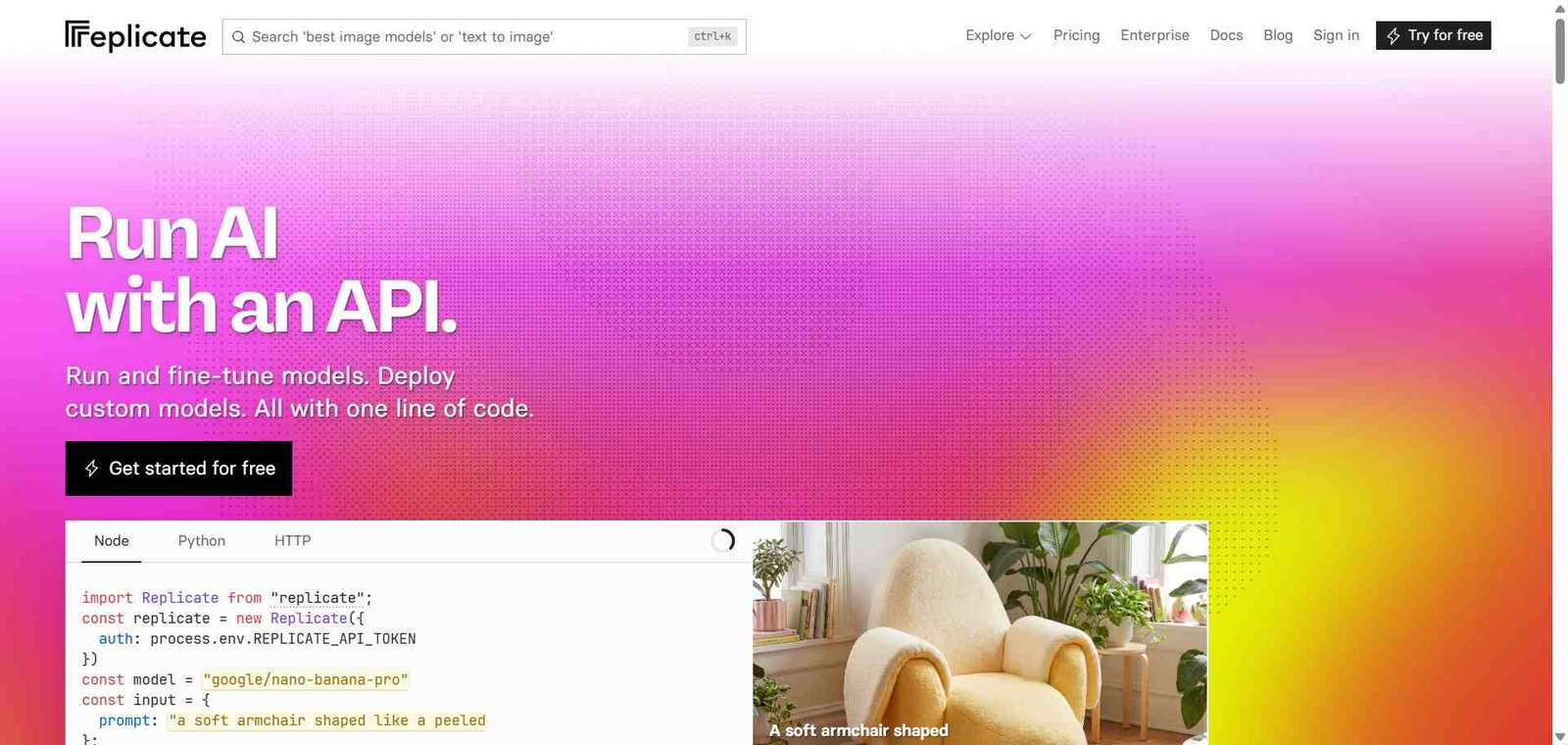
The open-source AI model ecosystem moves faster than any team can self-host — new image generation models, LLMs, audio models, and video models are released weekly, and running each requires setting up GPU infrastructure, installing dependencies, managing containers, and handling scaling. Replicate was built to make this problem disappear: a single consistent API that provides access to 50,000 plus community-contributed and officially maintained AI models, charged per GPU-second of active processing with no subscription and no idle costs. Acquired by Cloudflare in December 2025, Replicate continues operating under its own brand with the same API, now with the added infrastructure depth and AI Gateway integration that Cloudflare’s network provides.
Quick Summary
Replicate is a cloud AI model platform — acquired by Cloudflare in December 2025 — providing API access to 50,000 plus open-source models including Flux image generation, Llama 4 LLMs, Whisper transcription, and video models, through a consistent REST API with per-GPU-second billing, $5 free signup credit, fine-tuning for SDXL and Llama models, Deployments for dedicated production GPU instances, and SDKs for Python, JavaScript, Go, and Elixir.
Is it worth using? Yes for developers and AI startups who want fast, zero-infrastructure-management access to the full range of open-source AI models via a consistent API — Replicate is the fastest path from “I want to use model X” to working API integration without any GPU setup.
Who should use it? Developers, AI startups, and product teams who need to integrate open-source AI models into applications quickly — image generation, LLM inference, audio processing, video generation — without building and managing their own model serving infrastructure.
Who should avoid it? Teams running high-volume production workloads where Replicate’s per-second GPU pricing produces a higher total cost than dedicated GPU infrastructure at equivalent throughput — modal, RunPod, or self-managed clouds are more cost-effective at sufficient scale.
Verdict Summary
Best for
- Developers building AI-powered applications who want to experiment with the latest open-source models — new Flux variants, Llama releases, and community-fine-tuned speciality models — without waiting to set up GPU infrastructure for each new model
- AI startups in the prototyping and early production phase who want to validate product-market fit with real AI capabilities before investing in dedicated model serving infrastructure — Replicate’s pay-per-prediction billing means zero fixed infrastructure cost during validation
- Teams who need a diverse model catalogue within one API integration — combining image generation, LLM inference, audio transcription, and video generation in one application through one SDK rather than managing separate providers for each modality
Not for
- High-volume production workloads where sustained GPU usage at scale produces costs above equivalent dedicated infrastructure — model the break-even point before committing to Replicate for production traffic that never stops
- Teams needing the lowest possible latency for production inference — Replicate’s cold start times, while improved to under 5 seconds for most models, add latency that dedicated GPU instances eliminate
- Organisations with strict data sovereignty requirements who cannot use Cloudflare-managed infrastructure for model inference
Rating
⭐⭐⭐⭐ 4.2 / 5
What Is Replicate?
Replicate was founded in 2021 by Ben Firshman and Andreas Jansson — building the Cog open-source tool for packaging ML models alongside the Replicate platform for running them. The platform’s core innovation was standardising how models are packaged and exposed through an API — any model packaged with Cog follows the same prediction input/output pattern, making thousands of community-contributed models accessible through identical API calls.
In December 2025, Cloudflare announced the acquisition of Replicate — adding Replicate to Cloudflare’s AI infrastructure alongside AI Gateway for caching, rate limiting, and observability. The acquisition adds Cloudflare’s global network and infrastructure depth to Replicate’s model catalogue and developer experience, while the Replicate brand and API continue operating without disruption as of August 2026.
How Replicate Works
- Call models via a consistent REST API. Every model on Replicate follows the same API pattern — send a POST request with model-specific input parameters, receive a prediction output. No model-specific SDK or authentication different from any other model.
- Choose from 50,000 plus models. The model catalogue spans every major AI modality — image generation with Flux and Stable Diffusion, LLMs including Llama 4 and DeepSeek, audio transcription with Whisper, video generation, image enhancement, text-to-speech, and thousands of community fine-tuned speciality models.
- Pay per second of active processing. Replicate bills per GPU-second during active prediction — CPU at $0.000025/second, T4 at $0.000225/second, H100 at $0.001525/second. Some popular models use fixed per-output pricing (Flux Schnell at $3/1,000 images) rather than per-second tracking.
- Fine-tune models on custom data. SDXL and Llama models support fine-tuning directly on Replicate — upload a training dataset and Replicate runs the fine-tuning job, producing a custom model version accessible through the same API pattern as any other model.
- Deploy for dedicated production instances. Replicate Deployments provide reserved GPU instances — dedicated A40 from approximately $1.00/hr, A100 from approximately $2.40/hr — eliminating cold start latency for production applications that need consistent response times.
- Integrate with AI Gateway. Cloudflare AI Gateway integration adds caching, rate limiting, and observability on top of Replicate model calls — reducing cost through cached responses and providing request-level analytics.
Key Features
- 50,000 plus open-source AI models across image, video, audio, LLM, and multimodal categories
- Consistent REST API across all models — same authentication, same input/output pattern regardless of model
- Official Models programme — curated, maintained versions of the most popular open-source models with production SLAs
- Pay-per-GPU-second billing — CPU at $0.000025/sec, T4 at $0.000225/sec, A100 at $1.52/hr effective, H100 at $5.49/hr effective
- Fixed per-output pricing for popular models — Flux Schnell at $3/1,000 images, Flux Dev at $0.025/image
- $5 free credit on signup — enough to run hundreds of predictions across most models
- Fine-tuning for SDXL and Llama on custom datasets through the platform
- Deployments — dedicated GPU instances for production workloads with no cold start
- SDKs for Python, JavaScript, Go, and Elixir
- Cloudflare AI Gateway integration for caching, rate limiting, and observability
- Webhook support for asynchronous prediction workflows
- Cog open-source tool for packaging and publishing custom models
- Acquired by Cloudflare December 2025 — operating under own brand with same API
Real-World Use Cases
- AI startup prototyping: A developer building an AI portrait generation feature wants to test Flux 1.1 Pro, SDXL, and three community fine-tuned portrait models to determine which produces the best output for their use case. Replicate lets them call all five through the same API pattern, compare outputs, and choose the best model — without setting up a single GPU instance or managing any containers.
- Multi-modal application: A content creation app needs image generation, automatic transcription, and background music generation. Replicate provides Flux for images, Whisper for transcription, and a music generation model — all through one API integration rather than three separate provider accounts with different authentication and response formats.
- Custom model fine-tuning: A fashion e-commerce company fine-tunes SDXL on their product photography style — uploading 50 representative product images and running a fine-tuning job on Replicate. The resulting custom model generates new product images in their specific visual style through the standard Replicate API without any infrastructure management.
- Production deployment: An AI application serving 10,000 daily users needs consistent inference latency for their Llama-based chat feature. They deploy a Replicate Deployment with a dedicated A100 instance — eliminating cold start variability and providing a guaranteed response time SLA for production traffic.
Pros and Cons
| Pros | Cons |
|---|---|
| 50,000 plus models accessible through one consistent API — the widest open-source model catalogue available through any single provider | Per-second GPU pricing becomes expensive at high sustained production volume compared to dedicated infrastructure at equivalent throughput |
| Pay-per-prediction with no subscription or idle charges — zero fixed cost during prototyping and early-stage validation | Cold start latency of up to 5 seconds for less popular models adds response time variability that production applications need to accommodate |
| $5 free credit on signup — enough to genuinely evaluate multiple models before payment | Cloudflare acquisition creates platform risk consideration for teams evaluating long-term infrastructure dependencies |
| Fine-tuning for SDXL and Llama directly on the platform — custom model versions without managing training infrastructure | Limited infrastructure customisation — teams needing specific GPU configurations, networking, or security controls beyond what Replicate provides must use alternative providers |
| Official Models programme with production SLAs for the most popular community models | Pricing opacity for high-volume use — per-second metering requires careful monitoring to avoid unexpected bills at scale |
Pricing & Plans
No monthly subscription — pay only for active compute
Free Signup
- $5 credit on account creation
- Valid for 1 year
- Access to all public models
Pay-As-You-Go (all models)
| Hardware | Cost per second |
|---|---|
| CPU | $0.000025/sec |
| Nvidia T4 | $0.000225/sec |
| Nvidia A40 | $0.000575/sec |
| Nvidia A100 (40GB) | $0.00115/sec |
| Nvidia H100 | $0.001525/sec |
Fixed per-output pricing (selected popular models):
- Flux Schnell: $3.00/1,000 images
- Flux Dev: $0.025/image
- Flux 1.1 Pro: $0.04/image
- Llama 4 inference: approximately $0.90/million input tokens
Deployments (dedicated instances):
- A40 from approximately $1.00/hr
- A100 from approximately $2.40/hr
- Pre-purchased credits available — valid 1 year
Public model calls billed only for active processing — cold starts and idle time are free. Check replicate.com/pricing for current model-specific rates.
Best Alternatives & Comparisons
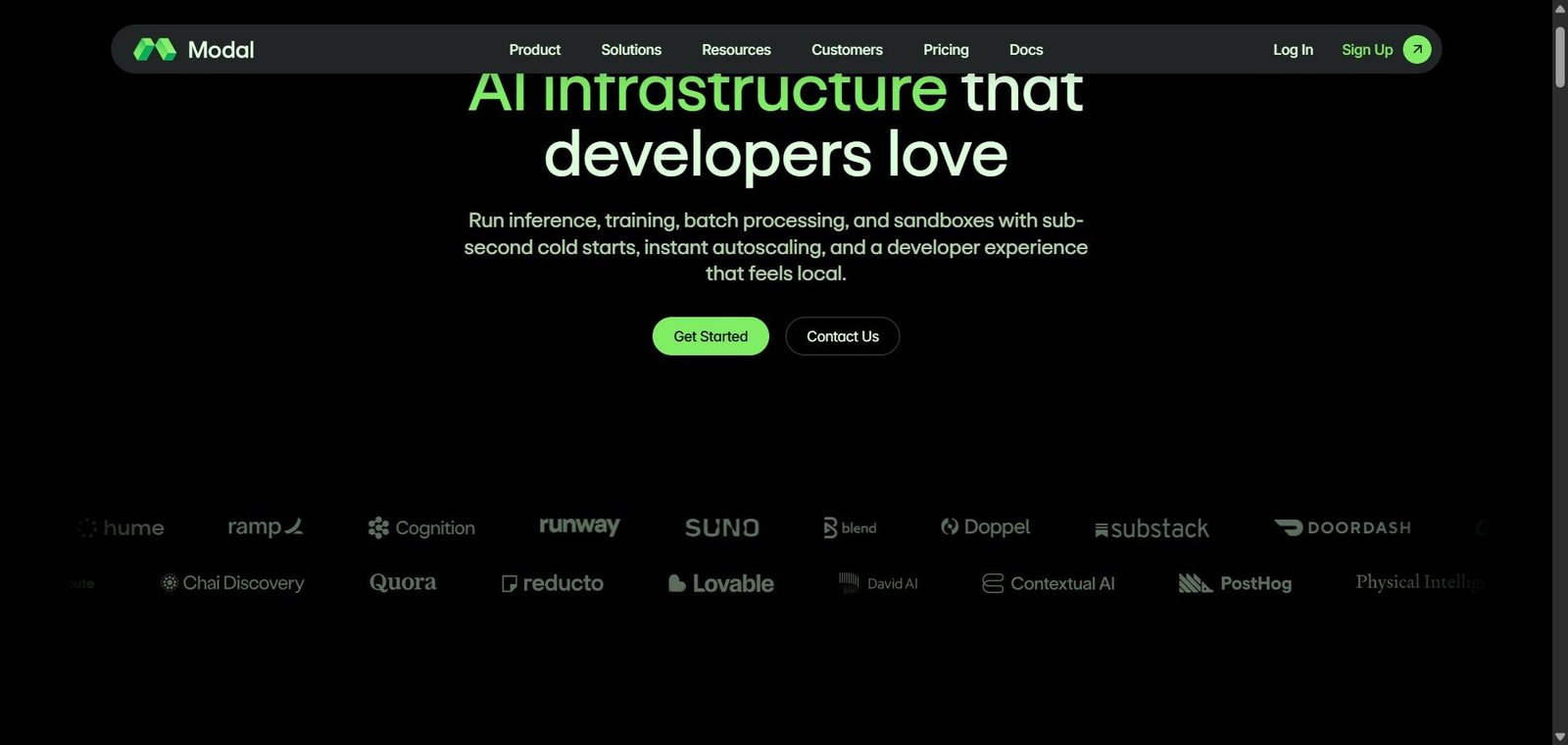
- Modal — Better for Python-native serverless GPU compute where custom model code is the primary workflow rather than calling pre-built open-source models
- Baseten — Better for production model serving with guaranteed SLAs and enterprise support requirements for custom model deployments
- Hugging Face Inference API — Better for teams already in the Hugging Face ecosystem wanting direct access to Hub models without re-publishing
- Fal.ai — Better for teams prioritising the lowest GPU-hour cost for image generation models — H100 at $1.89/hr versus Replicate’s $5.49/hr
Frequently Asked Questions (FAQ)
Replicate is a cloud AI model platform providing API access to 50,000 plus open-source models — Flux, Llama 4, Whisper, Stable Diffusion, and thousands more — through a consistent REST API with pay-per-GPU-second billing. Acquired by Cloudflare in December 2025, operating under its own brand.
New accounts receive $5 in free credits on signup, valid for one year. Beyond that, Replicate is pay-as-you-go with no monthly subscription — you pay only for active GPU compute time during predictions.
Yes — Cloudflare acquired Replicate in December 2025. Replicate continues operating under its own brand with the same API and pricing structure as of August 2026. The acquisition adds Cloudflare AI Gateway integration for caching, rate limiting, and observability.
Replicate bills per second of active GPU compute during prediction — no charges during cold starts, setup, or idle time. Popular models use fixed per-output pricing instead (Flux Schnell at $3/1,000 images). New accounts use prepaid credits purchased upfront and valid for one year.
Yes — use Cog, Replicate’s open-source packaging tool, to package and publish custom models to the platform. Private models are accessible only through your account. Replicate Deployments provide dedicated GPU instances for production custom model serving.
Replicate is a model catalogue platform — the value is access to 50,000 plus pre-built open-source models through one API without any infrastructure management. Modal is a Python-native serverless compute platform — the value is running custom Python code on GPUs without infrastructure management. Replicate for accessing and integrating existing open-source models. Modal for deploying custom ML code and model serving.
Final Recommendation
Replicate is the most practical entry point to the open-source AI ecosystem for developers and AI startups who want to integrate AI capabilities without managing GPU infrastructure. The 50,000 plus model catalogue, consistent API across all models, and pay-per-prediction billing with no idle cost create the lowest-friction path from “I want to use this AI model” to working integration in a product. The Cloudflare acquisition adds long-term infrastructure depth while the Replicate brand and API continue without disruption. For any developer whose AI feature roadmap includes models from the open-source ecosystem, Replicate removes the infrastructure barrier that previously separated idea from implementation.
Next steps