Dust AI Review: Enterprise AI Agent Platform That Connects to Your Actual Company Data
Generic AI assistants give generic answers. They cannot reference your company’s specific processes, past decisions, or proprietary knowledge because they have never seen any of it. Dust AI is built on the premise that AI assistants are only as valuable as the data they can access, and it gives enterprises the platform to build AI agents connected directly to their own knowledge base, tools, and workflows — producing answers and automations grounded in your actual organisational context rather than general training data.
Quick Summary
Dust AI is an enterprise AI agent platform that enables organisations to build custom AI assistants connected to their company data, documentation, and tools, producing context-aware answers and automations tailored to their specific business workflows.
Is it worth using? Yes for enterprise teams that have found generic AI assistants inadequate because they lack access to company-specific knowledge and context. Who should use it? Enterprise teams, department heads, and knowledge workers in organisations that need AI assistance grounded in their proprietary data rather than general model knowledge. Who should avoid it? Small teams or individuals who need a general-purpose AI assistant rather than an enterprise knowledge-connected platform.
Verdict Summary
Best for
Enterprise teams building AI assistants connected to proprietary company knowledge and documentation
Organisations wanting department-specific AI agents that understand their specific workflows and data
Teams that have tried generic AI tools and found the lack of company context a fundamental limitation
Not for
Small teams or individuals who need a simple general-purpose AI writing or research tool
Teams without sufficient documented company knowledge to meaningfully improve AI answers
Organisations without technical resources for initial setup and agent configuration
Rating ⭐⭐⭐⭐ 4.4 / 5
What Is Dust AI?
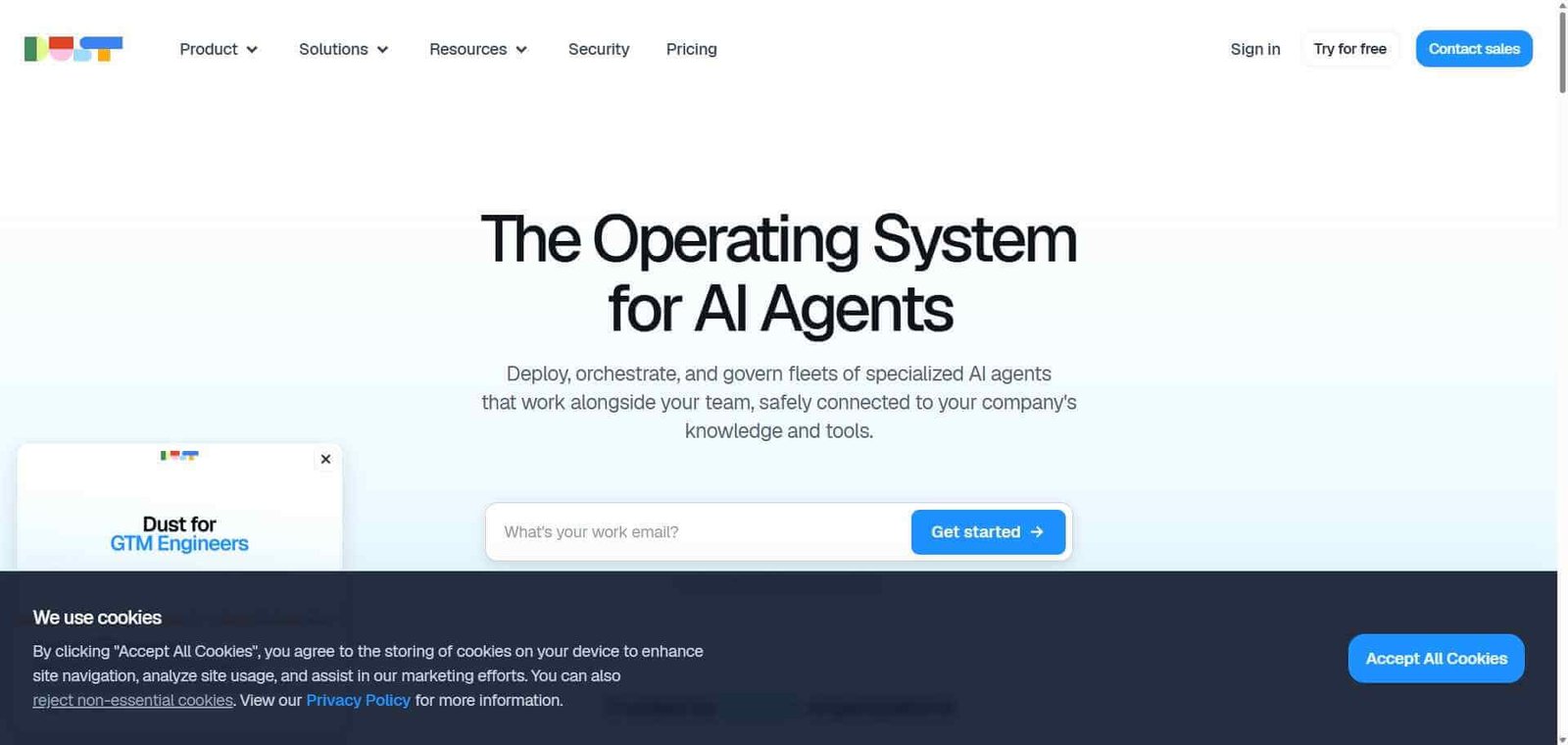
Dust AI is an enterprise AI platform focused on making AI agents genuinely useful within specific organisational contexts by connecting them to the knowledge and tools that define how that organisation operates. Rather than deploying a generic chatbot, organisations using Dust build purpose-specific AI agents — a support agent trained on their product documentation, an onboarding agent connected to their HR knowledge base, a sales agent with access to CRM data and past deal intelligence.
The platform supports connection to major enterprise data sources and tools, and uses retrieval-augmented generation to ensure that agent responses are grounded in actual company data rather than hallucinated from general training. This grounding is what makes Dust AI responses genuinely useful rather than plausible-sounding but unreliable.
How Dust AI Works
Set up your workspace at dust.tt. Create an organisational workspace and invite team members who will build and use AI agents.
Connect your data sources. Link Dust AI to your company’s knowledge sources — Notion, Confluence, Google Drive, GitHub, Slack, Intercom, and others — to build the knowledge base your agents will draw from.
Build your AI agents. Define each agent’s purpose, the data sources it should access, the tools it can use, and the instructions governing how it responds in different situations.
Deploy agents to your team. Make completed agents available to your organisation through the Dust interface, Slack integration, or API, so team members can access them in their existing workflows.
Query agents with company context. Team members ask questions and the agent responds with answers grounded in your actual company data, citing the specific documents or sources it used.
Monitor and improve. Review agent performance, identify knowledge gaps, and update data sources or instructions to improve accuracy over time.
Key Features
Custom AI agent building connected to your specific company knowledge and tools
Retrieval-augmented generation grounding answers in actual company data
Connections to Notion, Confluence, Google Drive, GitHub, Slack, Intercom, and other enterprise tools
Multi-agent workflows enabling agents to collaborate on complex tasks
Slack integration for accessing agents directly within team communication
API access for embedding agents in existing enterprise products and workflows
Role-based access control for managing which agents different teams can access
Analytics for monitoring agent usage and identifying knowledge gaps
Real-World Use Cases
Customer support agent: Build an AI support agent connected to your product documentation and past support conversations that handles common queries with accurate, source-grounded answers.
Engineering knowledge agent: Create an agent connected to your codebase, architecture documentation, and engineering discussions that answers technical questions with specific references to your actual systems.
Sales enablement agent: Deploy an agent connected to your product knowledge base, competitor intelligence, and past deal data that helps sales teams prepare for conversations and draft proposals.
HR and onboarding agent: Build a new hire onboarding agent connected to your policies, processes, and organisational knowledge that answers employee questions accurately without burdening HR teams.
Requires meaningful documented knowledge to unlock full value
Strong data source integrations cover major enterprise tools
Initial agent setup and configuration requires time investment
RAG architecture reduces hallucination on company-specific topics
Less suitable for general-purpose AI assistance use cases
Slack integration brings agents into existing team workflows
Technical understanding helpful for optimal agent configuration
Pricing & Plans
Enterprise — Custom pricing
Pricing based on team size and data source volume
Full platform access including all integrations
Dedicated implementation support
Enterprise security and compliance features
SLA guarantees
Contact Dust AI at dust.tt for pricing based on your organisation’s requirements.
Best Alternatives & Comparisons
Glean — Better for broad cross-tool search and knowledge discovery across 100 plus applications, less custom agent building
Dify — Open-source alternative with more technical flexibility, less enterprise-focused managed deployment
Wordware — Better for non-technical teams building agents in a document interface, less enterprise integration depth
NotebookLM — Better for individual document analysis and research, not an enterprise agent deployment platform
Frequently Asked Questions (FAQ)
What is Dust AI?
Dust AI is an enterprise AI agent platform that enables organisations to build custom AI assistants connected to their own company data, documentation, and tools, producing context-aware answers grounded in actual organisational knowledge.
How does Dust AI prevent AI hallucination on company topics?
Dust AI uses retrieval-augmented generation, meaning agent responses are grounded in documents and data retrieved from your connected company knowledge sources rather than generated from general model training. Each answer cites the specific sources it drew from.
What data sources does Dust AI connect to?
Dust AI integrates with major enterprise data sources including Notion, Confluence, Google Drive, GitHub, Slack, Intercom, and others, with more integrations being added as the platform develops.
Is Dust AI different from a general AI chatbot?
Yes, fundamentally. A general AI chatbot draws only from its training data and has no knowledge of your company. Dust AI agents are connected to your specific company documents, tools, and knowledge sources, producing responses that are relevant to your actual business context.
How does Dust AI compare to Glean?
Dust AI focuses on building purpose-specific AI agents that actively engage with and respond using company knowledge. Glean focuses on search and discovery, surfacing the most relevant existing information across tools. They are complementary rather than directly competing: Glean for finding things, Dust AI for AI-powered engagement with what you find.
Does Dust AI have a Slack integration?
Yes, Dust AI integrates with Slack allowing team members to query AI agents directly within their Slack workspace without switching to a separate application.
Final Recommendation
Dust AI delivers on the promise that generic AI tools consistently fail to keep: AI that actually knows your organisation. For enterprise teams that have experienced the frustration of AI assistants that cannot answer questions about their specific products, processes, or past decisions, Dust AI provides the infrastructure to build something genuinely useful. The value scales directly with the quality and volume of company knowledge you connect to the platform.