itirupati.com AI Tools

Neon

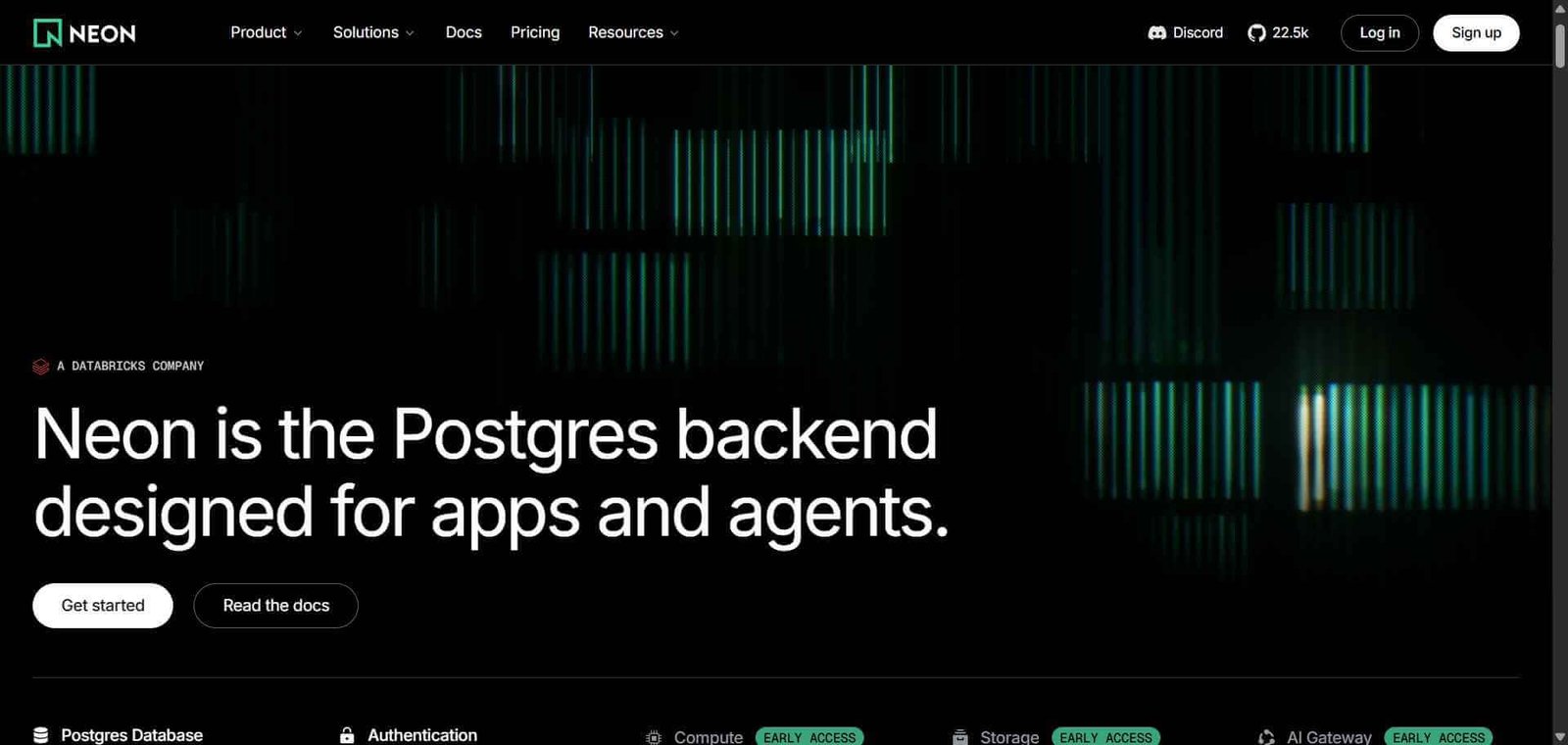
Serverless Postgres that scales to zero, branches like Git, and provisions in seconds.

Neon Review: The Serverless Postgres Database Built for the Modern Development Workflow

Traditional databases are always on — they run continuously whether or not anyone is using them, consuming compute and costing money around the clock. Neon introduces serverless architecture to Postgres, meaning databases scale to zero when inactive, scale up instantly when needed, and cost nothing when not in use. Combined with database branching — the ability to create an isolated copy of your database for a new feature branch the same way you branch code in Git — Neon fundamentally changes how developers work with databases in the same way that Vercel changed how they deploy frontend code.

Quick Summary

Neon is a serverless Postgres database platform with autoscaling, scale-to-zero, database branching, and instant provisioning, designed for modern web applications, AI workloads, and development workflows that benefit from isolated database environments per branch.

Is it worth using? Yes for developers building on Next.js, Vercel, and other serverless platforms who want a Postgres database that matches the serverless architecture of their deployment environment.
Who should use it? Full-stack developers, indie hackers, and engineering teams building modern web applications who want Postgres with serverless economics, database branching for development workflows, and deep integration with Vercel and other modern deployment platforms.
Who should avoid it? Teams running traditional always-on applications that require persistent database connections and predictable flat-rate pricing rather than usage-based serverless pricing.

Verdict Summary

Best for

  • Next.js and Vercel developers who want a Postgres database that matches the serverless architecture of their frontend deployment
  • Development teams who want database branching to create isolated test environments for each feature branch without managing separate databases
  • AI application developers who need a Postgres database with vector extension support for embedding storage and similarity search

Not for

  • Applications requiring persistent database connections incompatible with serverless connection pooling
  • Teams who want traditional flat-rate database pricing without usage-based variability
  • Legacy applications built around connection-heavy database architectures

Rating
⭐⭐⭐⭐½ 4.6 / 5

What Is Neon?

Neon is a serverless Postgres database company that separates storage and compute to enable the scale-to-zero capability that traditional Postgres cannot offer. When no queries are running, Neon databases pause their compute and cost nothing. When a query arrives, compute spins up in milliseconds — fast enough that users do not notice the delay. This architecture makes Neon economics match perfectly with serverless application deployments where traffic is bursty or variable rather than constant.

The database branching feature is Neon’s most developer-experience-defining capability. Each branch creates an isolated copy-on-write snapshot of the database state, sharing storage with the parent branch for unchanged data but creating independent data as changes are made. This means every pull request can have its own isolated database environment without duplicating storage costs, enabling development workflows that were previously impractical with traditional databases.

How Neon Works

  • Create a Neon project. Sign up and create a project. Neon provisions a serverless Postgres database with a connection string in seconds — no server configuration required.
  • Connect your application. Use the connection string with any Postgres-compatible client, ORM, or framework — Prisma, Drizzle, TypeORM, or the standard node-postgres library all work without modification.
  • Use database branching. Create a branch from your main database for a new feature or pull request. The branch has its own isolated Postgres environment that inherits the parent’s schema and data but diverges independently as changes are made.
  • Scale automatically. Neon autoscales compute based on query load within your defined limits. During periods of no activity, the database scales to zero and costs nothing.
  • Integrate with Vercel. Use the Neon integration in the Vercel marketplace to automatically create database branches that correspond to Vercel preview deployments, giving each preview its own isolated database environment.
  • Use vector search. Enable the pgvector extension for storing and querying vector embeddings, enabling AI applications that need similarity search capabilities alongside standard Postgres functionality.

Key Features

  • Serverless Postgres with scale-to-zero when inactive
  • Autoscaling compute within defined minimum and maximum limits
  • Database branching for isolated development and testing environments
  • Instant provisioning of new databases and branches in seconds
  • pgvector support for AI application embedding storage and similarity search
  • Vercel integration for preview deployment database branches
  • Connection pooling via PgBouncer for serverless connection compatibility
  • Point-in-time restore for recovering data to any previous state
  • Postgres 16 compatible with full extension support

Real-World Use Cases

  • Next.js application database: A developer builds a Next.js app with Neon as the database, benefiting from matching serverless architecture and Vercel integration that creates a preview database branch for every pull request automatically.
  • Development environment isolation: An engineering team creates a Neon branch for each feature being developed, with isolated database environments that do not interfere with each other or the production database during development.
  • AI application vector storage: An AI application stores document embeddings in Neon using pgvector, performing similarity searches alongside standard Postgres queries in one database without a separate vector database subscription.
  • Hobby project economics: An indie developer runs multiple hobby projects on Neon’s free tier, with each project’s database scaling to zero when not in use and never costing anything for projects that receive occasional traffic.

Pros and Cons

ProsCons
Scale-to-zero makes hobby and low-traffic projects genuinely free to runCold start latency (milliseconds) affects first query after idle period
Database branching transforms development and preview workflowsUsage-based pricing can be unpredictable for variable traffic patterns
Vercel integration for preview branch databases is seamlessPersistent connection architectures incompatible without connection pooler
pgvector support eliminates need for separate vector databaseLess suitable for traditional always-on application architectures
Instant provisioning removes database setup overheadEnterprise features and dedicated compute on higher plan tiers

Pricing & Plans

Free — $0/month
  • 0.5 GB storage
  • 1 project
  • 10 branches
  • Shared compute
  • Community support
Launch — $19/month
  • 10 GB storage
  • 10 projects
  • Unlimited branches
  • Non-shared compute
  • Email support
Scale — $69/month
  • 50 GB storage
  • 50 projects
  • Autoscaling compute
  • Priority support
Business — $700/month
  • 500 GB storage
  • Unlimited projects
  • Dedicated compute
  • Advanced features
  • SLA guarantees

Best Alternatives & Comparisons

  • PlanetScale — Better for MySQL-based serverless database with similar branching capabilities, different database engine
  • Supabase — Better for teams wanting Postgres with a full backend platform including auth, storage, and real-time, less serverless economics
  • Railway — Better for teams wanting a broader infrastructure platform beyond just the database
  • Vercel Postgres — Powered by Neon under the hood, convenient for teams already in the Vercel ecosystem

Frequently Asked Questions (FAQ)

What is Neon?

Neon is a serverless Postgres database platform with scale-to-zero, autoscaling, database branching, and instant provisioning for modern web applications and AI workloads.

Is Neon free?

Yes, Neon offers a free plan with 0.5 GB storage, 1 project, and 10 branches. The free tier genuinely supports small applications and hobby projects indefinitely when traffic is low.

What is database branching in Neon?

Database branching creates an isolated copy-on-write snapshot of your database that diverges independently as changes are made, similar to branching in Git. It enables isolated development environments, preview deployment databases, and safe experimentation without affecting production data.

How does Neon's scale-to-zero work?

When no queries are running against a Neon database for a defined idle period, the compute component pauses and costs nothing. When a new query arrives, compute resumes in milliseconds. This eliminates the cost of running idle databases, making Neon economically efficient for variable traffic applications.

Does Neon support pgvector?

Yes, Neon supports the pgvector extension for storing vector embeddings and running similarity searches, enabling AI applications to use the same Postgres database for both standard data and AI embedding workloads.

How does Neon integrate with Vercel?

Neon has a native Vercel integration that automatically creates a Neon database branch for each Vercel preview deployment, giving every preview its own isolated database environment without manual branch creation or cleanup.

Final Recommendation

Neon is the most developer-friendly Postgres database available for modern serverless web application development. The scale-to-zero economics make it genuinely free for small projects, the database branching workflow eliminates one of the most frustrating aspects of collaborative database development, and the pgvector support future-proofs the choice for AI application development. For any developer building on Next.js, Vercel, or other modern serverless platforms, Neon is the natural database companion.

Next steps

Feature your app on AI tools for free

Subscribe to our Newsletter

Stay up-to-date with the latest AI Apps and cutting-edge AI news.

Trending Categories