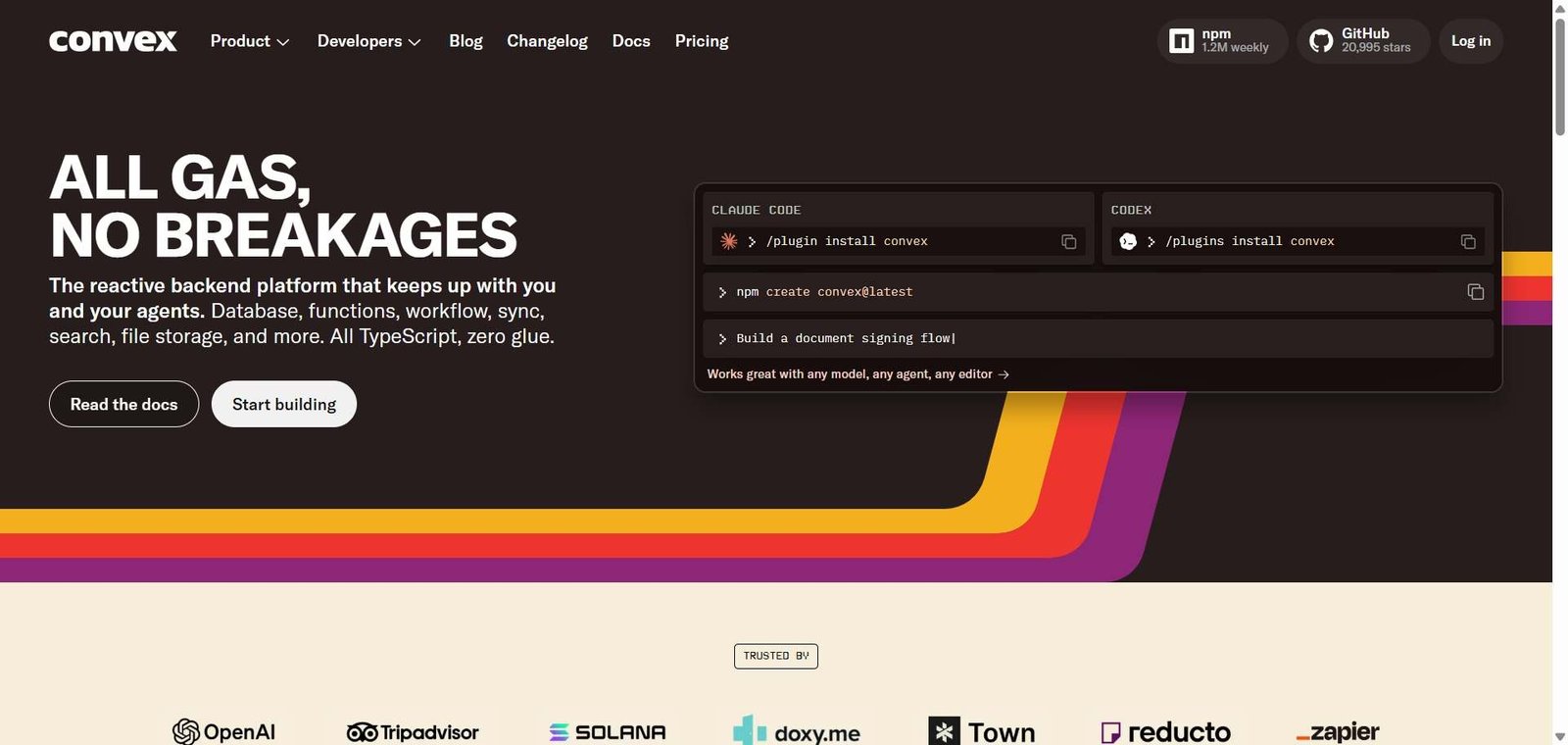
The reactive backend platform that keeps your UI in sync with your data — with built-in AI support.
Most backend platforms require developers to manage the complexity of keeping client state synchronised with server data — writing polling logic, WebSocket management, or cache invalidation code that makes every real-time feature a significant engineering effort. Convex eliminates this entirely through its reactive architecture, where any change to the database automatically pushes updates to every connected client subscribed to queries affected by that change — with no additional code required. Combined with built-in AI action support for calling LLMs and vector search for semantic retrieval, Convex has become the backend of choice for developers building AI-powered real-time applications.
Convex is a reactive backend-as-a-service platform providing a real-time database, serverless TypeScript functions, automatic client synchronisation, built-in vector search, and AI action support for building modern full-stack and AI-powered applications.
Is it worth using? Yes for TypeScript developers building real-time applications or AI-powered features who want automatic client-server synchronisation without managing WebSockets or cache invalidation manually.
Who should use it? Full-stack TypeScript developers, indie hackers, and engineering teams building real-time collaborative applications or AI features who want backend infrastructure that handles synchronisation automatically.
Who should avoid it? Teams with existing backend infrastructure they are happy with, or developers working outside TypeScript where Convex’s type-safe client does not apply.
Best for
Not for
Rating
⭐⭐⭐⭐ 4.4 / 5
Convex is a backend platform that provides a document database with a TypeScript query API, serverless functions for backend logic, and a reactive subscription system that keeps client state automatically synchronised with database state. When a document changes in the Convex database, every client query that reads that document is automatically re-run and the results pushed to connected clients — no WebSockets to manage, no polling to implement, no cache to invalidate.
Its AI features include vector search for storing and querying embeddings alongside regular document queries, and AI actions — serverless functions with longer execution windows and HTTP access for calling external LLM APIs — enabling AI-powered features to be built as first-class Convex functions alongside regular application logic.
useQuery hooks subscribe to query results and re-render automatically when the underlying data changes.| Pros | Cons |
|---|---|
| Automatic client synchronisation eliminates WebSocket and polling boilerplate | TypeScript-only — limited value for non-TypeScript development stacks |
| Built-in AI features — vector search and LLM actions — without separate infrastructure | Document model less flexible than relational SQL for complex query patterns |
| End-to-end type safety from database schema to React hooks is genuinely valuable | Newer platform with smaller community than Supabase or Firebase |
| Reactive architecture makes real-time features dramatically simpler to build | Some applications benefit from more granular database control than Convex provides |
| Free tier is generous for development and small production use | Platform is less proven at very large scale than established alternatives |
Convex is a reactive backend-as-a-service platform providing a real-time database, serverless TypeScript functions, automatic client synchronisation, vector search, and AI action support for building modern full-stack and AI-powered applications.
Yes, Convex offers a generous free tier. The Pro plan at $25/month provides higher limits and priority support.
In Convex, read queries are automatically subscribed to by connected clients. When any data the query reads changes, Convex re-runs the query and pushes updated results to every subscribed client automatically — eliminating the need for polling, WebSocket management, or manual cache invalidation.
Yes, Convex has built-in AI support through vector search for embedding storage and semantic retrieval, and actions — serverless functions with extended timeouts — for calling OpenAI, Anthropic, and other external LLM APIs as part of application workflows.
Convex uses a reactive document database with automatic client synchronisation. Supabase uses PostgreSQL with manual real-time subscription setup. Convex is better for real-time applications where automatic synchronisation removes significant boilerplate. Supabase is better for teams who want relational SQL power and a more complete backend platform covering auth, storage, and edge functions.
Convex has first-class React support through its hooks library. It also supports Next.js, Vue, Svelte, and other frameworks through its JavaScript client. The React hooks provide the most seamless reactive experience.
Convex is the most innovative backend platform for TypeScript developers building real-time applications or AI-powered features who want the automatic client synchronisation that eliminates the most tedious parts of real-time application development. The combination of reactive queries, built-in vector search, and AI actions in one TypeScript-native platform creates a backend experience that significantly reduces the engineering overhead of modern application development. For any developer building real-time or AI features who is tired of managing WebSockets and cache invalidation, Convex provides the architectural solution that makes those problems disappear.
Next steps