One workspace for product, engineering, and knowledge — with AI that connects everything and automates the rest.
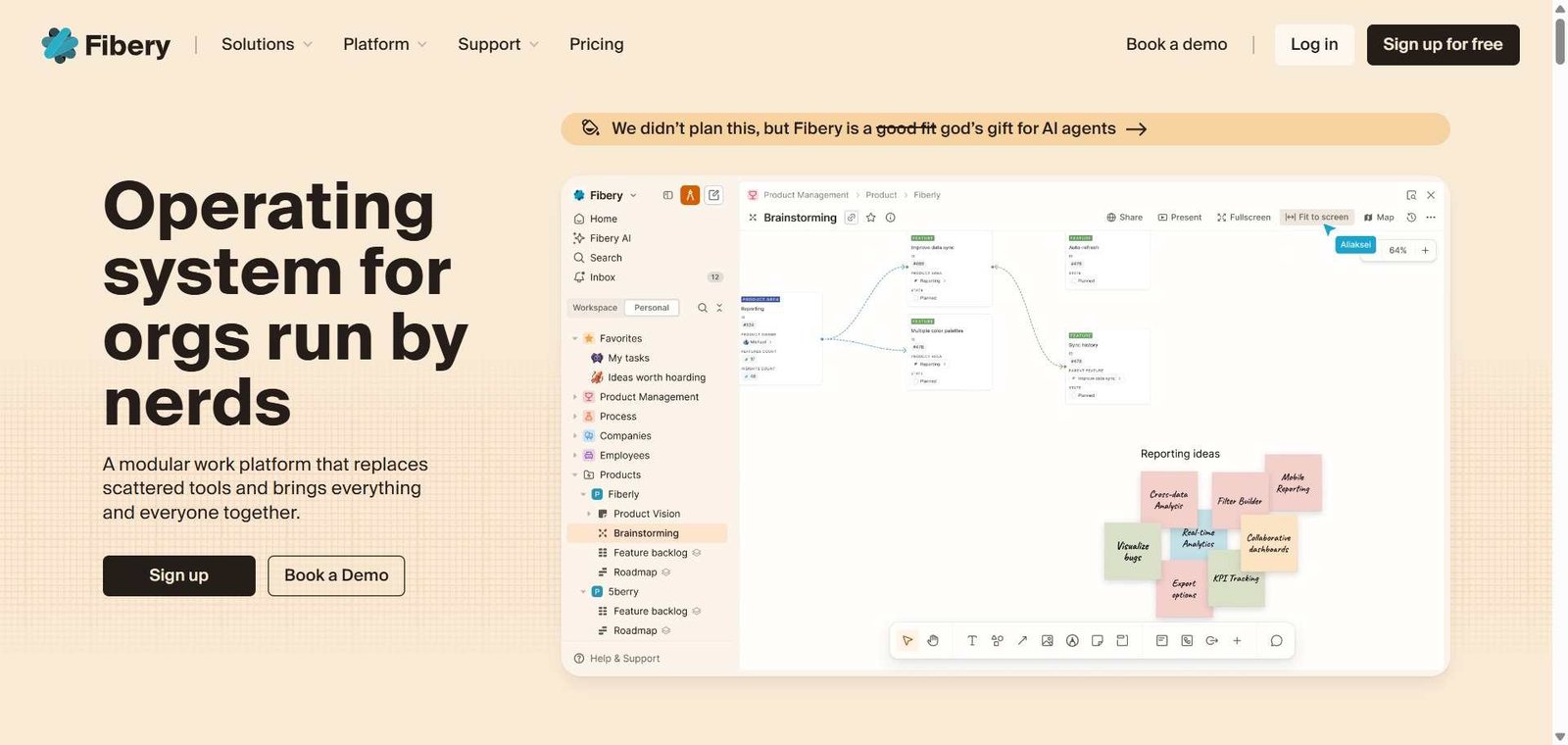
Most companies use separate tools for product management, engineering project tracking, and knowledge documentation — and spend significant time copying information between them. Fibery is built on the principle that these should be one connected workspace where a customer problem links to a product feature which links to engineering tasks which links to the documentation — all in one database with no duplication. The AI layer connects and automates across this single workspace, summarizing customer feedback into feature requests, generating task breakdowns from feature descriptions, and keeping all connected entities in sync.
Fibery is an AI-powered customizable work management platform combining product management, engineering tracking, and knowledge documentation in one connected workspace — where entities are linked across disciplines and AI automates information flow between them.
Is it worth using? Yes for product teams who want a single connected workspace covering the full journey from customer feedback to shipped feature, rather than separate tools for each stage that require manual information transfer.
Who should use it? Product managers, engineering leads, and product teams at growing companies who want to connect customer feedback, product strategy, engineering execution, and documentation in one platform.
Who should avoid it? Simple engineering teams who only need issue tracking without product strategy connection, or teams who need the most visual project management interface.
Best for
Not for
Rating
⭐⭐⭐⭐ 4.3 / 5
Fibery is a connected work management platform built around a flexible database model where any type of work entity — customer problem, feature request, engineering task, documentation page — can be defined, connected to other entity types, and managed in a unified workspace. Its schema is fully customizable — teams define their own entity types, fields, and relationships rather than conforming to a pre-built structure.
The AI layer works across this connected workspace — generating feature descriptions from customer feedback, creating engineering task breakdowns from feature specs, summarizing insights across linked entities, and automating information flows that would otherwise require manual copying between disconnected tools.
| Pros | Cons |
|---|---|
| Connected workspace genuinely eliminates cross-tool information duplication | Significant customization investment required upfront before productivity gains |
| Highly flexible schema accommodates any team process without compromise | Steeper learning curve than pre-built opinionated tools |
| AI generates useful content across the connected entity graph | Interface less visually polished than some competitors |
| Formula fields enable calculated metrics without external BI tools | Smaller community and fewer templates than established platforms |
| Single source of truth from customer problem to shipped feature | Some enterprise features require higher plan tiers |
Fibery is an AI-powered customizable work management platform combining product management, engineering tracking, and knowledge documentation in one connected workspace where entities are linked across disciplines.
Yes, Fibery offers a free plan for up to 5 users with core workspace features. The Standard plan at $10/user/month provides unlimited users, full AI assistant, and advanced features.
Fibery is built around entity relationships and connected work management — linking customer problems to features to tasks to documentation in a structured graph. Notion is built around documents and pages with embedded databases. Fibery is better for connected cross-discipline work management; Notion for document-centric knowledge management.
Yes, Fibery integrates with GitHub for engineering workflow connection and has Jira import for teams migrating from Jira. These integrations allow external tool data to appear within Fibery’s connected workspace.
Fibery is highly customizable — teams define their own entity types (what kinds of things exist in the workspace), fields (what properties each entity has), relationships (how entities connect to each other), views (how entities are visualized), and automations (how entity changes trigger other actions). This flexibility accommodates virtually any team process.
Setting up Fibery properly requires a meaningful upfront investment in defining the workspace schema. Teams typically spend one to two weeks designing their entity structure before the productivity benefits emerge. The platform provides templates to reduce this setup time for common configurations.
Fibery is the right work management platform for product teams who have genuinely felt the pain of maintaining four separate tools for product strategy, customer feedback, engineering tracking, and documentation — and who are willing to invest in setup to eliminate that overhead permanently. The connected entity model, flexible schema, and AI assistance create a workspace that understands the relationship between every piece of work rather than treating each tool as an island. For teams whose work spans product, engineering, and knowledge, Fibery delivers the single connected workspace that makes cross-discipline visibility genuinely achievable.
Next steps