Build product tours, onboarding checklists, and in-app announcements — without writing a line of code.
The most common user onboarding bottleneck is not a lack of ideas — it is the engineering queue. Every tooltip, product tour, and onboarding checklist that product and growth teams want to test requires a development sprint to implement, a review cycle to approve, and a deployment to release. By the time the onboarding experience ships, the hypothesis it was testing may already be stale. Appcues breaks this cycle by letting product and growth teams build, test, and publish in-app onboarding experiences directly — through a visual editor that overlays on the live product — without engineering involvement after the initial installation.
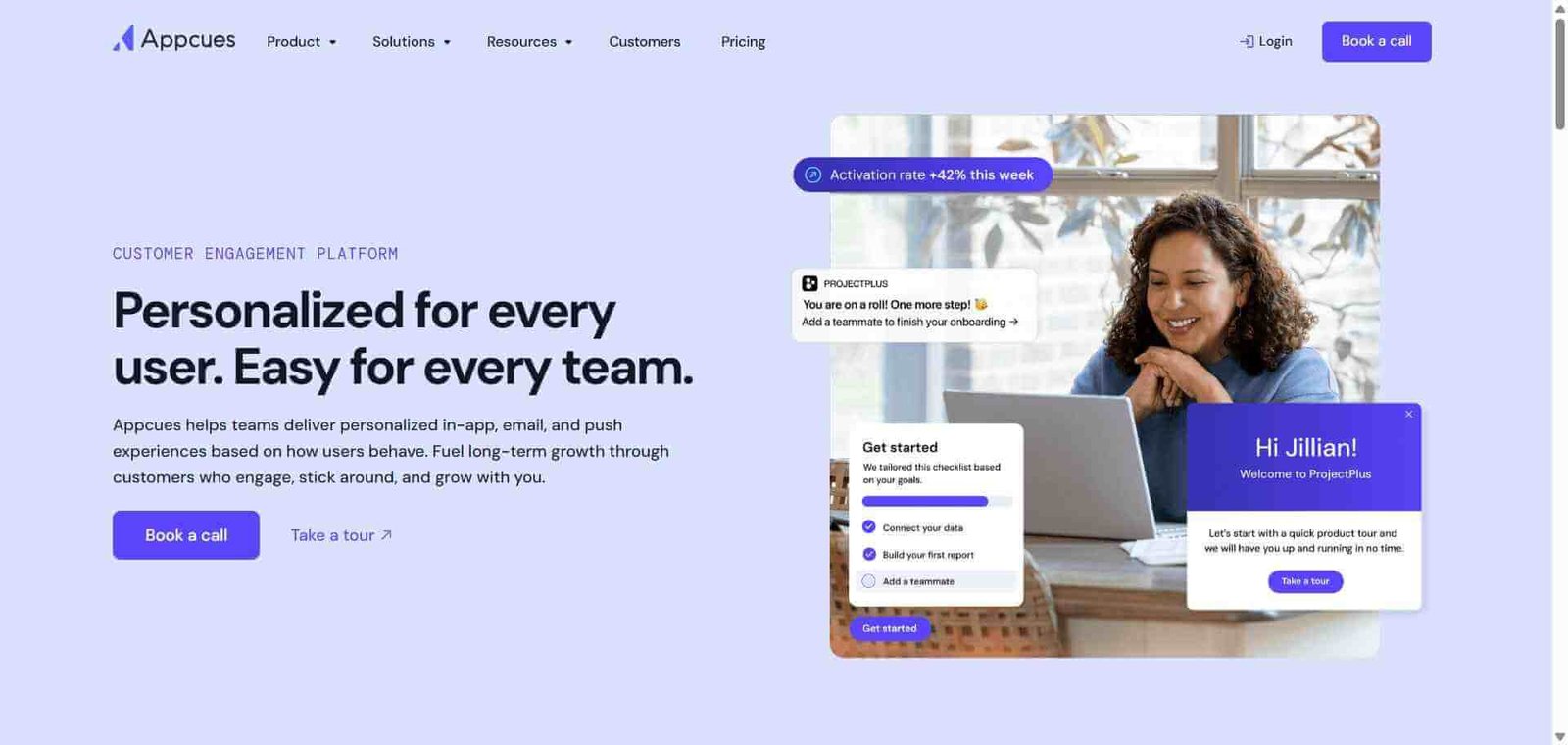
Appcues is a no-code user onboarding and in-app experience platform that lets product and growth teams create product tours, checklists, tooltips, modals, and announcements visually and publish them to specific user segments without developer involvement.
Is it worth using? Yes for SaaS product and growth teams who want to improve new user activation and feature adoption but are blocked by the engineering queue for every in-app experience change.
Who should use it? Product managers, growth marketers, and customer success teams at SaaS companies who want to control their in-app onboarding experience directly without filing engineering tickets for every change.
Who should avoid it? Very early-stage teams with small user bases where the cost of Appcues exceeds the value, or teams using Pendo which already provides in-app guidance alongside analytics.
Best for
Not for
Rating
⭐⭐⭐⭐ 4.3 / 5
Appcues is a user onboarding and in-app experience platform built around a visual editor that overlays on top of your live SaaS product, allowing product and growth teams to create, target, and publish in-app experiences — product tours, onboarding checklists, tooltips, modals, banners, and NPS surveys — without modifying the product’s codebase for each experience.
Its targeting system uses user attributes and events to show experiences to specific users at the right moment — a welcome modal for new users who have not yet completed setup, a tooltip pointing to an underused feature for users who have been active for 30 days but have not discovered it, or an announcement banner for users on a specific plan tier when a relevant feature ships.
| Pros | Cons |
|---|---|
| No-code editor genuinely enables non-engineers to build in-app experiences | Premium pricing makes it harder to justify for small teams |
| Targeting flexibility enables precise segment-specific experiences | In-app guidance without analytics depth means pairing with another tool |
| Rapid iteration without engineering dependency is the core value proposition | Some complex product UIs have compatibility challenges with the overlay approach |
| A/B testing enables systematic onboarding optimisation | Analytics less comprehensive than Pendo which combines guidance and analytics |
| Checklists, tours, tooltips, and announcements cover every onboarding format | Performance impact requires careful optimisation for complex experiences |
Appcues is a no-code user onboarding and in-app experience platform that lets product and growth teams create product tours, checklists, tooltips, and announcements visually and publish them to specific user segments without engineering involvement.
Appcues starts at $249/month for up to 2,500 monthly active users on the Essentials plan. Growth starts at $879/month for up to 10,000 MAU.
Appcues requires a one-time developer installation of a JavaScript snippet. After that, product and growth teams can build and publish experiences without any further engineering involvement.
Appcues uses user attributes (plan type, company size, signup date, role) and product events (feature activated, page visited, step completed) as targeting criteria, allowing experiences to be shown to precisely defined user segments at specific moments in the product journey.
Both provide no-code in-app guidance without engineering dependency. Pendo also includes product analytics showing feature usage, retention, and NPS alongside the guidance tools. Appcues focuses purely on the in-app experience layer with more polished experience building tools. Pendo is better if analytics alongside guidance is needed; Appcues if the focus is purely on rapid onboarding iteration.
Yes, Appcues supports A/B testing on the Growth plan, allowing product teams to test different onboarding flow variants and measure the impact on completion rates and downstream activation metrics.
Appcues delivers on its core promise: letting product and growth teams iterate on in-app onboarding experiences without engineering bottlenecks. The visual editor, flexible targeting, and rapid publishing workflow create an onboarding iteration cycle that engineering-dependent implementations cannot match. For any SaaS team where the time from onboarding idea to live implementation is measured in weeks rather than hours, Appcues resolves the constraint that prevents systematic onboarding improvement.
Next steps