Upstash Review: The Serverless Data Platform That Brings Redis and Kafka to Edge Deployments
Traditional Redis and Kafka require persistent server infrastructure — always-on instances consuming compute whether or not requests are coming in. This pricing model works for high-traffic production services but creates unnecessary cost for development environments, low-traffic applications, and the edge deployment environments that serverless and Next.js applications increasingly use. Upstash was built specifically for these contexts, providing Redis, Kafka, and vector database capabilities with per-request pricing, scale-to-zero when inactive, and global edge deployment that puts data close to users regardless of where they are.
Quick Summary
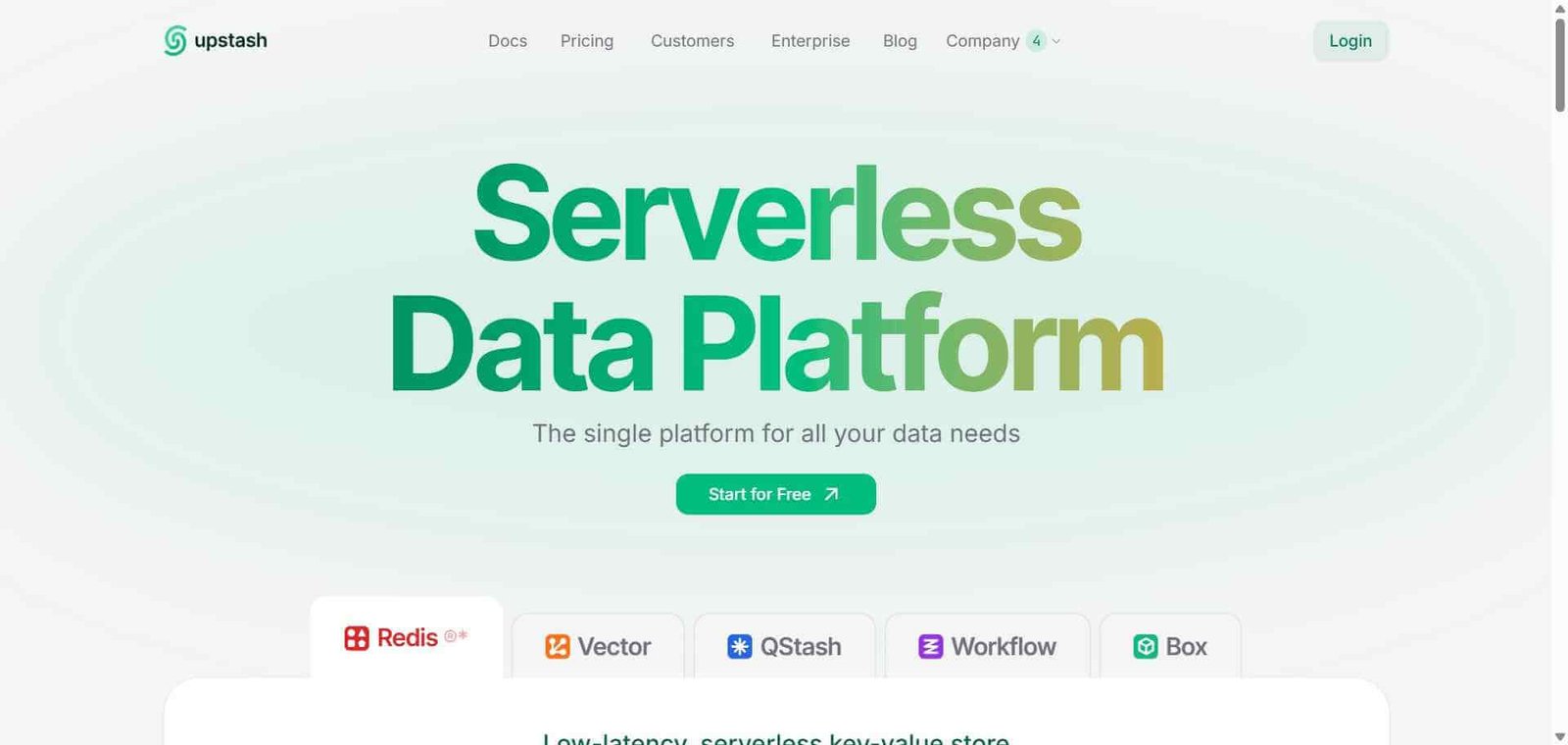
Upstash is a serverless data platform providing Redis, Kafka, and vector database services with per-request pricing, scale-to-zero idle behaviour, and global edge distribution for modern web, serverless, and edge computing applications.
Is it worth using? Yes for developers building serverless, edge, or Next.js applications who need Redis caching, rate limiting, or Kafka event streaming without managing always-on server infrastructure. Who should use it? Full-stack developers, backend engineers, and platform teams building serverless and edge applications who need Redis or Kafka without the infrastructure overhead of self-managed instances. Who should avoid it? High-frequency production applications with very high request volumes where traditional Redis hosting becomes more cost-effective than per-request pricing.
Verdict Summary
Best for
Next.js and serverless developers who need Redis caching, session storage, or rate limiting in edge-compatible deployments without managing infrastructure
Development teams who want Redis and Kafka accessible in preview and staging environments without paying for always-on instances across multiple environments
AI application developers who need a vector database alongside Redis for embedding storage and similarity search
Not for
Very high-frequency applications where per-request pricing exceeds traditional Redis hosting costs
Teams running traditional server-based applications where always-on Redis instances are already cost-effective
Production use cases requiring the most advanced Redis Enterprise features beyond Upstash’s implementation
Rating ⭐⭐⭐⭐ 4.4 / 5
What Is Upstash?
Upstash is a serverless data platform providing three core services: Upstash Redis for caching, session management, and rate limiting; Upstash Kafka for event streaming and message queuing; and Upstash Vector for storing and querying vector embeddings in AI applications. All three services use per-request pricing and scale to zero when not in use — matching the cost model of serverless application deployments where compute is also billed per execution.
The platform’s HTTP-based API alongside the standard Redis and Kafka protocols makes it compatible with edge runtime environments like Vercel Edge Functions and Cloudflare Workers that cannot maintain persistent TCP connections required by traditional Redis clients.
How Upstash Works
Create your database. Sign up and create an Upstash Redis database, Kafka topic, or Vector index in your chosen region from the Upstash console in seconds.
Connect via REST API or SDK. Use Upstash’s HTTP REST API for edge-compatible connections, or standard Redis and Kafka clients for server-side applications. Install the @upstash/redis or @upstash/kafka npm package for the simplest integration.
Implement your use case. Use Redis commands for caching, session management, rate limiting, and pub/sub. Use Kafka for event streaming and message queuing between services. Use Vector for storing embeddings and running similarity searches.
Deploy globally. Upstash automatically replicates your data to multiple regions when global replication is enabled, serving requests from the region closest to each user for minimum latency.
Pay per request. You are charged only for the requests your application makes. During periods of inactivity — development environments, off-peak hours — costs are zero.
Key Features
Upstash Redis with full Redis API compatibility and HTTP REST API for edge runtimes
Upstash Kafka for event streaming and message queuing without managed cluster overhead
Upstash Vector for AI embedding storage and similarity search
Per-request pricing with scale-to-zero — no cost during idle periods
Global replication across multiple regions for low-latency edge access
Edge runtime compatibility with Vercel Edge Functions and Cloudflare Workers
TLS encryption and authentication for all connections
REST API eliminating persistent connection requirements for serverless environments
Vercel and Netlify marketplace integrations for one-click provisioning
Real-World Use Cases
Next.js rate limiting: A Next.js API route uses Upstash Redis to implement per-user rate limiting in a Vercel Edge Function, checking and incrementing request counts in Redis via HTTP with no persistent connection and millisecond latency from the edge.
Serverless session management: A serverless application stores user session data in Upstash Redis, accessing it from multiple serverless function instances without a central server maintaining Redis connections.
AI embedding search: An AI application stores document embeddings in Upstash Vector and runs similarity searches to find the most relevant context for user queries — all alongside standard Redis operations in one Upstash account.
Multi-environment Redis: A development team creates separate Upstash Redis databases for production, staging, and each developer’s preview environment at near-zero cost for the inactive environments, eliminating the expense of always-on Redis instances per environment.
Per-request pricing with scale-to-zero matches serverless cost model
Per-request pricing more expensive than self-managed Redis at very high volumes
Edge-compatible HTTP API enables Redis in environments that prohibit TCP
Redis feature subset compared to Redis Enterprise for complex use cases
Vector database alongside Redis eliminates a separate AI infrastructure tool
Global replication adds cost — single region is the free tier default
Vercel integration enables one-click provisioning in deployment workflow
Some advanced Redis modules not available in Upstash implementation
Multi-region global distribution for low-latency edge applications
Kafka implementation less feature-complete than Apache Kafka at scale
Pricing & Plans
Free — $0/month
10,000 commands per day (Redis)
10,000 messages per day (Kafka)
200 vectors per index
Single region
Community support
Pay as you go — Usage-based
Redis from $0.20 per 100K commands
Kafka from $0.60 per GB transferred
Vector from $0.40 per 100K queries
No monthly minimum
Fixed Plans — From $10/month
Higher included commands
Lower per-request rates
Priority support options
Best Alternatives & Comparisons
Neon — Better for PostgreSQL with similar serverless and branching capabilities, different database type (Postgres vs Redis)
PlanetScale — Better for MySQL at scale with branching, different use case from Redis caching
Redis Cloud — Better for the most complete Redis feature set with Redis Enterprise capabilities, always-on pricing model
Vercel KV — Powered by Upstash under the hood, convenient for Vercel-native teams
Frequently Asked Questions (FAQ)
What is Upstash?
Upstash is a serverless data platform providing Redis, Kafka, and vector database services with per-request pricing, scale-to-zero idle behaviour, and global edge distribution for modern serverless and edge applications.
Is Upstash free?
Yes, Upstash offers a free plan with 10,000 Redis commands per day, 10,000 Kafka messages per day, and 200 vector index entries. Usage above free limits is billed per request with no monthly minimum.
Why use Upstash instead of self-hosted Redis?
Self-hosted Redis requires always-on server infrastructure consuming compute whether or not requests arrive. Upstash charges per request and scales to zero, making it more cost-effective for development environments, low-traffic applications, and serverless deployments where traditional Redis hosting creates unnecessary baseline cost.
What is Upstash Vector?
Upstash Vector is a vector database service for storing and querying vector embeddings — numerical representations of text, images, or other data used in AI applications. It enables similarity search alongside standard Redis operations in the same Upstash account.
How does Upstash handle global distribution?
Upstash supports global replication that copies your Redis database to multiple regions simultaneously, serving each request from the nearest region to minimise latency for globally distributed applications and edge deployments.
How does PlanetScale compare to Neon?
PlanetScale uses MySQL (Vitess). Neon uses PostgreSQL. Both offer serverless architecture, scale-to-zero, and database branching. The choice between them depends entirely on whether your application uses MySQL or Postgres — both are strong platforms for their respective database engines.
Final Recommendation
Upstash is the most practical Redis and Kafka solution for developers building modern serverless and edge applications where always-on infrastructure pricing does not match the serverless cost model of the rest of the stack. The per-request pricing with scale-to-zero, edge-compatible HTTP API, and vector database integration make it the natural data infrastructure choice for Next.js and serverless applications deployed on Vercel and similar platforms. The generous free tier makes evaluation genuinely risk-free.