itirupati.com AI Tools

Obviously AI

Build predictive AI models in minutes from your data — no code, no data science degree required.

Obviously AI Review: The No-Code Machine Learning Platform That Makes Predictive Analytics a Business Skill

Predictive analytics has traditionally been the exclusive domain of data science teams — building models requires Python or R knowledge, machine learning expertise, and weeks of development time before the business sees any results. Obviously AI removes every technical barrier from this process — a business analyst uploads their historical data, defines what they want to predict, and receives an accurate predictive model within minutes. No code. No data science background. No waiting for an engineering sprint.

Quick Summary

Obviously AI is a no-code automated machine learning platform built for citizen data analysts — enabling business professionals to build predictive AI models from historical data in minutes, simulate what-if scenarios, share predictions with teams, and integrate results via API into existing business systems.

Is it worth using? Yes for business analysts, operations managers, sales leaders, and marketing teams who want to make data-driven predictions without depending on a data science team for every analytical question.
Who should use it? Business analysts, operations managers, sales forecasters, marketers, and any professional who has historical data and wants to make forward-looking predictions without writing code or waiting for data science resources.
Who should avoid it? Data scientists and ML engineers who need full model customisation, fine-tuning, and programmatic control that dedicated ML platforms like DataRobot or SageMaker provide.

Verdict Summary

Best for

  • Sales teams who want to predict which leads will convert, which accounts are at churn risk, or which deals will close this quarter — without submitting a request to the data science team
  • Operations and supply chain managers who need demand forecasting from historical order data without building a forecasting model from scratch
  • Marketing teams who want to predict customer lifetime value, campaign response probability, or segment propensity to purchase — turning historical campaign data into forward-looking intelligence

Not for

  • Data scientists who need granular control over model architecture, hyperparameters, and training pipelines
  • Teams whose data volumes and model complexity require enterprise ML platforms with dedicated infrastructure
  • Organisations needing real-time model serving at very high throughput where managed ML infrastructure is more appropriate

Rating
⭐⭐⭐⭐ 4.2 / 5

What Is Obviously AI?

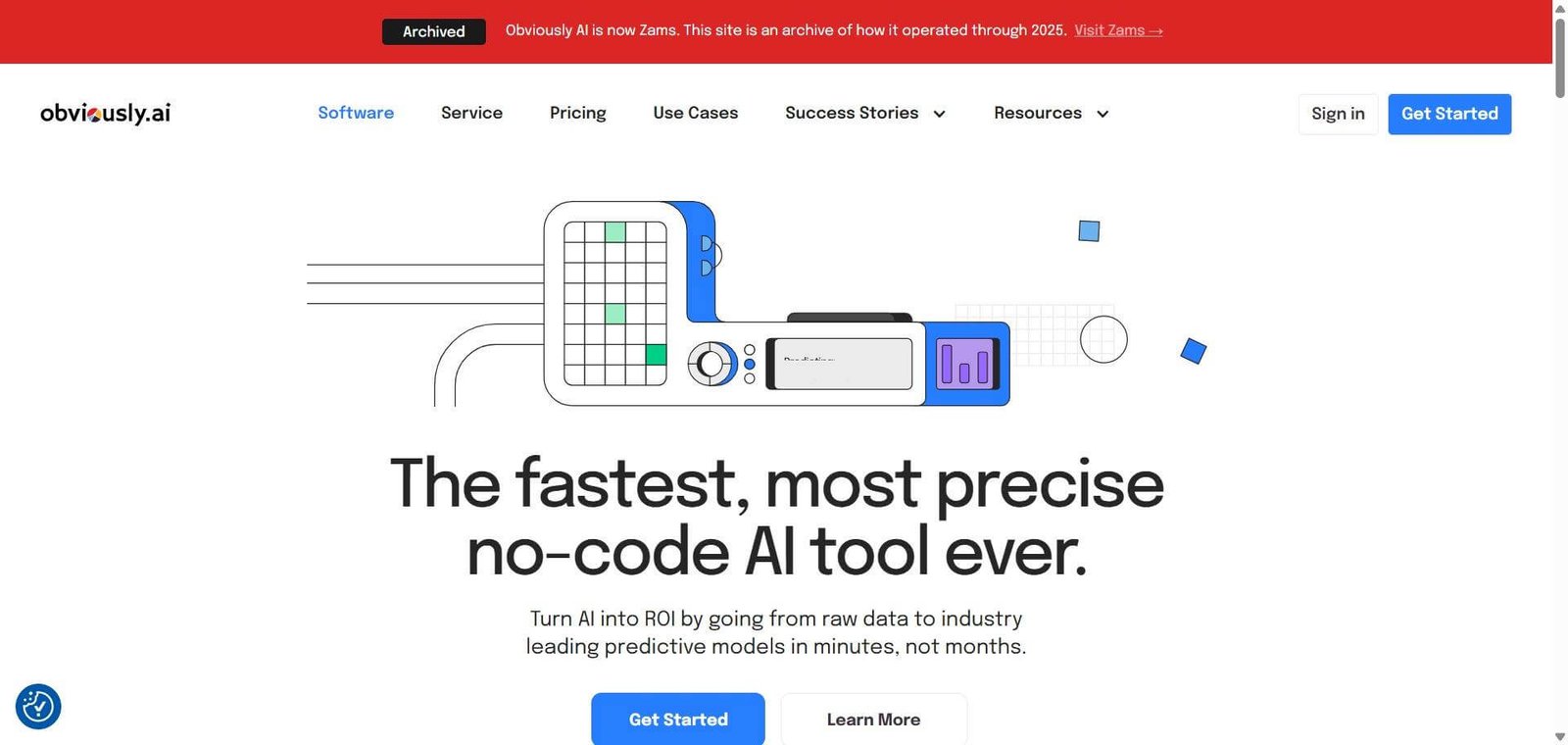
Obviously AI is a no-code automated machine learning platform that handles the full model-building workflow automatically — data ingestion, preprocessing, feature engineering, model selection, training, and evaluation — allowing business users to focus on the prediction problem rather than the mechanics of solving it. The platform’s philosophy is that predictive intelligence should be as accessible as a spreadsheet, and its interface reflects that — the prediction workflow takes minutes even for first-time users.

Beyond model building, Obviously AI provides what-if simulation tools that let users explore how changes in input variables affect predicted outcomes, team sharing features for distributing predictions across the organisation, and REST APIs for integrating prediction outputs into CRM systems, marketing platforms, and other business applications.

How Obviously AI Works

  • Upload your historical data. Connect a CSV, Google Sheet, database, or integration like Salesforce, HubSpot, or Airtable. Obviously AI reads the data structure automatically.
  • Define what you want to predict. Select the column you want to predict — churn (yes/no), deal value (number), conversion probability (percentage) — and Obviously AI identifies this as a classification or regression problem automatically.
  • AI builds the model. Obviously AI runs automated data preprocessing, feature engineering, and model selection — testing multiple algorithms and selecting the best performer for the specific prediction problem. This takes minutes rather than days.
  • Review model performance. View accuracy metrics, feature importance rankings showing which variables most influence the prediction, and model quality indicators to assess reliability.
  • Generate predictions. Upload new data for prediction — the model scores each record immediately, producing the predicted outcome for every row.
  • Simulate what-if scenarios. Use the simulation tools to explore how changing specific input variables — increasing marketing spend, changing pricing, adjusting product features — affects predicted outcomes.
  • Share and integrate. Share prediction results with team members or connect predictions to CRM and marketing platforms via REST API for automated real-time prediction in existing workflows.

Key Features

  • No-code model building from upload to prediction in minutes without any coding requirement
  • Automated machine learning handling data preprocessing, feature engineering, model selection, and training automatically
  • Support for classification predictions (churn, conversion, win/loss) and regression predictions (revenue, demand, lifetime value)
  • What-if simulation for exploring how changes to inputs affect predicted outcomes
  • Feature importance analysis showing which variables drive each prediction
  • REST API for integrating predictions into CRM, marketing, and operational systems
  • Integrations with Salesforce, HubSpot, Airtable, Google Sheets, Amazon RDS, Amazon Redshift, MySQL, PostgreSQL, and Dropbox
  • Team sharing and collaboration for distributing predictions across business teams
  • Real-time analytics dashboard for monitoring prediction outputs and model performance

Real-World Use Cases

  • Sales churn prediction: A SaaS sales operations manager uploads their customer account history — usage frequency, support ticket volume, contract value, and renewal dates — and builds a churn prediction model. Obviously AI scores every account by churn probability, allowing the customer success team to prioritise intervention on the accounts most likely to cancel before the next renewal cycle.
  • Lead conversion scoring: A marketing team uploads six months of lead data with conversion outcomes and builds a conversion probability model. New leads entering the CRM are automatically scored via API, allowing sales reps to prioritise the highest-probability leads rather than working through the full list chronologically.
  • Demand forecasting: A retail operations manager uploads two years of weekly sales data by product category and builds a demand forecasting model. The predictions inform inventory purchasing decisions three weeks in advance — reducing both stockout and overstock situations compared to intuition-based ordering.
  • Campaign response prediction: A direct mail team uploads historical campaign data with response rates by customer segment and builds a response probability model. The model scores the full mailing list before the next campaign, targeting the top 30% of respondents by predicted probability and reducing campaign cost per response significantly.

Pros and Cons

ProsCons
Full model building in minutes — the fastest path from historical data to prediction in the no-code ML categoryLess model customisation than dedicated ML platforms — not suitable for data scientists needing full control
What-if simulation enables business scenario planning directly from the prediction modelPricing starts at $75/month — not a free-tier tool for casual or occasional use
REST API integrates predictions into CRM and marketing workflows without manual exportModel accuracy depends on data quality and volume — small or noisy datasets produce less reliable predictions
Feature importance analysis gives business context to model outputs rather than a black box resultEnterprise ML governance, audit trails, and compliance features less developed than dedicated ML platforms
Integrates with Salesforce, HubSpot, Airtable, and major databases without custom ETL workVery high-volume or complex multi-model prediction pipelines require enterprise discussion

Pricing & Plans

Basic — $75/month
  • No-code model building
  • Standard prediction features
  • Core integrations
  • Email support
Professional — Custom pricing
  • Advanced features
  • Higher data volumes
  • API access
  • Priority support
Enterprise — Custom pricing
  • Custom volumes and features
  • Dedicated infrastructure
  • SLA guarantees
  • Dedicated support

Contact obviously.ai for current plan details and pricing.

Best Alternatives & Comparisons

  • Julius AI — Better for conversational data analysis through natural language questions, less forward-looking prediction
  • Polymer — Better for automatic dashboard generation from spreadsheets, less predictive model building
  • DataRobot — Better for enterprise automated ML with full governance and model lifecycle management, higher investment
  • Akkio — Similar no-code ML platform at comparable pricing and target audience

Frequently Asked Questions (FAQ)

What is Obviously AI?

Obviously AI is a no-code automated machine learning platform that enables business analysts to build predictive AI models in minutes from historical data — without writing code or requiring data science expertise.

How long does it take to build a model in Obviously AI?

Obviously AI’s automated machine learning workflow takes minutes from data upload to working prediction model — the platform handles preprocessing, feature engineering, model selection, and training automatically.

What types of predictions can Obviously AI make?

Obviously AI handles classification predictions — churn probability, conversion likelihood, win/loss — and regression predictions — revenue forecast, demand volume, customer lifetime value — covering the most common business prediction use cases.

Does Obviously AI require coding knowledge?

No — Obviously AI is built specifically for business analysts without coding knowledge. The full workflow from data upload to prediction output is point-and-click with no code required at any stage.

Can Obviously AI integrate with CRM systems?

Yes — Obviously AI integrates with Salesforce, HubSpot, Airtable, and other business systems, and provides a REST API for connecting prediction outputs into existing workflows for automated real-time scoring.

How does Obviously AI compare to DataRobot?

Obviously AI is designed for business analysts who want immediate predictions without technical expertise — fast, accessible, and focused on business use cases. DataRobot is designed for data science teams who need enterprise ML governance, model lifecycle management, and advanced customisation. Obviously AI for business-led predictive analytics. DataRobot for enterprise ML operations.

Final Recommendation

Obviously AI is the most accessible no-code predictive analytics platform for business teams who want to make forward-looking predictions from their own data without waiting for data science resources. The minutes-to-model workflow, what-if simulation, and API integration remove every practical barrier between a business analyst with historical data and the predictive intelligence that historically required a data scientist to produce. For any sales, marketing, or operations team sitting on historical data and making gut-feel forecasts where model-based predictions could be better, Obviously AI delivers the upgrade without the technical investment.

Next steps

Feature your app on AI tools for free

Subscribe to our Newsletter

Stay up-to-date with the latest AI Apps and cutting-edge AI news.

Trending Categories