Flux AI Review: Open Source Image Generation Model That Challenged Midjourney
When Black Forest Labs released Flux.1 in August 2024, the AI image generation landscape shifted. For the first time, an open-source model produced photorealistic output that meaningfully challenged Midjourney and DALL-E on prompt adherence, human anatomy accuracy, and text rendering. Flux AI has since become the model powering dozens of third-party tools and the go-to foundation model for developers building image generation into their own products.
Quick summary
Flux AI is a family of open-source AI image generation models developed by Black Forest Labs that produces photorealistic images with strong prompt adherence, accurate human anatomy, and improved text rendering compared to previous open-source alternatives.
Is it worth using? Yes — the most capable open-source image generation model available and a genuine alternative to Midjourney for photorealistic output. Who should use it? Developers building image generation into products, creators wanting high-quality open-source generation, and technical users comfortable with model deployment. Who should avoid it? Beginners who want a simple point-and-click interface without technical setup (use Ideogram or Leonardo AI instead).
Verdict Summary
Best for
Developers integrating image generation into their own applications via API
Technical creators wanting high-quality generation with full model control
Teams wanting open-source flexibility without vendor lock-in
Not for
Complete beginners wanting a simple consumer interface
Users who prioritise artistic painterly style over photorealism
Teams needing custom model training on proprietary datasets
Rating ⭐⭐⭐⭐½ 4.5 / 5
What Is Flux AI?
Flux AI refers to the Flux.1 family of image generation models developed by Black Forest Labs, founded in 2024 by former Stability AI researchers including Robin Rombach, the lead author of the Latent Diffusion paper that underpins Stable Diffusion. The Flux.1 family includes three variants — Flux.1 Pro (highest quality, API only), Flux.1 Dev (open-weights for research), and Flux.1 Schnell (fastest, Apache 2.0 licence for commercial use).
The models use a 12-billion parameter hybrid transformer architecture, producing images with significantly better prompt adherence and human anatomy accuracy than comparable open-source models. Flux.1 is now integrated into tools like ComfyUI and Automatic1111 as their underlying generation model.
How Flux AI Works
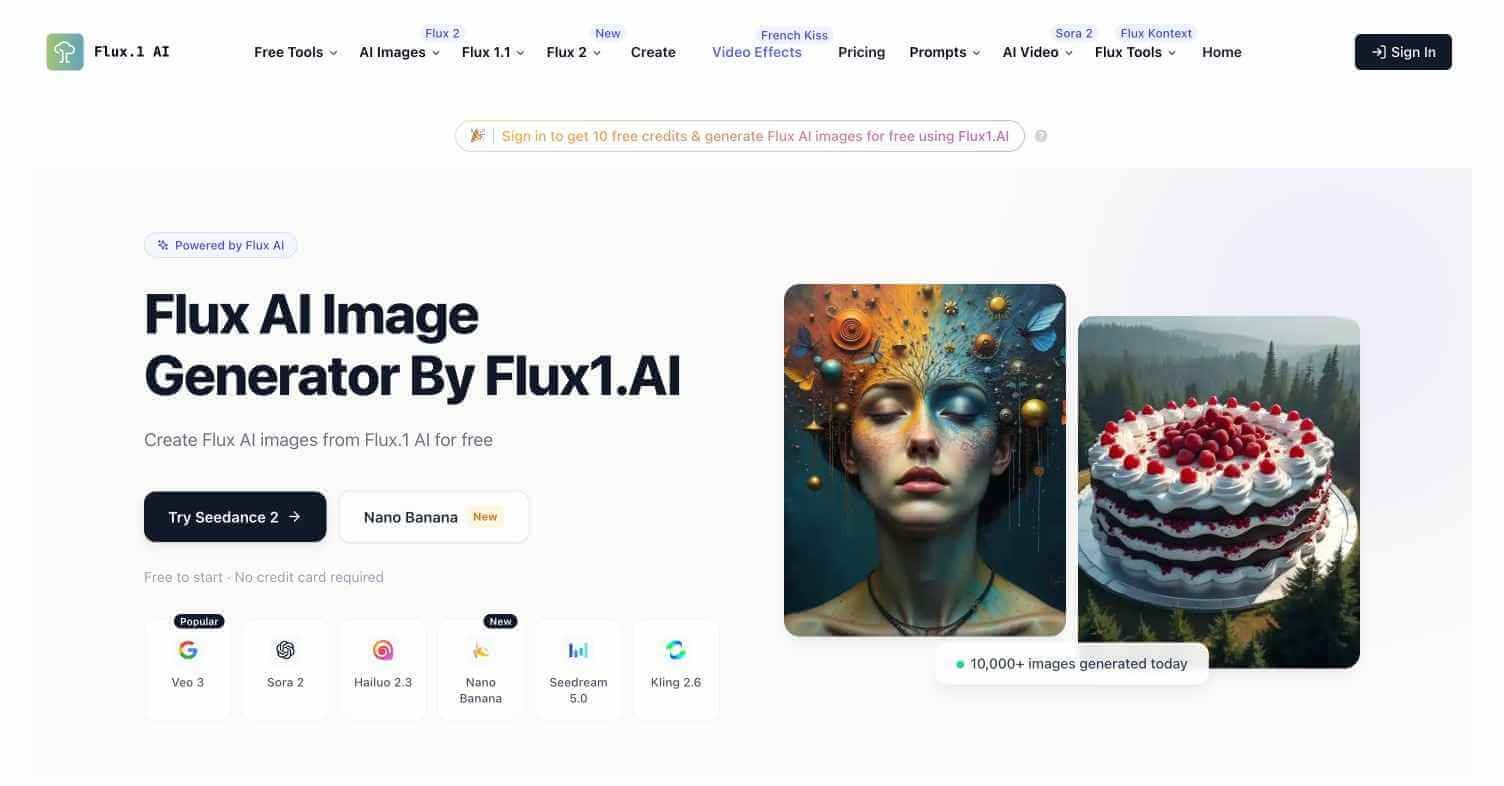
Access via flux1.ai — Use the consumer-facing web interface for direct generation without technical setup.
Or access via API — Developers access Flux.1 Pro via the Black Forest Labs API or through providers like Replicate, fal.ai, and Together AI.
Write your prompt — Enter a detailed text description. Flux’s strong prompt adherence means detailed prompts produce significantly better results.
Choose your model variant — Select Flux.1 Pro for highest quality, Flux.1 Dev for open-source development, or Flux.1 Schnell for fast generation.
Generate and download — Flux produces the image ready for download. No watermark on Schnell or via API on Pro.
Deploy in your own tool — Use the open-weight Dev or Schnell variants to run Flux locally or in your own cloud infrastructure.
Best open-source image quality — rivals Midjourney
Consumer interface less polished than Midjourney
Apache licence on Schnell — full commercial freedom
Pro variant costs per image via API
Strong prompt adherence on complex descriptions
Running locally requires capable GPU hardware
Developer-friendly with multiple API providers
Less artistic output than Midjourney
Active open-source community and ecosystem
Technical knowledge needed for local deployment
Pricing & Plans
flux1.ai Web Interface — Free tier
Limited free generations per day
Access to Flux.1 model variants
Standard resolution output
API via Black Forest Labs — Pay per use
Flux.1 Pro — approximately $0.05 per image
Flux.1 Dev — lower cost per image
Flux.1 Schnell — lowest cost per image
Self-Hosted (Flux.1 Dev / Schnell) — Free
Download open-weight model files
Run locally with compatible GPU
Unlimited generation at infrastructure cost only
Best Alternatives & Comparisons
Midjourney — Superior artistic quality, closed source and subscription-only
Ideogram — Better text rendering in images, simpler consumer interface
Leonardo AI — Better custom training and game asset consistency
Stable Diffusion API — Previous generation open-source standard, Flux significantly outperforms it
Frequently Asked Questions (FAQ)
What is Flux AI?
Flux AI refers to the Flux.1 family of open-source image generation models by Black Forest Labs, known for photorealistic output, strong prompt adherence, and improved human anatomy accuracy.
Is Flux AI free?
Flux.1 Schnell is available under Apache 2.0 for free commercial use. Self-hosting is free with your own hardware. The web interface offers limited free generations daily.
What is the difference between Flux.1 Pro, Dev, and Schnell?
Pro is highest quality via API only. Dev is open-weight for research and development. Schnell is the fastest with Apache 2.0 licence for unrestricted commercial use.
Who made Flux AI?
Black Forest Labs, founded in 2024 by former Stability AI researchers including Robin Rombach, lead author of the Latent Diffusion paper.
Can I run Flux AI locally?
Yes — Flux.1 Dev and Schnell are open-weight models runnable locally via ComfyUI or Automatic1111 on a compatible GPU.
Is Flux AI better than Midjourney?
Flux AI produces stronger photorealistic output with better prompt adherence. Midjourney produces superior artistic and stylised imagery. Choose based on your priority.
Final Recommendation
Flux AI is the most important development in open-source image generation since Stable Diffusion. For developers building image generation into products, the combination of API accessibility, open-weight availability, and commercial licensing makes it the clear choice. For technical creators, Flux.1 Schnell’s Apache licence provides unlimited commercial-use generation at infrastructure cost only.